Duas for Qunoot are among the beautiful supplications associated with Islamic prayer, especially Witr Salah. They express a Muslim’s dependence upon Allah for guidance, protection, well-being, blessings, and safety from harm. One well-known Qunoot was taught by the Prophet Muhammad ﷺ to his grandson al-Hasan ibn Ali (رضي الله عنهما), who reported that the Messenger of Allah ﷺ taught him words to say during Witr. This narration is recorded in Sunan Abi Dawud 1425 and Jami‘ at-Tirmidhi 464.
Qunoot is more than a collection of Arabic words to memorize. Its message teaches humility, reliance upon Allah, gratitude, acceptance of divine decree, and the importance of asking Allah for what is truly beneficial. When a Muslim understands the meaning of the supplication, the words can become a meaningful part of personal worship rather than simply a memorized passage.

What Is Qunoot in Islam?
The word Qunoot is associated with devotion, humility, obedience, and standing before Allah in worship. In the context of Salah, Qunoot commonly refers to a special supplication recited during prayer.
One of the best-known forms is Qunoot al-Witr, connected with the Witr prayer. In the narration of al-Hasan ibn Ali (رضي الله عنهما), the Prophet ﷺ taught a supplication beginning:
اللَّهُمَّ اهْدِنِي فِيمَنْ هَدَيْتَ
“O Allah, guide me among those whom You have guided.”
The same narration continues with requests for well-being, Allah’s care, blessings in what He has given, and protection from the evil of what He has decreed.
This opening is significant. A believer does not begin by asking only for wealth, status, or worldly success. Instead, the first request is guidance.
That teaches an important Islamic principle: having the right direction is more valuable than simply having more possessions.
A person can possess knowledge but still make poor choices. Someone can have wealth but lack peace. A person can have opportunities but choose a harmful path. Therefore, asking Allah for guidance is one of the most valuable supplications a believer can make.

Duas for Qunoot Arabic Text
The well-known Witr Qunoot taught in the narration of al-Hasan ibn Ali (رضي الله عنهما) is:
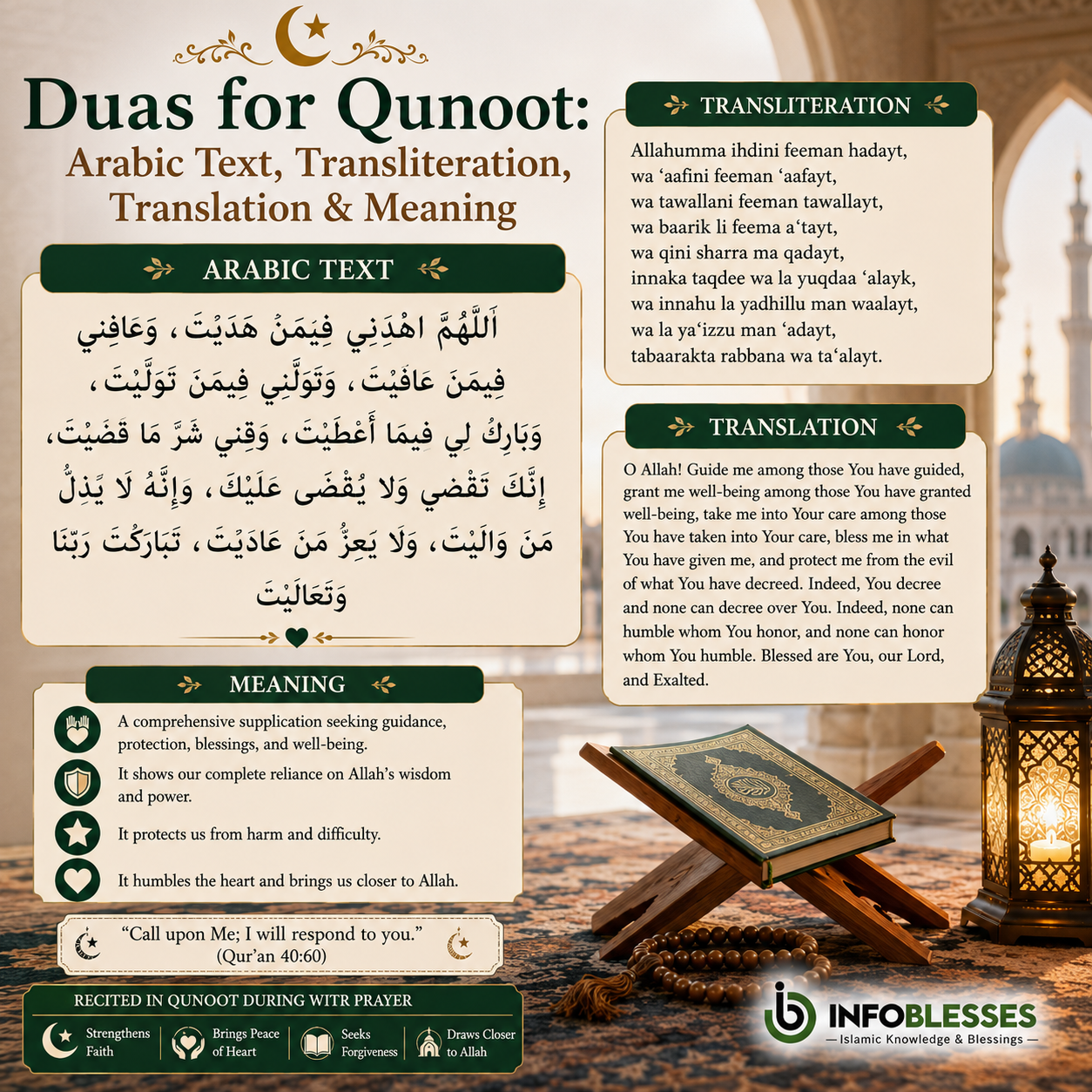
اللَّهُمَّ اهْدِنِي فِيمَنْ هَدَيْتَ، وَعَافِنِي فِيمَنْ عَافَيْتَ، وَتَوَلَّنِي فِيمَنْ تَوَلَّيْتَ، وَبَارِكْ لِي فِيمَا أَعْطَيْتَ، وَقِنِي شَرَّ مَا قَضَيْتَ، إِنَّكَ تَقْضِي وَلَا يُقْضَى عَلَيْكَ، وَإِنَّهُ لَا يَذِلُّ مَنْ وَالَيْتَ، وَلَا يَعِزُّ مَنْ عَادَيْتَ، تَبَارَكْتَ رَبَّنَا وَتَعَالَيْتَ.
This wording is reported in Sunan Abi Dawud 1425 and Jami‘ at-Tirmidhi 464.
The Arabic wording contains several interconnected requests. The believer asks Allah for guidance, well-being, divine care, blessings, and protection.
The supplication then moves from personal requests to a declaration of Allah’s absolute authority:
“Indeed, You decree, and none can decree over You.”
Finally, it ends by praising Allah:
“Blessed are You, our Lord, and Exalted.”
This structure makes Qunoot beautifully balanced. It combines asking, dependence, faith, submission, and praise.

Qunoot Dua Transliteration
For Muslims who are beginning to learn Arabic, transliteration can provide temporary assistance with pronunciation.
A commonly used transliteration of the above Qunoot is:
Allahumma ihdini feeman hadayt,
wa ‘aafini feeman ‘aafayt,
wa tawallani feeman tawallayt,
wa baarik lee feemaa a‘tayt,
wa qini sharra maa qadayt,
fa innaka taqdee wa laa yuqda ‘alayk,
wa innahu laa yadhillu man waalayt,
wa laa ya‘izzu man ‘aadayt,
tabaarakta Rabbanaa wa ta‘aalayt.
Transliteration is helpful for beginners, but it should not permanently replace learning the original Arabic. English letters cannot perfectly represent every Arabic sound.
For better pronunciation, a learner can listen to a reliable recitation while reading the Arabic text. Studying the meaning at the same time is also beneficial because understanding what is being said can make memorization more meaningful.
The goal is not merely to pronounce a sequence of sounds. The goal is to stand before Allah with awareness of the message.

Qunoot Dua English Translation
A meaning-based English translation of the well-known Qunoot is:
“O Allah, guide me among those whom You have guided, grant me well-being among those whom You have granted well-being, take me into Your care among those whom You have taken into Your care, bless me in what You have given me, and protect me from the evil of what You have decreed. Indeed, You decree, and none can decree over You. The one whom You befriend is not humbled, and the one whom You oppose is not honored. Blessed are You, our Lord, and Exalted.”
Every section of this translation carries a meaningful lesson.
The believer asks for guidance because human judgment is limited.
The believer asks for well-being because health, safety, faith, and peace are blessings from Allah.
The believer asks Allah to take them into His care because ultimate protection belongs to Him.
The believer asks for barakah in what has already been given rather than simply requesting more.
The believer asks for protection from harm while accepting that Allah has complete authority over His decree.
The supplication therefore teaches a complete attitude toward life: ask Allah, rely upon Allah, appreciate Allah’s blessings, and trust His wisdom.

Meaning of “Allahumma Ihdini Fiman Hadayt”
The first request is:
اللَّهُمَّ اهْدِنِي فِيمَنْ هَدَيْتَ
“O Allah, guide me among those whom You have guided.”
This is one of the most powerful themes in Qunoot.
Guidance is not something a Muslim should assume they no longer need. Every day brings choices.
A person chooses what to say, what to watch, whom to trust, how to earn money, how to treat family, how to respond to anger, and how to use their time.
Some decisions appear small but gradually shape a person’s character.
Therefore, asking Allah for guidance should not be limited to major life decisions.
A Muslim can make this request meaningful by reflecting on questions such as:
- Am I choosing what pleases Allah?
- Are my words beneficial or harmful?
- Are my earnings halal?
- Am I treating my parents and family well?
- Am I keeping my promises?
- Am I using my time responsibly?
- Am I becoming closer to Allah or increasingly distracted from Him?
Qunoot begins with guidance because the right path is the foundation upon which other blessings become meaningful.

Asking Allah for Well-Being
The next part says:
وَعَافِنِي فِيمَنْ عَافَيْتَ
“Grant me well-being among those whom You have granted well-being.”
This request reminds us that well-being is broader than physical health.
A believer can ask Allah for well-being in faith, family, livelihood, relationships, safety, and daily circumstances.
We often recognize a blessing most clearly after it disappears.
A person may not think much about peaceful sleep until they struggle to sleep. Someone may not appreciate family harmony until conflict enters the home. A person may not notice the blessing of safety until they experience fear.
Qunoot encourages us to ask Allah for well-being while also recognizing that every form of security is ultimately a blessing.
It also teaches gratitude.
Instead of assuming that our blessings will always remain, we acknowledge our dependence upon the One who gave them.
This makes the supplication relevant to ordinary life.
Whether a person is preparing for an important exam, starting a new job, caring for a family, traveling, or simply asking for peace in daily life, the request for well-being remains meaningful.

Asking Allah to Take Us Into His Care
Qunoot continues:
وَتَوَلَّنِي فِيمَنْ تَوَلَّيْتَ
This can be understood as asking Allah to take the believer into His care among those whom He has taken into His care.
This is a deeply comforting request.
Human beings naturally depend upon others. We need parents, spouses, relatives, friends, teachers, colleagues, and communities.
But every human relationship has limitations.
Allah’s care is different.
When a believer asks Allah to take them into His care, they recognize that their ultimate dependence is upon Him.
This does not mean abandoning practical effort.
Islam teaches believers to take appropriate means.
A person who wants success should work.
Someone who wants knowledge should study.
Someone who wants halal income should pursue lawful opportunities.
Someone facing a difficult situation should seek appropriate advice.
Alongside these efforts, the believer places their trust in Allah.
This is the spirit of tawakkul: making a sincere effort while recognizing that the final outcome belongs to Allah.

Asking Allah for Barakah
One of the most beautiful lines is:
وَبَارِكْ لِي فِيمَا أَعْطَيْتَ
“Bless me in what You have given.”
This teaches us the importance of barakah.
Barakah does not simply mean having a larger quantity.
A person can have a modest income and experience tremendous benefit from it.
Someone may have limited free time but accomplish meaningful things.
A family may live in a simple home yet experience love, peace, worship, and contentment.
A student may have ordinary abilities but gain remarkable benefit from sincere effort and beneficial knowledge.
Therefore, asking Allah for barakah is often more meaningful than simply asking for more.
A Muslim can ask Allah to place barakah in:
- Time
- Knowledge
- Family
- Children
- Work
- Income
- Health
- Home
- Friendships
- Opportunities
- Worship
This part of Qunoot also teaches gratitude. We should notice what Allah has already given us.
Sometimes the greatest blessing is not receiving something new but discovering greater goodness in something we already possess.

Seeking Protection From Harm
The supplication continues:
وَقِنِي شَرَّ مَا قَضَيْتَ
“Protect me from the evil of what You have decreed.”
This part teaches believers to seek Allah’s protection from harmful outcomes.
Human beings cannot see the future.
We make plans based upon what we know, but Allah’s knowledge encompasses what we cannot see.
Sometimes something we desperately want may not actually be beneficial for us. At other times, a difficulty we dislike may eventually lead us toward something better.
Qunoot teaches the believer to ask Allah for protection while accepting His ultimate wisdom.
This creates an important balance.
We do not become passive.
We do not stop planning.
We do not stop making efforts.
But we also do not assume that our limited understanding is greater than Allah’s wisdom.
A believer can work hard, make dua, seek advice, and then trust Allah with the result.
That mindset can protect the heart from excessive anxiety about things beyond human control.

Qunoot and Belief in Allah’s Decree
The Qunoot says:
إِنَّكَ تَقْضِي وَلَا يُقْضَى عَلَيْكَ
“Indeed, You decree, and none can decree over You.”
These words affirm Allah’s complete authority.
Muslims believe in Qadar, the divine decree, while also being responsible for their choices and actions.
This belief can change how a person responds to success and difficulty.
When something good happens, a believer remembers Allah and gives thanks.
When something does not go according to plan, the believer does not assume that life has lost all meaning.
Instead, they remain patient, seek guidance, learn from the situation, and continue moving forward.
This does not mean every difficult event is easy or that Muslims should pretend not to feel sadness.
Rather, faith provides a framework through which hardship can be faced with hope.
Qunoot reinforces this attitude by reminding the worshipper that Allah’s authority is greater than every human plan.

The Meaning of “Tabarakta Rabbana Wa Ta‘alayt”
The supplication ends with:
تَبَارَكْتَ رَبَّنَا وَتَعَالَيْتَ
“Blessed are You, our Lord, and Exalted.”
Ending with praise is spiritually significant.
The believer has asked Allah for many things, but the dua does not finish with another request.
It finishes with glorification.
This teaches that worship is not merely about asking for what we want.
We worship Allah because He is worthy of worship.
We ask because we are dependent upon Him.
We praise Him because He is our Lord.
This distinction is important.
If a person treats dua only as a list of requests, they may become disappointed when their expectations are not fulfilled immediately.
But when dua is understood as an act of worship and communication with Allah, the believer develops a deeper relationship with their Creator.
Qunoot therefore combines need and worship.
We ask Allah because we need Him, and we praise Allah because He is our Lord.

When Are Duas for Qunoot Recited?
The well-known Qunoot discussed in this article is specifically connected with Witr in the hadith narrated by al-Hasan ibn Ali (رضي الله عنهما). The narration states that the Prophet ﷺ taught him these words to say during Witr.
There are, however, differences among Islamic schools of jurisprudence concerning details such as the timing and position of Qunoot in Witr and other prayers.
Some scholars discuss reciting it before Ruku‘, while others accept or prefer reciting it after Ruku‘ based on different evidence and juristic approaches.
There are also circumstances in which Qunoot is discussed in relation to other prayers, such as Qunoot al-Nazilah, a supplication made during certain severe circumstances.
Because these matters involve established differences of fiqh, Muslims should not turn them into unnecessary arguments.
A person should learn the practice of their madhhab or follow the guidance of a qualified scholar they trust.
The important point is that the famous Witr Qunoot itself has a strong basis in the Sunnah.

Spiritual Benefits of Understanding Qunoot
Learning Qunoot can provide several spiritual lessons.
It Strengthens Dependence on Allah
The supplication repeatedly asks Allah for guidance, care, blessings, and protection.
It Encourages Humility
The believer admits that they cannot navigate life successfully without Allah’s guidance.
It Builds Gratitude
Asking for barakah in what Allah has already given encourages appreciation.
It Develops Trust
The words about Allah’s decree remind the believer that Allah’s wisdom is greater than human understanding.
It Creates Hope
The believer knows that they can turn to Allah regardless of their circumstances.
It Connects Prayer With Everyday Concerns
The requests in Qunoot are relevant to real life: guidance, safety, family, health, provision, decisions, and protection.
The Qur’an also emphasizes the nearness of Allah and the importance of calling upon Him. In Surah al-Baqarah 2:186, Allah says that He is near and responds to the invocation of the supplicant who calls upon Him.

How to Memorize Qunoot Dua Step by Step
A long Arabic supplication becomes easier to memorize when divided into smaller sections.
First: Learn the Guidance Request
Allahumma ihdini feeman hadayt
“O Allah, guide me among those whom You have guided.”
Repeat this until you can say it without looking.
Second: Learn the Well-Being Request
Wa ‘aafini feeman ‘aafayt
“Grant me well-being among those whom You have granted well-being.”
Third: Learn the Request for Allah’s Care
Wa tawallani feeman tawallayt
“Take me into Your care among those whom You have taken into Your care.”
Fourth: Learn the Barakah Request
Wa baarik lee feemaa a‘tayt
“Bless me in what You have given.”
Fifth: Learn the Protection Request
Wa qini sharra maa qadayt
“Protect me from the evil of what You have decreed.”
Then learn the concluding statements gradually.
Do not focus only on repetition. Learn the meaning of every phrase.
When Arabic words have an emotional and spiritual meaning in your mind, memorization often becomes much easier.
How Qunoot Can Improve Your Connection With Salah
Salah can sometimes become routine when a person repeats the same actions without reflecting upon their meaning.
Understanding Qunoot can help bring greater awareness into the prayer.
When saying “O Allah, guide me,” think about an area of life where you need guidance.
When saying “grant me well-being,” remember the blessings of safety and health.
When asking for Allah’s care, remember that every human source of support is ultimately limited.
When asking for barakah, remember the blessings you already possess.
When asking for protection, remember that Allah knows what you cannot see.
And when praising Allah at the end, remember that worship is not simply about getting something from Allah. It is about recognizing Him as your Lord.
The Qur’an describes Allah’s nearness and encourages believers to call upon Him.
This understanding can make the opening of Witr feel less like memorized text and more like sincere conversation through worship.

Qunoot Duas and Tawakkul in Everyday Life
The lessons of Qunoot do not remain inside the prayer.
They can influence everyday decisions.
Suppose someone is searching for a job. They can make sincere effort, apply for appropriate positions, improve their skills, and ask Allah for guidance and halal provision.
A student can study diligently while asking Allah to bless their knowledge and efforts.
A parent can care for their children while asking Allah to guide and protect them.
Someone facing an important decision can seek advice, consider the available information, perform appropriate acts of worship, and then trust Allah.
This is practical tawakkul.
It is not simply saying, “Allah will take care of everything,” while refusing to act.
Rather, it means:
Take the means. Make sincere effort. Ask Allah for guidance. Then trust Allah with the result.
Qunoot beautifully combines these ideas because it asks Allah for guidance, well-being, care, blessings, and protection while recognizing His authority over all matters.

Common Questions About Duas for Qunoot
What are Duas for Qunoot?
Duas for Qunoot are supplications associated with Qunoot in Islamic prayer. The well-known Witr Qunoot taught by the Prophet ﷺ to al-Hasan ibn Ali asks Allah for guidance, well-being, care, blessings, and protection.
What is the main Qunoot Dua?
One of the most well-known is:
Allahumma ihdini feeman hadayt, wa ‘aafini feeman ‘aafayt…
It is narrated from al-Hasan ibn Ali (رضي الله عنهما) as a supplication taught by the Prophet ﷺ for Witr.
What does Qunoot Dua mean?
It asks Allah for guidance, well-being, His care, blessings in what He has given, and protection from the evil of His decree. It ends with praise and glorification of Allah.
Is Qunoot Dua authentic?
The famous Witr Qunoot reported from al-Hasan ibn Ali is recorded in Sunan Abi Dawud 1425 and Jami‘ at-Tirmidhi 464.
When is Qunoot recited?
The famous narration connects this Qunoot with Witr. Details concerning its exact position and practice vary among Islamic schools of jurisprudence.
Can Qunoot be recited in English?
For learning and understanding, studying the English meaning is beneficial. For the formal recitation within Salah, Muslims should follow the applicable rulings of their school of fiqh and consult a qualified scholar if uncertain.
Why does Qunoot ask for guidance first?
Guidance is the foundation for a good life. Without guidance, worldly blessings may not lead to beneficial outcomes. The dua therefore begins by asking Allah for the right direction.
What is the meaning of barakah in Qunoot?
The phrase “wa baarik lee feemaa a‘tayt” asks Allah to place blessing and goodness in what He has already given.
Is there only one Qunoot?
There are different reported forms and circumstances of Qunoot in Islamic tradition. The Witr Qunoot discussed here is one of the best-known supplications.

Final Reflection on Duas for Qunoot
Duas for Qunoot provide a remarkable summary of what a believer can ask Allah for during prayer.
The supplication begins with guidance because every person needs Allah’s direction.
It asks for well-being because safety and peace are blessings.
It asks Allah to take the believer into His care because human strength and support are limited.
It asks for barakah because the value of a blessing is not always measured by its quantity.
It asks for protection from harm because Allah knows what human beings cannot know.
It then affirms Allah’s complete authority and ends by praising Him.
This makes Qunoot much more than a prayer for a specific need.
It is a lesson in faith, humility, gratitude, tawakkul, and submission.
The Qur’an reminds believers that Allah is near and responds to those who call upon Him. The Sunnah gives us beautiful words through which we can express our dependence upon Him.
When you learn Qunoot, try not to memorize it mechanically.
Learn the Arabic.
Understand the transliteration.
Study the translation.
Reflect upon the meaning.
Then allow the message to influence your everyday life.
Ask Allah for guidance before making decisions. Ask Him for well-being when you recognize your vulnerability. Ask Him for barakah in what you already possess. Ask Him to protect you from harm. And when life does not unfold according to your plans, remember the words affirming that Allah decrees and none can decree over Him.
May Allah guide us among those whom He has guided, grant us well-being, take us into His care, bless us in what He has given, protect us from harm, strengthen our faith, accept our prayers, and grant us goodness in this world and the Hereafter.
Ameen.