
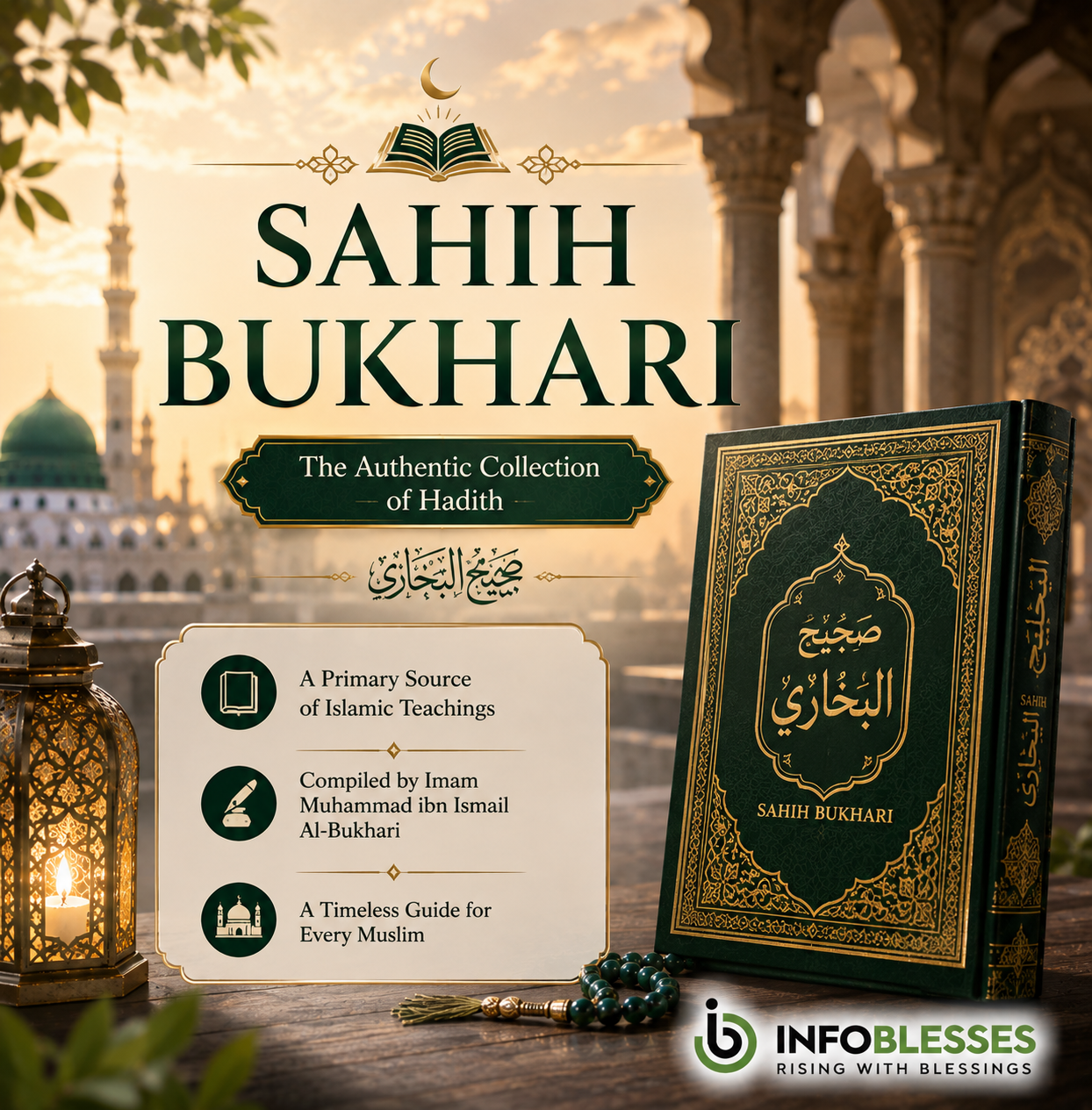
What Is Sahih Bukhari?

Hadith are reports describing the sayings, actions, approvals, and characteristics of Prophet Muhammad ﷺ. They help Muslims understand how the teachings of Islam were practiced and explained by the Prophet ﷺ.
Sahih Bukhari contains thousands of narrations arranged into books and chapters covering many aspects of Islamic life. The collection available through Sunnah.com contains approximately 7,563 Hadith with repetitions in 98 books.
The word Sahih means authentic or sound. The title therefore reflects the compiler’s intention to collect narrations meeting strict standards of authenticity.
For Muslims who want to learn about the Sunnah, Sahih Bukhari provides a valuable source of Prophetic guidance. It includes teachings about faith, prayer, fasting, charity, pilgrimage, manners, family relationships, business, knowledge, patience, generosity, and many other subjects.
However, reading Hadith should be approached responsibly. A single narration shouldn’t always be taken as an independent legal ruling without considering its context and the explanations of qualified scholars.
What Does Hadith Mean?
A Hadith is a report concerning the Prophet Muhammad ﷺ. Hadith literature preserves information about what the Prophet ﷺ said, did, approved, or taught.
The Qur’an remains the central revealed scripture of Islam, while the Sunnah provides practical guidance concerning the Prophet’s example.
For example, Muslims know from the Qur’an that prayer is obligatory. Hadith literature provides extensive details about how the Prophet ﷺ performed and taught prayer.
Why Do Muslims Study Hadith?
Studying Hadith helps Muslims understand the practical application of Islamic teachings.
It can teach a believer how to:
- Strengthen faith
- Improve worship
- Develop good character
- Treat family members kindly
- Deal honestly in business
- Practice patience
- Give charity
- Avoid harmful behavior
- Seek knowledge
- Follow the Sunnah
In other words, Hadith can turn religious principles into practical guidance for everyday life.
Why Is Sahih Bukhari Important in Islam?

Sunnah.com describes it as one of the most authentic collections of the Sunnah and records that Imam Bukhari traveled extensively in search of knowledge and Hadith.
The importance of the collection isn’t simply its size. Its value also comes from the careful attention given to the chains of transmission and the narrators who transmitted the reports.
Preserving the Prophetic Tradition
The Sunnah provides Muslims with a model of how Islamic principles can be lived.
The Prophet ﷺ demonstrated mercy, patience, courage, honesty, worship, generosity, humility, and justice.
By studying authentic reports, Muslims can learn more about this example and attempt to apply its lessons in their own lives.
A Source of Spiritual Guidance
Sahih Bukhari includes narrations that encourage believers to improve their relationship with Allah.
Its teachings remind Muslims that worship isn’t limited to outward actions. Intention, sincerity, character, and treatment of others are also important.
One of the most famous narrations in the collection is the Hadith concerning intentions. It begins the Book of Revelation in Sahih Bukhari and teaches that actions are judged according to intentions.
This principle can change the way a Muslim approaches everyday activities.
A person can work, study, raise children, help others, or earn a lawful income while seeking Allah’s pleasure through sincere intentions.
Guidance Beyond the Mosque
Another reason Sahih Bukhari is important is its broad coverage.
Islam doesn’t only address prayer and fasting. It also provides guidance concerning family life, social responsibilities, commerce, ethics, and personal behavior.
The collection therefore gives readers a broader picture of the Sunnah.
Who Was Imam Bukhari?

He was born in 194 AH, approximately 810 CE, in Bukhara, in present-day Uzbekistan. He dedicated much of his life to learning, collecting, examining, and teaching Hadith.
His life is often remembered as an example of dedication to Islamic knowledge.
His Journey in Search of Knowledge
Imam Bukhari didn’t limit his studies to his hometown.
Historical accounts describe his travels to major centers of Islamic learning, including Makkah, Madinah, Baghdad, Basra, Kufa, Egypt, and Syria.
These journeys demonstrate how seriously early Muslim scholars treated the preservation of knowledge.
In an age without modern databases, scholars depended heavily on teachers, written records, memory, and careful examination of chains of transmission.
His Remarkable Scholarship
Imam Bukhari became known for his exceptional memory and deep understanding of Hadith.
He wasn’t merely gathering quotations. He examined the people who transmitted them and paid attention to the reliability and continuity of their chains.
This approach became an important part of his scholarly legacy.
A Lasting Legacy
Imam Bukhari died in 256 AH/870 CE near Samarkand. His work continued to influence generations of Muslim scholars after him.
Today, Sahih Bukhari remains widely studied in Islamic schools, universities, mosques, and homes.
His legacy teaches an important lesson: valuable knowledge requires patience, discipline, verification, and sincerity.
How Was Sahih Bukhari Compiled?

The compilation of Sahih Bukhari reflects the sophisticated nature of classical Hadith scholarship.
Imam Bukhari collected reports from numerous teachers and examined their chains of transmission.
According to the biographical information presented by Sunnah.com, the methodology associated with his collection included requirements concerning narrator reliability, memory, connected chains, and evidence that narrators had met one another.
Understanding the Chain of Transmission
A Hadith normally includes a sanad, or chain of narrators.
This chain identifies the people through whom a report was transmitted.
Hadith scholars examined these narrators and investigated questions such as:
- Was the narrator trustworthy?
- Was the narrator known for accurate transmission?
- Did the narrator meet the person from whom they reported?
- Was the chain complete?
- Were there reasons to question the report?
This process helped scholars distinguish stronger reports from weaker ones.
Why Verification Matters
The careful verification of Hadith teaches an important lesson that remains relevant today.
Modern Muslims receive religious quotations through:
- Social media
- Messaging apps
- Websites
- Videos
- Memes
- Short posts
But something being widely shared doesn’t make it authentic.
A quotation attributed to Prophet Muhammad ﷺ should be checked before it is presented as a Hadith.
The Role of Scholarly Context
Hadith can sometimes be misunderstood when separated from their context.
A narration may address a specific situation or require comparison with other narrations and Qur’anic principles.
Therefore, beginners should avoid making major religious conclusions from isolated translations.
Learning from reliable explanations and qualified scholars can provide a much clearer understanding.
Major Themes in Sahih Bukhari

Its books address revelation, faith, knowledge, purification, prayer, fasting, pilgrimage, business, marriage, manners, and numerous other subjects.
Faith and Belief
Faith is one of the major themes of Islamic teaching.
Hadith concerning faith help Muslims understand the relationship between belief and action.
A believer isn’t expected merely to claim faith. Faith should influence behavior, worship, choices, and character.
Worship
Sahih Bukhari contains extensive material related to acts of worship.
These include:
- Prayer
- Fasting
- Zakat
- Hajj
- Purification
- Remembrance of Allah
- Supplication
- Qur’an recitation
These teachings help Muslims understand the practical Sunnah.
Character and Manners
Islamic character is another major theme.
A Muslim is encouraged to be honest, patient, merciful, humble, generous, and trustworthy.
This is important because religious knowledge should produce positive changes in behavior.
Family and Social Life
The Sunnah also provides guidance concerning relationships.
The collection includes material related to marriage, family responsibilities, neighbors, community relationships, and social conduct.
This reminds Muslims that religious practice isn’t separated from daily life.
Generosity
Sahih Bukhari records that the Prophet ﷺ was exceptionally generous, especially during Ramadan when Jibril met him to review the Qur’an with him.
This provides a beautiful connection between Qur’an, worship, and generosity.
7 Essential Lessons From Sahih Bukhari

1. Make Your Intentions Sincere
The famous first Hadith of Sahih Bukhari concerns intentions.
The Prophet ﷺ taught that actions are judged according to intentions.
This lesson is powerful because intention affects ordinary activities.
Before starting an important action, ask:
Why am I doing this?
A sincere intention can transform everyday work into an opportunity for reward.
2. Take Worship Seriously
Prayer and other acts of worship should have a meaningful place in a Muslim’s daily routine.
Rather than rushing through worship, try to develop concentration and understanding.
Even small improvements can make worship more meaningful.
3. Practice Kindness
Kindness doesn’t always require money.
It can mean:
- Speaking gently
- Helping someone
- Forgiving a mistake
- Visiting the sick
- Supporting a struggling person
- Respecting parents
- Helping neighbors
- Avoiding hurtful speech
A believer should try to make other people’s lives easier rather than harder.
4. Seek Beneficial Knowledge
Knowledge is valuable when it leads to action.
Don’t study Islam simply to win arguments or collect information.
Instead, ask:
How can this knowledge make me a better Muslim?
That question can transform Islamic learning.
5. Be Patient During Hardship
Every person experiences difficulties.
Islamic guidance encourages believers to respond to hardship with patience, prayer, responsible effort, and trust in Allah.
Patience doesn’t mean ignoring problems.
It means facing them without abandoning faith or ethical behavior.
6. Be Honest and Trustworthy
Honesty should guide personal and professional life.
A Muslim should aim to be trustworthy in:
- Business
- Marriage
- Friendships
- Employment
- Communication
- Financial dealings
- Promises
Trust is one of the foundations of a healthy community.
7. Never Lose Hope in Allah
People make mistakes.
The correct response isn’t permanent despair.
A believer should recognize the mistake, seek forgiveness, correct the behavior, and return to Allah.
Repentance creates a path toward improvement.
Sahih Bukhari and Daily Muslim Life

The real goal is to understand the Sunnah and apply its lessons.
For example, studying Prophetic guidance can encourage a Muslim to improve:
- Prayer
- Family relationships
- Business ethics
- Patience
- Generosity
- Speech
- Charity
- Forgiveness
- Time management
- Personal discipline
Applying Hadith at Home
A Muslim can begin with simple changes.
Speak more gently to family members. Keep promises. Avoid unnecessary arguments. Help with household responsibilities. Show appreciation.
These small actions can make Islamic teachings visible in everyday life.
Applying Hadith at Work
Islamic character should continue outside the home.
Be honest with customers. Complete work responsibly. Avoid deception. Respect colleagues. Don’t take what doesn’t belong to you.
Faith should influence professional behavior just as much as personal worship.
Applying Hadith Online
Modern Muslims also need Prophetic ethics when using the internet.
Before sharing an Islamic quotation, verify it.
Before criticizing someone, consider whether your words are fair.
Before forwarding a religious claim, check its source.
The Sunnah can guide digital behavior too.
How Beginners Can Study Sahih Bukhari

A gradual approach is often more beneficial.
Start With Selected Hadith
Choose a small number of Hadith and read them carefully.
For each Hadith, consider:
- What does it teach?
- What was its context?
- What character does it encourage?
- How can I apply it?
- Do I need scholarly explanation?
This method encourages reflection rather than rushing.
Keep Notes
Create a simple Hadith notebook.
You can record:
| Category | Example |
|---|---|
| Reference | Hadith number |
| Main lesson | Sincerity |
| Reflection | Improve intention |
| Action | Make sincere intention before work |
| Question | Seek scholarly explanation |
This makes your study more organized.
Use Reliable Sources
Sunnah.com provides an accessible English collection of Sahih al-Bukhari and its books and Hadith references.
Read Sahih al-Bukhari on Sunnah.com
For advanced questions involving Islamic law or theology, use recognized scholarly resources or consult a qualified Islamic scholar.
Authenticity and the Science of Hadith

Hadith scholars developed detailed methods to evaluate narrations.
The Importance of Narrators
The reliability of a Hadith depends partly on the people who transmitted it.
Scholars investigated narrator biographies and their ability to preserve and transmit information accurately.
A narrator’s character and memory could therefore become important subjects of scholarly study.
Connected Chains
A connected chain means that the transmission between narrators is properly established according to the relevant scholarly standards.
The methodology attributed to Imam Bukhari included particular attention to whether consecutive narrators actually met.
Authenticity Doesn’t Mean “Read Without Context”
Even when a Hadith is authentic, understanding it properly still matters.
A narration may be:
- Connected to a particular event
- Explained by another narration
- Related to a specific circumstance
- Subject to scholarly interpretation
- Part of a larger legal discussion
That’s why serious Islamic study involves more than reading translations.
Avoiding Misquoted Hadith
A common problem today is the circulation of statements that are presented as Hadith without reliable references.
When you encounter a quote online, try to identify:
- The collection
- The book
- The Hadith number
- The narrator
- A reliable translation
- Scholarly explanation when necessary
This simple habit can improve the quality of Islamic content shared online.
Frequently Asked Questions About Sahih Bukhari

What is Sahih Bukhari?
Sahih Bukhari is a major collection of Hadith compiled by Imam Muhammad ibn Ismail al-Bukhari. It records narrations concerning the Prophet Muhammad ﷺ and covers many areas of Islamic belief, worship, character, and daily life.
Who wrote Sahih Bukhari?
Sahih Bukhari was compiled by Imam Muhammad ibn Ismail al-Bukhari, a renowned Hadith scholar born in Bukhara around 810 CE.
How many Hadith are in Sahih Bukhari?
The commonly presented collection contains approximately 7,563 Hadith including repetitions, organized in 98 books.
Why is Sahih Bukhari considered important?
It is regarded by Sunni Muslims as one of the most authentic collections of the Sunnah. Its importance comes from the rigorous Hadith scholarship associated with its compilation and its broad coverage of Prophetic guidance.
What is the most famous Hadith in Sahih Bukhari?
One of the most famous is the Hadith about intentions: actions are judged according to intentions. It appears as Sahih al-Bukhari 1 at the beginning of the Book of Revelation.
Can beginners read Sahih Bukhari?
Yes. Beginners can read selected Hadith using a reliable translation and explanation. For complicated legal or theological questions, however, it’s wise to consult qualified scholars.
Is Sahih Bukhari the same as the Qur’an?
No. The Qur’an is the revealed scripture of Islam. Sahih Bukhari is a Hadith collection compiled by Imam Bukhari from transmitted reports concerning the Prophet Muhammad ﷺ.
How can I verify a Hadith?
Look for the Hadith’s collection, book, reference number, narrator, and a reliable translation. Avoid relying only on unattributed social media posts.
Does Sahih Bukhari cover only worship?
No. It covers many subjects, including faith, knowledge, purification, prayer, fasting, pilgrimage, marriage, business, manners, social life, and other areas.
Why should Muslims study the Sunnah?
The Sunnah helps Muslims understand the Prophet’s example and apply Islamic teachings to practical situations. Studying authentic Hadith can strengthen worship, character, knowledge, and daily conduct.
Conclusion:

Sahih Bukhari is a landmark collection of Hadith and an important source for understanding the Sunnah of Prophet Muhammad ﷺ. Compiled by Imam Muhammad ibn Ismail al-Bukhari, it preserves thousands of narrations covering faith, worship, character, family, knowledge, business, generosity, patience, and many other aspects of Muslim life.

Welcome to Info Blesses I am Rana Ahtasham an AI Powered SEO and Content Writer With 3 year experience.I help websites rank highter, grow traffic, and look amazing. My goal is to make SEO and web design simple and effective for everyone.Lets achieve more togather!