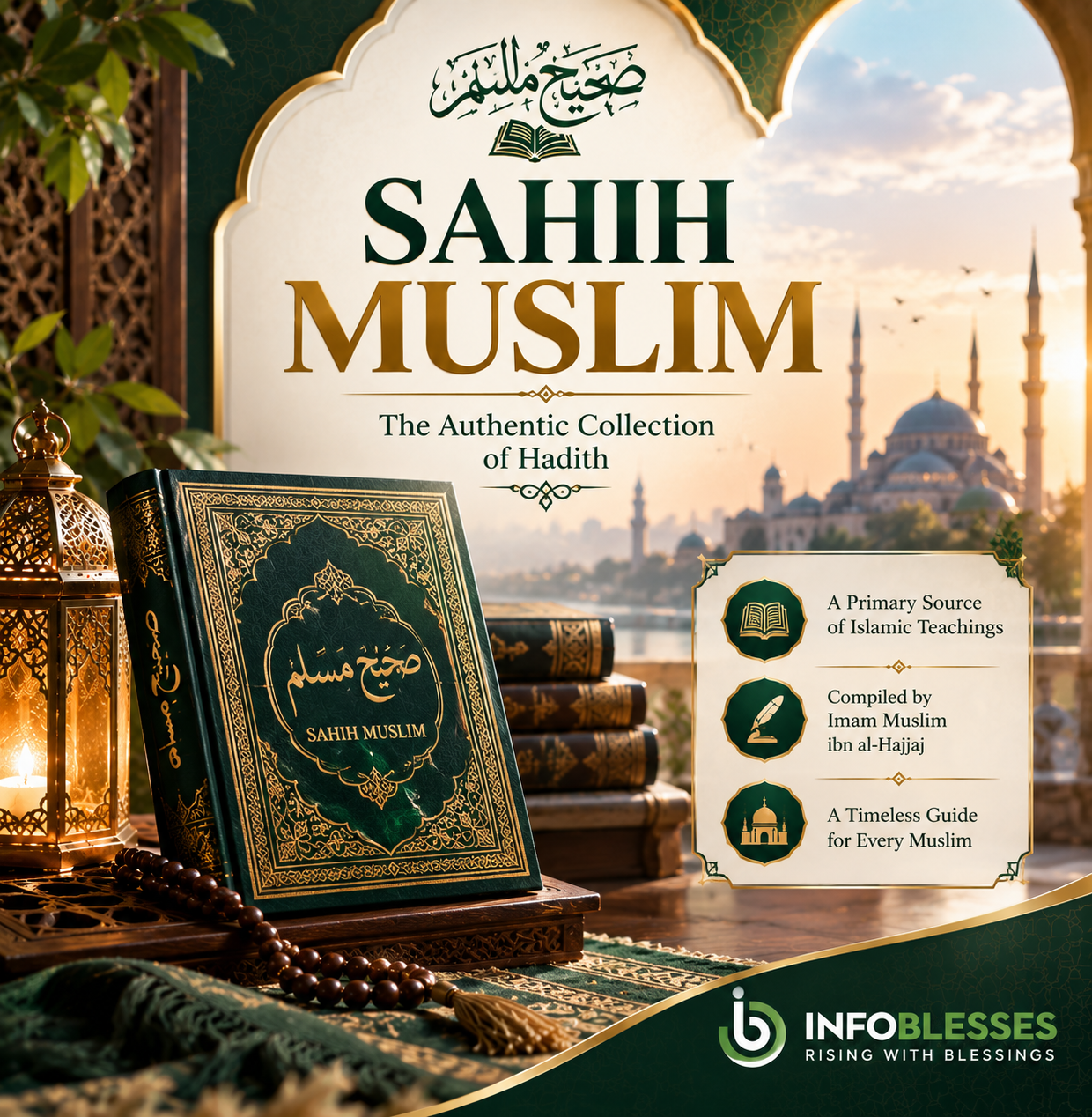
Sahih Muslim holds a special place in Islamic scholarship. Compiled by Imam Muslim ibn al-Hajjaj al-Naysaburi, it is traditionally regarded in Sunni Islam as one of the two most authoritative collections of authentic hadith, alongside Sahih al-Bukhari. The collection contains roughly 7,500 hadith reports when repetitions are included and is arranged into 57 books.
For Muslims around the world, Sahih Muslim is more than a historical collection. Its narrations cover faith, prayer, purification, fasting, charity, pilgrimage, family life, manners, repentance, remembrance of Allah, and many other aspects of religious and social life.
The collection is also important because it represents a tradition of careful verification. Imam Muslim and other hadith scholars devoted enormous effort to examining narrators and chains of transmission before accepting reports.
That lesson remains especially relevant today. Information travels faster than ever, and religious quotations can be copied thousands of times without verification. The hadith tradition encourages a better habit: check the source, understand the context, and seek reliable scholarship before presenting something as authentic.
This guide explores the history, structure, significance, themes, and practical lessons of Sahih Muslim while keeping the discussion accessible to modern readers.
Comprehensive Outline
| Section | Main Topic |
|---|---|
| Introduction | Importance of Sahih Muslim |
| What Is Sahih Muslim? | Definition and significance |
| Who Was Imam Muslim? | Life and scholarship |
| Historical Background | Development of hadith scholarship |
| How Sahih Muslim Was Compiled | Selection and organization |
| Hadith Authentication | Chains, narrators, and verification |
| Structure of Sahih Muslim | Books and subjects |
| Sahih Muslim and Sahih Bukhari | Key similarities and differences |
| Major Themes | Faith, worship, ethics, and society |
| Islamic Wisdom | Practical lessons |
| Studying Sahih Muslim | Beginner-friendly approach |
| Hadith in Daily Life | Modern applications |
| Common Mistakes | Responsible reading |
| Online Hadith Research | Verification in the digital age |
| Frequently Asked Questions | Common reader questions |
| Conclusion | Lasting value of the collection |
What Is Sahih Muslim?
Sahih Muslim is a major compilation of hadith attributed to the Prophet Muhammad ﷺ. It was compiled by Imam Muslim ibn al-Hajjaj, a leading hadith scholar who lived during the third Islamic century.
The word sahih generally means sound or authentic. The name therefore identifies the collection as a work focused on reports that met Imam Muslim’s standards for authenticity.
Sahih Muslim is traditionally placed among the most authoritative Sunni hadith collections. Along with Sahih al-Bukhari, it is commonly referred to as the Sahihayn, or “the Two Sahihs.”
The collection is organized by subject rather than being presented as a random list of reports. Its books include faith, purification, prayer, fasting, pilgrimage, marriage, social conduct, virtues, repentance, and other areas of Islamic life.
What Is a Hadith?
A hadith is a report concerning something attributed to the Prophet Muhammad ﷺ. Depending on the narration, it may describe his words, actions, approvals, characteristics, or responses to particular circumstances.
Hadith therefore provides an important source for understanding the Sunnah.
However, studying hadith requires care. A reader should not assume that finding a statement online automatically tells the whole story. The source, chain, wording, context, and scholarly interpretation can all matter.
Why Does Sahih Muslim Matter?
Its significance comes from both its contents and the scholarly methodology behind its compilation.
The collection gives readers access to a vast body of prophetic reports while also reflecting the careful culture of classical hadith scholarship.
That combination makes Sahih Muslim an important resource for anyone seeking to understand Islamic teachings more deeply.
Who Was Imam Muslim?
Imam Muslim’s full name was Abu al-Husayn Muslim ibn al-Hajjaj al-Naysaburi. He was born in Nishapur in 206 AH, approximately 821 CE, and died in 261 AH, approximately 875 CE.
He became one of the leading hadith scholars of his time.
Imam Muslim traveled extensively in search of knowledge, visiting regions including Arabia, Egypt, Syria, and Iraq. During these journeys, he studied under prominent scholars and collected reports from recognized teachers.
His scholarly environment was one in which hadith transmission was treated with extraordinary seriousness.
A Life Dedicated to Hadith
Imam Muslim spent much of his life studying, collecting, evaluating, organizing, teaching, and transmitting hadith.
His work demonstrates that preserving knowledge isn’t simply a matter of possessing a good memory.
It requires discipline.
It requires comparison.
It requires knowledgeable teachers.
And it requires the willingness to reject information that doesn’t meet established standards.
Imam Muslim and Imam al-Bukhari
Imam Muslim also studied under and was influenced by major scholars of his period, including Imam al-Bukhari. Their works later became closely associated because both collections gained exceptional status in Sunni hadith scholarship.
The relationship between their works also demonstrates the richness of classical Islamic scholarship. Different scholars could use related methods while organizing and presenting material in different ways.
Historical Background of Hadith Scholarship
The preservation of prophetic teachings developed over generations.
Early Muslims transmitted reports orally and in written form. Students traveled to meet teachers, and scholars compared transmissions from different individuals and regions.
Over time, specialized disciplines developed to evaluate hadith.
These disciplines examined both the chain of transmission and the content of reports.
The Science of Hadith
Hadith scholars developed terminology for describing different types of reports and different levels of narrator reliability.
They examined questions such as:
- Was the narrator trustworthy?
- Was the narrator known for accurate memory?
- Did the narrator actually meet the person from whom they reported?
- Was the chain continuous?
- Were there conflicting versions?
- Did another chain support the report?
- Were there hidden defects?
- Was the wording transmitted accurately?
This methodology helped establish a sophisticated scholarly tradition.
Why This History Still Matters
Modern readers live in an environment where information is abundant but verification can be difficult.
The historical development of hadith scholarship therefore offers a useful lesson.
Not everything that is transmitted should automatically be accepted.
That principle is particularly valuable in the age of viral posts, edited videos, AI-generated content, and unattributed quotations.
How Was Sahih Muslim Compiled?
Imam Muslim did not simply gather every narration available to him.
According to the biographical material accompanying the collection, he examined a very large body of hadith and selected a much smaller corpus for his compilation. The same source describes his attention to narrator reliability, continuity of transmission, and variations in wording.
The result was organized into thematic books.
This organization makes the collection useful for both scholars and students.
Organization by Subject
The collection begins with the Book of Faith and continues through subjects such as purification, prayer, mosques, fasting, pilgrimage, marriage, business, manners, and other aspects of life.
The arrangement allows related narrations to be studied together.
Why Repetition Can Be Valuable
A reader may notice that similar reports sometimes appear more than once.
This doesn’t necessarily mean the material is redundant.
Different versions can preserve different chains, word choices, or contextual details. Comparing them can help scholars understand the transmission history of a report.
For a beginner, this may seem complicated at first. With study, however, the structure becomes easier to appreciate.
How Are Hadiths Authenticated?
One of the most important features of classical hadith scholarship is its attention to transmission.
A hadith is commonly discussed in terms of its isnad, or chain of transmitters, and its matn, or textual content.
Scholars investigated both.
The Chain of Transmission
The chain identifies the individuals through whom a report passed.
For example, a narration might be transmitted from one scholar to another, eventually reaching a Companion who reported something from the Prophet ﷺ.
Scholars studied these transmitters carefully.
They investigated their reliability, memory, teachers, students, locations, dates, and reputation.
The Text of the Hadith
Scholars also compared the actual wording of reports.
Small differences could sometimes provide useful information about transmission.
Imam Muslim’s approach placed particular emphasis on accurate transmission and differences in wording.
This attention to detail is one reason hadith scholarship became a specialized academic discipline.
A Lesson for Modern Readers
The basic principle is easy to understand:
Evidence matters.
If someone attributes a statement to the Prophet ﷺ, the responsible response isn’t simply to ask whether it sounds inspirational.
The better question is:
Where is the evidence?
Why Is Sahih Muslim Considered Authentic?
Sahih Muslim is traditionally regarded in Sunni Islam as one of the most authentic collections of prophetic hadith. It is commonly paired with Sahih al-Bukhari as one of the Sahihayn.
Its reputation is connected to Imam Muslim’s rigorous approach to transmission and the long scholarly tradition surrounding the work.
Authenticity and Interpretation Are Different Questions
A common misunderstanding is that once a hadith is considered authentic, no further explanation is necessary.
That’s not always the case.
An authentic narration may still require explanation regarding:
- Language
- Historical circumstances
- Related narrations
- Legal implications
- Theological questions
- General versus specific wording
- How classical scholars understood it
This is why serious Islamic study involves more than simply finding a hadith number.
The Role of Scholars
Qualified scholars can compare evidence from multiple sources and explain how individual narrations fit into broader Islamic teachings.
For difficult questions, this approach is far safer than building an entire position around one isolated quotation.
What Is the Structure of Sahih Muslim?
Sahih Muslim contains approximately 7,500 reports when repetitions are included and is divided into 57 books according to the commonly used online edition.
The first major section is the Book of Faith.
It is followed by books dealing with purification, prayer, mosques, Friday prayer, travel prayer, and many other subjects.
Major Areas of the Collection
| Topic | Examples of Subjects |
|---|---|
| Faith | Belief, divine decree, Islam and ihsan |
| Purification | Wudu, cleanliness, ritual purity |
| Prayer | Obligatory and voluntary prayers |
| Fasting | Ramadan and fasting practices |
| Pilgrimage | Hajj and related practices |
| Family | Marriage and family matters |
| Ethics | Character, manners, and conduct |
| Repentance | Returning to Allah |
| Social Life | Relationships and responsibilities |
| Hereafter | Paradise, Hell, resurrection |
The breadth of these topics shows that prophetic guidance encompasses many areas of human life.
Sahih Muslim and Sahih Bukhari: What Is the Difference?
Sahih Muslim and Sahih al-Bukhari are separate collections compiled by different scholars.
Both are traditionally regarded as highly authoritative Sunni hadith works.
They contain many of the same narrations, but they differ in organization, presentation, and certain methodological details.
| Category | Sahih Muslim | Sahih al-Bukhari |
|---|---|---|
| Compiler | Imam Muslim ibn al-Hajjaj | Imam al-Bukhari |
| Era | 9th century CE | 9th century CE |
| Traditional status | One of the Two Sahihs | One of the Two Sahihs |
| Content | Authentic prophetic reports | Authentic prophetic reports |
| Organization | Thematic books | Thematic books and chapters |
| Importance | Major hadith reference | Major hadith reference |
Rather than viewing the two works as competitors, students can recognize their complementary value within the classical Sunni hadith tradition.
Major Themes in Sahih Muslim
Sahih Muslim addresses many dimensions of Islamic life.
The Book of Faith appears at the beginning of the collection, highlighting the central importance of belief. Its contents discuss subjects connected with faith, Islam, ihsan, and divine decree.
Faith
Faith is not treated as an abstract concept.
The collection presents discussions about belief and its relationship to actions and spiritual life.
Worship
Prayer, purification, fasting, pilgrimage, and other forms of worship occupy major portions of the collection.
These practices create structure and discipline in a believer’s life.
Character
Islamic teachings also address how people behave toward one another.
Honesty, mercy, patience, kindness, humility, and responsibility are essential dimensions of religious character.
Repentance
Human beings make mistakes.
The concept of repentance offers hope and encourages believers to return to Allah rather than becoming trapped in despair.
11 Powerful Lessons From Sahih Muslim
Sahih Muslim contains many lessons that can inspire reflection and practical improvement.
1. Verify What You Hear
The introduction to Sahih Muslim includes a warning about transmitting everything a person hears.
That principle is incredibly relevant to modern social media.
Before forwarding an Islamic quotation, check its source.
2. Seek Knowledge Carefully
True learning takes patience.
A person should be willing to study, ask questions, compare evidence, and recognize the limits of their own knowledge.
3. Sincerity Matters
Religious actions should not become performances for other people.
Sincerity gives worship its spiritual direction.
4. Worship Should Improve Character
Prayer and other acts of worship should influence how a person treats others.
Faith should appear in everyday behavior.
5. Mercy Is a Strength
Mercy encourages people to respond to weakness and mistakes with compassion rather than unnecessary harshness.
6. Patience Builds Resilience
Difficult circumstances are part of life.
Patience can help a believer respond to hardship without losing hope.
7. Repentance Offers Hope
Mistakes don’t have to become the final chapter of someone’s life.
Repentance encourages people to correct themselves and return to Allah.
8. Community Matters
Islamic teachings emphasize responsibilities toward other people.
Family, neighbors, friends, and wider society all matter.
9. Avoid Arrogance
Knowledge should produce humility.
The more someone studies, the more they may recognize how much remains to be learned.
10. Context Matters
A hadith should not automatically be separated from its surrounding material.
Related narrations and scholarly commentary can clarify meaning.
11. Knowledge Should Produce Action
The goal isn’t simply to memorize hundreds of references.
Knowledge should improve worship, character, decisions, and relationships.
How Can Beginners Study Sahih Muslim?
A beginner may find the size of Sahih Muslim intimidating.
There’s no need to rush.
Start with manageable sections and develop a consistent study habit.
Choose a Reliable Edition
Use an established translation with clear references.
An accessible online edition is available through Sunnah.com, which organizes Sahih Muslim by book and hadith reference.
Study One Theme at a Time
Good starting topics include:
- Faith
- Prayer
- Character
- Patience
- Repentance
- Charity
- Family relationships
A thematic approach makes it easier to connect the material with daily life.
Keep Notes
For each narration, record:
- The reference
- The main subject
- The key lesson
- Questions that arise
- Relevant scholarly explanations
- A practical action inspired by the teaching
This method turns reading into meaningful study.
How Can Sahih Muslim Be Applied to Daily Life?
The value of hadith study becomes clearer when it influences everyday decisions.
Consider communication.
A person receives an emotional religious message online. It includes a quotation attributed to the Prophet ﷺ.
Instead of immediately forwarding it, the person checks the reference.
That simple action reflects a major principle of responsible knowledge.
In Family Life
Hadith teachings can encourage kindness, patience, responsibility, and good treatment of others.
In Business
Islamic teachings about honesty, fairness, trust, and avoiding harm can provide ethical guidance.
In Personal Development
Teachings about sincerity, patience, repentance, humility, and remembrance can encourage spiritual growth.
In Online Communication
The emphasis on reliable transmission provides an especially valuable lesson.
Not everything deserves to be shared.
Sometimes the wisest response is to pause and verify.
Common Mistakes When Reading Sahih Muslim
Even sincere readers can misunderstand hadith when they approach the collection without context.
Mistake 1: Sharing Unverified Quotes
A quotation isn’t authentic simply because it has been copied thousands of times.
Mistake 2: Reading Only Short Excerpts
A single sentence may not communicate the full meaning of a narration.
Mistake 3: Ignoring the Chapter
The chapter heading and surrounding narrations can provide important context.
Mistake 4: Treating Translation as the Arabic Original
Translations are useful, but difficult passages may require reference to Arabic wording and scholarly commentary.
Mistake 5: Giving Legal Rulings Without Knowledge
A hadith reference alone doesn’t necessarily provide enough information to issue a religious ruling.
Mistake 6: Assuming Every Difficult Narration Is Contradictory
Some apparent difficulties disappear when multiple narrations, language, chronology, or scholarly interpretation are considered.
Sahih Muslim in the Digital Age
Modern technology has transformed access to Islamic knowledge.
A student in almost any country can now search thousands of hadith references within seconds.
That’s an extraordinary opportunity.
But it also creates new responsibilities.
The Problem of Misinformation
Social platforms reward content that is emotional, surprising, and easy to share.
Religious knowledge can become vulnerable to the same pressures.
A dramatic quotation may receive thousands of shares while a carefully researched explanation receives far less attention.
A Better Digital Habit
Before sharing Islamic content, ask:
- Is the source named?
- Is the reference correct?
- Is the wording complete?
- Is the translation reliable?
- Is the context included?
- Does the claim represent scholarly consensus or one interpretation?
- Am I presenting an opinion as though it were an established fact?
These questions can make online Islamic communication more responsible.
Why Sahih Muslim Remains Relevant Today
Although Sahih Muslim was compiled many centuries ago, its themes continue to address enduring human concerns.
People still experience grief, fear, temptation, family disagreements, financial difficulties, success, failure, hope, and uncertainty.
Technology has changed.
Human nature has not changed nearly as much.
The collection can therefore serve as a source of spiritual reflection for readers seeking guidance on worship and character.
Its lasting relevance isn’t based on pretending that every historical circumstance is identical to modern life. Instead, its value lies in the enduring principles found within prophetic guidance.
Frequently Asked Questions About Sahih Muslim
Is Sahih Muslim authentic?
Yes. Sahih Muslim is traditionally regarded in Sunni Islam as one of the most authoritative collections of authentic hadith and is commonly paired with Sahih al-Bukhari as one of the Two Sahihs.
Who compiled Sahih Muslim?
It was compiled by Imam Muslim ibn al-Hajjaj al-Naysaburi, a major hadith scholar of the third Islamic century.
When was Imam Muslim born?
Imam Muslim was born in 206 AH, approximately 821 CE, in Nishapur.
When did Imam Muslim die?
He died in 261 AH, approximately 875 CE.
How many hadiths are in Sahih Muslim?
The commonly cited figure is approximately 7,500 hadith reports when repetitions are counted. The collection is organized into 57 books in the commonly used online edition.
Is Sahih Muslim better than Sahih Bukhari?
Both are traditionally regarded as exceptionally authoritative Sunni hadith collections. They were compiled by different scholars and have different organizational and methodological features.
Why are some hadiths repeated?
Repeated reports can contain different chains, wording, or details. Such variations can have important scholarly value.
Can beginners study Sahih Muslim?
Yes. Beginners should ideally use a reliable translation, study gradually, and consult qualified scholars when they encounter difficult legal, theological, linguistic, or historical questions.
Where can I read Sahih Muslim?
An accessible online edition is available at Sunnah.com, organized into books and hadith references.
Conclusion:
Sahih Muslim is one of the most important works in the Sunni hadith tradition. Its significance comes not only from the prophetic reports it preserves but also from the scholarly effort devoted to transmitting and evaluating those reports.
For modern readers, its lessons remain powerful.
Verify information before sharing it.
Seek knowledge with humility.
Value sincerity.
Practice patience.
Show mercy.
Respect scholarship.
Avoid arrogance.
And allow knowledge to influence character and action.
In an age when information can spread instantly, the careful methodology represented by Sahih Muslim offers an especially valuable reminder: authentic knowledge deserves careful transmission.
Studying Sahih Muslim can therefore be both an academic and spiritual journey. With a reliable edition, thoughtful reading, and appropriate scholarly guidance, readers can explore prophetic wisdom while developing a deeper appreciation for the Islamic tradition of preserving knowledge.

Welcome to Info Blesses I am Rana Ahtasham an AI Powered SEO and Content Writer With 3 year experience.I help websites rank highter, grow traffic, and look amazing. My goal is to make SEO and web design simple and effective for everyone.Lets achieve more togather!