
Qunoot Duas are among the beautiful supplications associated with Islamic prayer, especially Witr. They express a believer’s dependence upon Allah, asking Him for guidance, protection, well-being, blessings, and safety from harm. The well-known Witr Qunoot was taught by the Prophet Muhammad ﷺ to his grandson al-Hasan ibn Ali (رضي الله عنهما), as recorded in Sunan Abi Dawud.
The word Qunoot is associated with devotion, humility, obedience, and standing before Allah with sincere submission. It reminds Muslims that no matter how capable a person may be, ultimate guidance, protection, and success belong to Allah.
This article explores Qunoot Duas, their Arabic text, English translation, meaning, spiritual lessons, connection with Witr prayer, and practical ways to understand these powerful supplications.

What Is Qunoot in Islam?
Qunoot refers to a form of humble supplication and devotion to Allah. In Islamic prayer, the term is particularly familiar because of Qunoot al-Witr, the supplication recited in connection with the Witr prayer.
The essence of Qunoot is beautifully captured by the believer’s attitude toward Allah: I need Your guidance, I seek Your protection, I depend upon Your decision, and I ask You to bless what You have given me.
The famous Witr Qunoot was taught to al-Hasan ibn Ali (رضي الله عنهما). The narration states that the Prophet ﷺ taught him words to say in Witr, beginning with:
اللَّهُمَّ اهْدِنِي فِيمَنْ هَدَيْتَ
“O Allah, guide me among those whom You have guided.”
This opening immediately establishes one of the most important themes of the dua: guidance.
A Muslim does not only ask Allah for material possessions or worldly success. The believer first asks for the guidance that leads to what is pleasing to Allah.

Qunoot Dua in Arabic
The well-known Witr Qunoot taught in the hadith of al-Hasan ibn Ali (رضي الله عنهما) is:
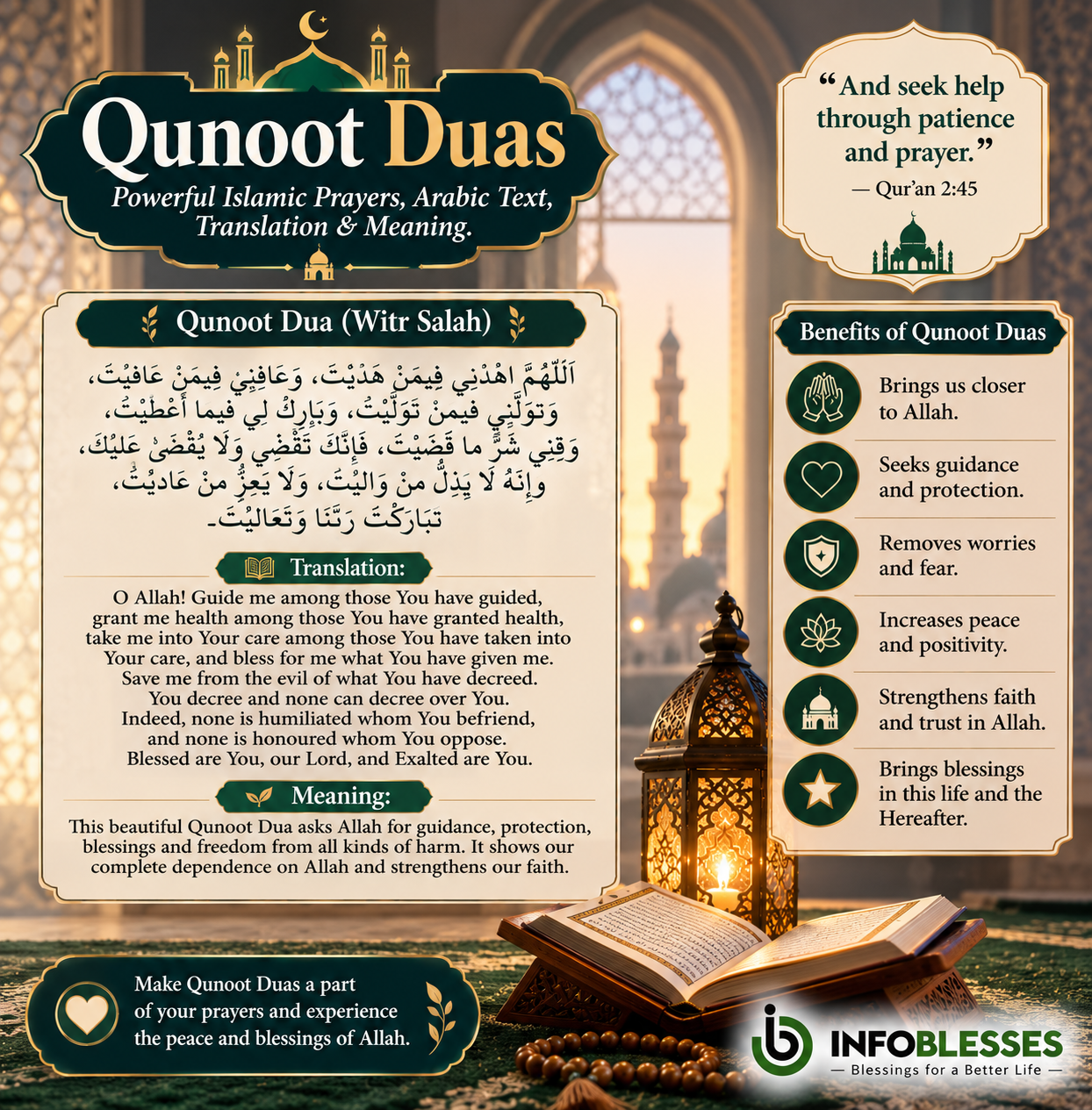
اللَّهُمَّ اهْدِنِي فِيمَنْ هَدَيْتَ، وَعَافِنِي فِيمَنْ عَافَيْتَ، وَتَوَلَّنِي فِيمَنْ تَوَلَّيْتَ، وَبَارِكْ لِي فِيمَا أَعْطَيْتَ، وَقِنِي شَرَّ مَا قَضَيْتَ، إِنَّكَ تَقْضِي وَلَا يُقْضَى عَلَيْكَ، وَإِنَّهُ لَا يَذِلُّ مَنْ وَالَيْتَ، وَلَا يَعِزُّ مَنْ عَادَيْتَ، تَبَارَكْتَ رَبَّنَا وَتَعَالَيْتَ.
This supplication contains several interconnected requests: guidance, well-being, Allah’s care, blessings, and protection from harm.
The hadith specifically reports that the Prophet ﷺ taught these words for Witr.
When learning the Arabic, Muslims should try to understand the meaning rather than simply memorizing sounds. Understanding the words can help develop khushu’, humility and attentiveness during prayer.

Qunoot Dua English Translation
A meaning-based translation of the well-known Qunoot is:
“O Allah, guide me among those whom You have guided, grant me well-being among those whom You have granted well-being, take me into Your care among those whom You have taken into Your care, bless for me what You have given me, and protect me from the evil of what You have decreed. Indeed, You decree, and none can decree over You. The one whom You befriend is not humbled, and the one whom You oppose is not honored. Blessed are You, our Lord, and Exalted.”
This translation shows how comprehensive the dua is.
It begins with guidance, moves toward well-being and Allah’s care, asks for blessing, seeks protection from harm, acknowledges Allah’s absolute authority, and ends by glorifying Him.
In other words, Qunoot teaches the believer how to ask Allah for both spiritual and worldly goodness while recognizing His complete sovereignty.

The Meaning of “Allahumma Ihdini Fiman Hadayt”
The first major request is:
اللَّهُمَّ اهْدِنِي فِيمَنْ هَدَيْتَ
“O Allah, guide me among those whom You have guided.”
Guidance is one of the greatest blessings a person can receive.
A person can have wealth, education, influence, and opportunities, yet still make choices that harm their faith or their future. Therefore, asking Allah for guidance is not a small request.
The dua reminds us that we need guidance repeatedly.
We need guidance when choosing friends.
We need guidance when making career decisions.
We need guidance in marriage.
We need guidance when dealing with disagreements.
We need guidance when facing temptation.
We need guidance when deciding between what we want and what is right.
The believer therefore begins Qunoot by asking Allah to guide them among those whom He has guided.
This teaches humility. We are not saying, “I know everything.” Instead, we are admitting, “O Allah, I need Your guidance.”

Asking Allah for Well-Being and Protection
The next request is:
وَعَافِنِي فِيمَنْ عَافَيْتَ
“Grant me well-being among those whom You have granted well-being.”
This beautiful request covers the desire for safety and well-being.
A believer can ask Allah for well-being in faith, body, family, circumstances, and life. It reminds us that security should never be taken for granted.
After asking for guidance, Qunoot asks for afiyah—well-being.
This sequence carries a meaningful lesson: having the right direction is essential, but we also need Allah’s protection and well-being while traveling through life.
We can therefore reflect on this part of Qunoot whenever we experience uncertainty.
Instead of believing that we control every outcome, we remember that Allah is the One who can protect us from difficulties that we know about and those we cannot even see.

Asking Allah to Take Us Into His Care
The Qunoot continues:
وَتَوَلَّنِي فِيمَنْ تَوَلَّيْتَ
This can be understood as asking Allah to take the believer into His care and protection among those whom He has taken into His care.
This is a deeply comforting meaning.
Human beings need support. We depend on family, friends, communities, and other people. Yet all human support has limits.
Allah’s care has no such limitation.
When a person sincerely turns toward Allah, they recognize that their ultimate reliance should be upon Him.
This does not mean abandoning practical effort. Islam encourages people to take appropriate means while placing their trust in Allah.
A student studies and asks Allah for success.
A person seeking employment applies for jobs and asks Allah for halal provision.
Someone facing a difficult decision seeks advice and asks Allah for guidance.
A person experiencing hardship takes appropriate steps while asking Allah for relief.
Qunoot therefore nurtures tawakkul—reliance upon Allah combined with responsible effort.

Asking Allah for Barakah in What He Has Given
Another beautiful part of Qunoot is:
وَبَارِكْ لِي فِيمَا أَعْطَيْتَ
“Bless for me what You have given me.”
This is a powerful reminder about barakah.
Barakah is not simply having more of something. A person may have a modest amount but find tremendous benefit, peace, usefulness, and goodness within it.
For example, someone may ask Allah to place barakah in:
- Their income
- Their family
- Their time
- Their knowledge
- Their health
- Their home
- Their work
- Their relationships
- Their children
- Their opportunities
This teaches an important Islamic principle: we should not only ask for more—we should ask Allah to bless what we already have.
A small amount of time with barakah can produce more benefit than many hours without purpose.
A modest income with barakah can bring greater peace than wealth accompanied by constant anxiety.
A small home filled with love and worship can be more valuable than a luxurious house without tranquility.
Qunoot therefore encourages gratitude as well as supplication.

Seeking Protection From the Evil of What Allah Has Decreed
The dua then says:
وَقِنِي شَرَّ مَا قَضَيْتَ
“Protect me from the evil of what You have decreed.”
This part reflects the believer’s need for protection from harmful outcomes.
Islam teaches Muslims to believe in Allah’s decree while continuing to ask Allah for goodness and protection.
A person does not know what tomorrow will bring. Therefore, they ask Allah to protect them from harm, guide them through difficulties, and grant them patience when they are tested.
This is not a rejection of Allah’s decree.
Rather, it is an expression of dependence upon Allah.
When something difficult happens, the believer can respond with patience, dua, reflection, and trust instead of assuming that everything is meaningless.
The Qunoot helps train the heart to turn toward Allah before, during, and after difficulty.

Qunoot and Trust in Allah’s Decree
The Qunoot says:
إِنَّكَ تَقْضِي وَلَا يُقْضَى عَلَيْكَ
“Indeed, You decree, and none can decree over You.”
These words emphasize Allah’s absolute authority.
Human beings make plans, but Allah’s knowledge and authority encompass everything.
This understanding can bring balance to a believer’s life.
When things go according to our plans, we express gratitude.
When they do not, we remain patient and seek Allah’s guidance.
This does not mean that Muslims should stop planning. Islam encourages effort, responsibility, consultation, and wise decision-making.
But our plans remain subordinate to Allah’s wisdom.
Qunoot therefore teaches a powerful spiritual attitude:
Plan carefully, work sincerely, make dua, and trust Allah with the outcome.
That approach can help protect the heart from both arrogance during success and despair during disappointment.

What Qunoot Teaches About Humility
The final words of the well-known Qunoot include:
تَبَارَكْتَ رَبَّنَا وَتَعَالَيْتَ
“Blessed are You, our Lord, and Exalted.”
The dua ends with praise of Allah.
This is significant because supplication is not only about asking.
It is also about recognizing who Allah is.
A believer asks Allah because Allah is the Creator, Sustainer, Guide, Protector, and Lord.
Qunoot therefore combines request and praise.
It teaches us that whenever we ask Allah for something, we should remember His greatness.
This develops humility and helps the heart move away from self-reliance toward sincere worship.

When Is Qunoot Dua Recited?
The best-known Qunoot associated with this narration is Qunoot al-Witr.
The hadith of al-Hasan ibn Ali specifically describes words taught by the Prophet ﷺ for Witr.
There are differences among Islamic schools of jurisprudence concerning details such as when Qunoot is recited in Witr, whether it is regularly performed, and the precise prayer position in which it is made.
For example, the hadith literature contains reports concerning Qunoot in Witr both before and after bowing, and scholars have discussed these narrations in detail. Sunan Abi Dawud records reports related to the placement of the supplication.
Because these details involve legitimate differences of Islamic jurisprudence, Muslims should follow a reliable scholar or the established practice of their school rather than treating every difference as an error.
The important point is that the believer should approach these matters with knowledge, sincerity, and respect.

The Spiritual Benefits of Understanding Qunoot
Learning Qunoot is not simply about memorizing Arabic words.
Understanding its meaning can transform how a person approaches prayer.
1. It Strengthens Reliance on Allah
The dua repeatedly places the believer’s needs in Allah’s hands.
2. It Encourages Gratitude
Asking Allah to bless what He has given us reminds us to appreciate existing blessings.
3. It Develops Humility
The believer acknowledges that guidance and protection ultimately come from Allah.
4. It Creates Hope
The person making Qunoot knows that they can turn to Allah regardless of their circumstances.
5. It Encourages Patience
The believer accepts that Allah’s decree is wiser than human knowledge.
6. It Connects Prayer With Everyday Life
The requests in Qunoot relate directly to real concerns—guidance, health, safety, provision, relationships, decisions, and protection.
The Qur’an also teaches believers to seek help through patience and prayer.

How to Learn Qunoot Dua Easily
Learning a longer Arabic dua can seem difficult at first, but consistent practice can make it manageable.
Start by dividing the dua into small sections.
Step One: Learn the First Phrase
اللَّهُمَّ اهْدِنِي فِيمَنْ هَدَيْتَ
Repeat it until you recognize the words.
Step Two: Learn the Next Request
وَعَافِنِي فِيمَنْ عَافَيْتَ
Understand its meaning before moving forward.
Step Three: Continue One Phrase at a Time
Do not pressure yourself to memorize the entire dua in one sitting.
Read the Arabic while listening to a reliable recitation, study the translation, and repeat each section regularly.
Most importantly, learn with accuracy. When memorizing Qur’anic verses or hadith-based supplications, it is better to consult a trustworthy teacher or qualified scholar for pronunciation and practice.

Qunoot Dua and the Importance of Sincere Prayer
A dua becomes spiritually meaningful when the heart participates.
It is possible to memorize words without reflecting upon them. But the purpose of learning Qunoot is to understand what we are asking Allah for.
When saying:
“O Allah, guide me…”
think about the decisions where you need guidance.
When saying:
“Grant me well-being…”
remember how much you depend upon Allah for safety.
When saying:
“Bless for me what You have given me…”
reflect on your family, health, time, knowledge, and provision.
When asking for protection from harm, remember that Allah knows dangers that you cannot see.
This kind of reflection can make the prayer more personal.
The Qur’an emphasizes seeking Allah’s help through patience and prayer, demonstrating the central role of prayer in developing spiritual strength.

Frequently Asked Questions About Qunoot Duas
What is Qunoot Dua?
Qunoot is a supplication associated with Islamic prayer. The best-known Qunoot is the supplication made in Witr, including the dua taught by the Prophet ﷺ to al-Hasan ibn Ali (رضي الله عنهما).
What does Qunoot Dua ask Allah for?
The well-known Witr Qunoot asks Allah for guidance, well-being, His care, blessings in what He has given, and protection from harm. It also affirms Allah’s absolute authority and greatness.
Is Qunoot only about worldly needs?
No. Its themes include guidance, protection, spiritual dependence, blessing, and submission to Allah. These are connected to both worldly life and the Hereafter.
Is Qunoot Dua found in Hadith?
Yes. The famous Witr Qunoot was narrated from al-Hasan ibn Ali, who said that the Messenger of Allah ﷺ taught him these words for Witr.
When is Qunoot recited?
Qunoot is particularly associated with Witr. There are differences among scholars regarding details of its timing and placement, so Muslims should follow a reliable scholarly tradition.
Can I understand Qunoot in English?
Yes. Understanding the translation can help you appreciate what you are asking Allah for. However, when dealing with the formal wording used in prayer, it is important to follow the relevant rulings of your school of Islamic jurisprudence.
What is the most important lesson of Qunoot?
One of its greatest lessons is dependence upon Allah. The believer asks Allah for guidance, protection, well-being, blessings, and safety while recognizing that Allah alone has ultimate authority.

Final Reflection on Qunoot Duas
Qunoot Duas offer a beautiful picture of the relationship between a believer and Allah. They teach us to ask for guidance before trusting our own judgment, to seek well-being rather than taking safety for granted, to ask Allah to care for us, and to request barakah in what He has already given.
The dua also teaches acceptance of Allah’s authority.
Life does not always unfold according to our plans. Sometimes we receive what we hoped for, and sometimes we face an outcome we never expected. Qunoot helps train the heart to remain connected to Allah through both situations.
Its message is deeply practical:
Ask Allah for guidance.
Ask Him for well-being.
Ask Him for protection.
Ask Him for barakah.
Trust His decree.
Praise Him.
And continue walking through life with faith and humility.
The Qur’an reminds believers to seek help through patience and prayer, while the Sunnah gives us beautiful supplications through which we can turn toward Allah.
May Allah make us among those who understand their duas, remember Him sincerely, establish their prayers with humility, and rely upon Him in every circumstance.
May Allah guide us toward what is right, grant us well-being, protect us from harm, place barakah in what He has given us, strengthen our faith, forgive our shortcomings, and grant us goodness in this life and the Hereafter. Ameen.