
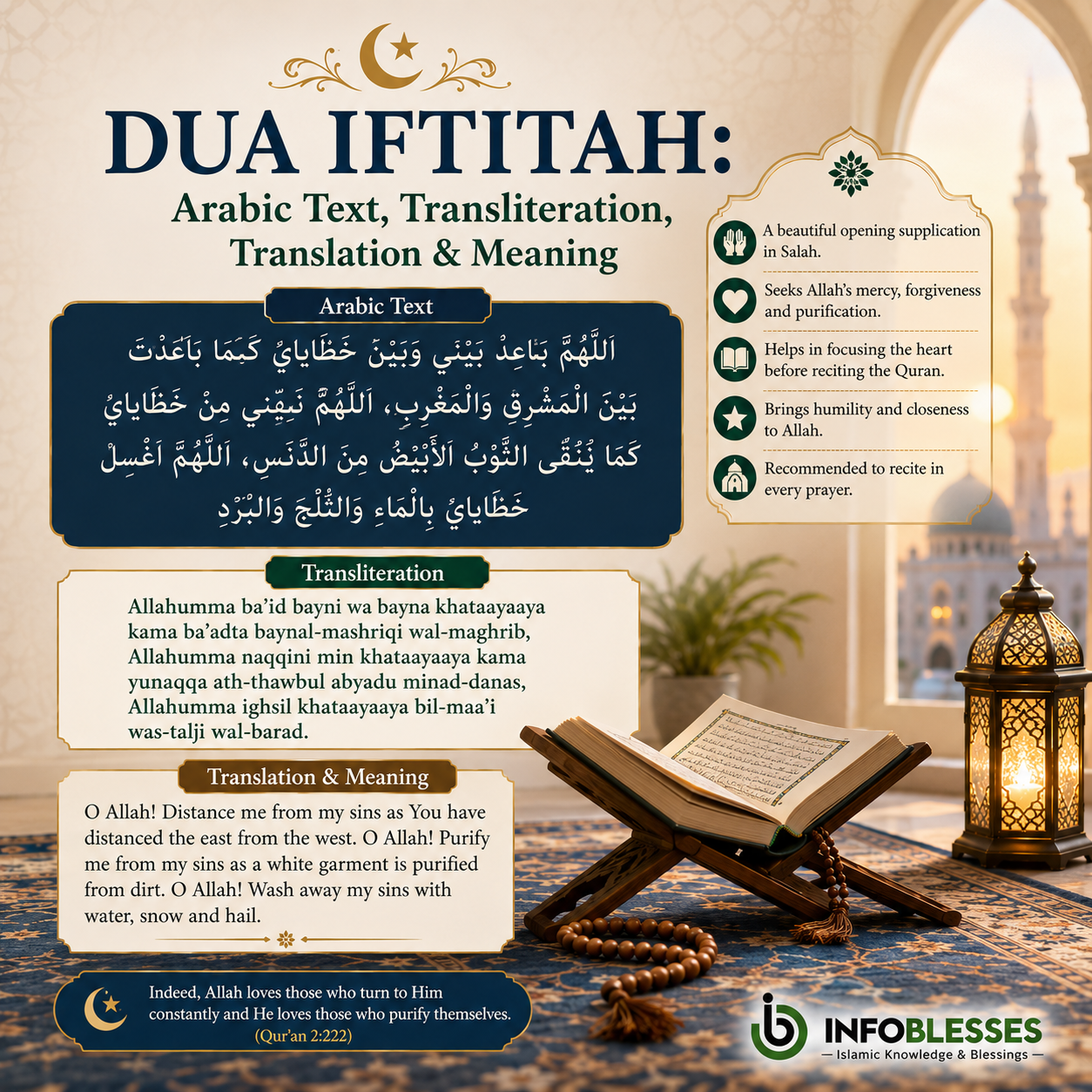
Dua Iftitah is a beautiful opening supplication recited at the beginning of Salah after the opening Takbir and before the Qur’anic recitation. It is also commonly called Dua Istiftah, meaning the supplication of opening. One well-known version was narrated by Abu Hurairah (رضي الله عنه), who asked the Prophet Muhammad ﷺ what he said during the brief pause between the opening Takbir and Qur’anic recitation. The Prophet ﷺ taught him a supplication asking Allah to distance the worshipper from sins and purify them completely. This narration is recorded in Sahih al-Bukhari 744.
Dua Iftitah is especially meaningful because Salah begins by turning the heart away from worldly distractions and toward Allah. Before reciting the Qur’an, the worshipper acknowledges their need for forgiveness and purification.

What Is Dua Iftitah?
The term Iftitah comes from an Arabic root associated with opening or beginning. In the context of Salah, Dua Iftitah refers to an opening supplication made after saying Allahu Akbar at the beginning of prayer and before beginning the Qur’anic recitation.
There is more than one authentic supplication reported from the Prophet ﷺ for this part of Salah. The version discussed in this article is the well-known supplication narrated by Abu Hurairah (رضي الله عنه) in which the Prophet ﷺ asks Allah to create a great distance between the worshipper and their sins, cleanse those sins, and wash them away.
Sahih al-Bukhari records that the Prophet ﷺ would remain briefly silent between the opening Takbir and recitation, and when Abu Hurairah asked what he said during that pause, he taught this supplication.
This makes the dua particularly powerful as an introduction to prayer. Before the believer listens to or recites the words of the Qur’an, they ask Allah for purification from their mistakes.
Dua Iftitah therefore helps establish a mindset of humility, repentance, sincerity, and concentration.

Dua Iftitah Arabic Text
The well-known narration of Dua Iftitah contains the following Arabic supplication:
اللَّهُمَّ بَاعِدْ بَيْنِي وَبَيْنَ خَطَايَايَ كَمَا بَاعَدْتَ بَيْنَ الْمَشْرِقِ وَالْمَغْرِبِ، اللَّهُمَّ نَقِّنِي مِنَ الْخَطَايَا كَمَا يُنَقَّى الثَّوْبُ الْأَبْيَضُ مِنَ الدَّنَسِ، اللَّهُمَّ اغْسِلْ خَطَايَايَ بِالْمَاءِ وَالثَّلْجِ وَالْبَرَدِ.
This wording is reported in Sahih al-Bukhari 744 from Abu Hurairah (رضي الله عنه).
Another authentic narration in Sunan an-Nasa’i 895 also records the same supplication as something the Prophet ﷺ said between the opening Takbir and recitation.
When learning the Arabic, it is beneficial to learn it gradually rather than attempting to memorize everything immediately. More importantly, understanding the meaning can make the supplication much more personal during Salah.

Dua Iftitah Transliteration
For readers who are learning Arabic pronunciation, the supplication can be transliterated approximately as:
Allahumma baa’id bayni wa bayna khatayaaya kamaa baa’adta baynal-mashriqi wal-maghrib.
Allahumma naqqini min khatayaaya kamaa yunaqqath-thawbul-abyadu minad-danas.
Allahumma ighsil khatayaaya bil-maa’i wath-thalji wal-barad.
Transliteration can be useful for beginners, but it should ideally be used as a temporary learning aid. Arabic pronunciation contains sounds that cannot always be represented perfectly using English letters.
If possible, learn the pronunciation by listening to a qualified teacher or reliable recitation while reading the Arabic text.
The purpose of learning Dua Iftitah is not merely to pronounce Arabic correctly. The deeper goal is to understand what you are saying to Allah and allow that understanding to affect your heart.

Dua Iftitah English Translation
A clear meaning-based translation of this supplication is:
“O Allah, distance me from my sins as You have distanced the East from the West. O Allah, purify me from my sins as a white garment is purified from stains. O Allah, wash away my sins with water, snow, and hail.”
This meaning is reported in the English translation accompanying the Sahih al-Bukhari narration.
The imagery in this dua is extremely powerful.
First, the worshipper asks Allah to create an enormous distance between them and their sins.
Then the worshipper asks Allah to cleanse them from their sins, comparing spiritual purification with a white garment being cleaned from stains.
Finally, the worshipper asks Allah to wash away their sins.
The three images—distance, cleansing, and washing—communicate a deep desire for forgiveness and spiritual purification.
This is an excellent mindset with which to begin Salah.

The Meaning of “Allahumma Baa’id Bayni Wa Bayna Khatayaaya”
The opening words are:
اللَّهُمَّ بَاعِدْ بَيْنِي وَبَيْنَ خَطَايَايَ
“O Allah, distance me from my sins.”
This is a profound request.
The believer does not merely ask Allah to forgive past mistakes. The supplication asks Allah to establish a distance between the person and their sins.
The comparison with the East and West makes the request especially vivid:
“As You have distanced the East from the West.”
East and West represent an immense separation. The worshipper is asking Allah for a similarly great separation between themselves and sinful behavior.
This can inspire personal reflection.
A person can ask:
- Which habits do I need to leave?
- Which mistakes do I repeatedly make?
- Which situations make sin easier for me?
- What can I change in my daily life?
- How can I strengthen my relationship with Allah?
Dua should encourage action as well as hope. Asking Allah for distance from sin should motivate us to avoid the circumstances that lead us toward wrongdoing.

The Meaning of “Kama Ba’adta Baynal-Mashriqi Wal-Maghrib”
The phrase:
كَمَا بَاعَدْتَ بَيْنَ الْمَشْرِقِ وَالْمَغْرِبِ
means:
“As You have distanced the East from the West.”
This comparison helps the worshipper visualize what they are asking for.
The East and West are not merely slightly separated. They represent opposite directions.
Therefore, the supplication asks Allah for a complete and decisive separation from sin.
This teaches us something important about repentance.
Repentance should not be treated casually. A believer should sincerely desire to leave sinful behavior behind and return to Allah.
The beginning of Salah can therefore become a spiritual reset.
A person may have struggled during the day. They may have become angry, spoken badly about someone, neglected something important, or made another mistake.
When they stand before Allah, they do not have to remain trapped in yesterday’s failure.
They can turn back to Allah.
This is one of the beautiful aspects of Islamic repentance: a person’s mistakes do not have to become the final definition of their life.

The Meaning of “Allahumma Naqqini Min Khatayaaya”
The next part says:
اللَّهُمَّ نَقِّنِي مِنَ الْخَطَايَا
“O Allah, purify me from my sins.”
The word naqqini conveys the idea of purification or cleansing.
The believer is asking Allah not only to forgive but to purify them from the effects of their wrongdoing.
The dua then gives a beautiful example:
كَمَا يُنَقَّى الثَّوْبُ الْأَبْيَضُ مِنَ الدَّنَسِ
“As a white garment is purified from stains.”
A white garment makes even a small stain easy to notice.
Likewise, this imagery encourages the believer to develop awareness of their spiritual condition.
We should not become comfortable with sin simply because a particular mistake seems small.
At the same time, Islam does not teach believers to lose hope because of their mistakes.
The appropriate response is to recognize the error, seek forgiveness, correct what can be corrected, and return sincerely to Allah.

Why the White Garment Is a Powerful Image
The comparison to a white garment is one of the most memorable aspects of Dua Iftitah.
Imagine a clean white garment becoming stained. The stain stands out immediately.
The Prophet ﷺ used this familiar image to communicate the idea of purification from sin.
A garment can be washed until the stain disappears. Similarly, the believer asks Allah for cleansing from their mistakes.
This teaches us that spiritual cleanliness matters.
Just as Muslims care about physical cleanliness before prayer, they should also care about the condition of the heart.
The worshipper enters Salah after performing purification where required, but Dua Iftitah reminds the heart that spiritual purification is also essential.
This creates a beautiful connection between outer preparation and inner preparation.
A clean body prepares us physically.
Sincere repentance prepares us spiritually.
Concentration prepares us mentally.
Together, these forms of preparation can help a person approach Salah with greater humility.

The Meaning of “Allahumma Ighsil Khatayaaya”
The final part says:
اللَّهُمَّ اغْسِلْ خَطَايَايَ
“O Allah, wash away my sins.”
The supplication then mentions:
بِالْمَاءِ وَالثَّلْجِ وَالْبَرَدِ
“With water, snow, and hail.”
This is a vivid expression of complete cleansing.
Water is commonly associated with washing and purification, while snow and hail add imagery of coolness and thorough cleansing.
The believer is asking Allah to remove their sins completely.
This teaches us not to approach repentance with a half-hearted attitude.
A sincere Muslim should desire real change.
If someone has harmed another person, they should seek to correct the harm where appropriate.
If they have neglected an obligation, they should strive to improve.
If they have developed a harmful habit, they should seek practical ways to leave it.
Dua provides spiritual support, while sincere action demonstrates the seriousness of repentance.

When Is Dua Iftitah Recited?
The narration in Sahih al-Bukhari describes this supplication as being said during the brief pause between the opening Takbir and Qur’anic recitation.
In practical terms, this is at the beginning of Salah after saying Allahu Akbar to enter the prayer.
However, it is important to understand that Islamic scholarship contains multiple authentic supplications for this opening portion of Salah.
For example, another authentic opening supplication begins with:
“Subhanaka Allahumma wa bihamdika…”
There are also other narrations concerning opening supplications.
Therefore, Muslims should not assume that only one wording is valid in every circumstance. The Prophet ﷺ taught and practiced different authentic forms of opening supplication.
The important principle is to follow authentic Sunnah and learn the applicable details from reliable Islamic scholarship.

Is Dua Iftitah Obligatory?
Dua Iftitah is not the same as the obligatory components of Salah.
The specific ruling regarding the opening supplication can differ according to the school of Islamic jurisprudence and the particular wording being discussed. Muslims should therefore follow the guidance of a qualified scholar or the established fiqh tradition they follow.
The important point for beginners is not to become anxious about making mistakes while learning.
If you are still memorizing Dua Iftitah, learn it gradually.
First learn the Arabic.
Then learn the pronunciation.
Then understand the translation.
Finally, reflect upon its meaning during prayer.
A person who is learning should also consult a knowledgeable teacher regarding the exact practice followed in their community or madhhab.
The diversity of authentic reports concerning opening supplications is part of the richness of the Sunnah, not something that should become a source of unnecessary conflict.

Spiritual Lessons From Dua Iftitah
Dua Iftitah contains several important lessons that can influence a Muslim’s everyday life.
1. Begin With Humility
The supplication begins by acknowledging our need for Allah’s forgiveness.
2. Do Not Become Comfortable With Sin
The request to be separated from sins teaches us to actively distance ourselves from wrongdoing.
3. Believe in Allah’s Mercy
Asking Allah for purification demonstrates hope in His forgiveness.
4. Take Repentance Seriously
The imagery of washing and cleansing encourages sincere spiritual renewal.
5. Prepare Your Heart for the Qur’an
The dua occurs before recitation, helping the worshipper transition from worldly thoughts toward worship.
6. Remember That Allah Knows Our Inner Condition
Salah is not merely physical movement. It is an act of worship involving the heart, tongue, and body.
7. Make Every Prayer an Opportunity for Renewal
Each Salah gives a Muslim another opportunity to turn toward Allah.
These lessons make Dua Iftitah relevant far beyond the few moments in which it is recited.

Dua Iftitah and the Importance of Repentance
One of the strongest themes in Dua Iftitah is repentance.
Islam teaches believers to return to Allah after making mistakes rather than allowing guilt to push them away from Him.
The Qur’an says:
“Indeed, Allah loves those who are constantly repentant and loves those who purify themselves.”
This verse is found in Qur’an 2:222. Repentance is therefore not something shameful. Turning back to Allah is an act of worship.
Dua Iftitah fits beautifully with this concept.
The worshipper stands before Allah and asks Him to distance them from their sins, purify them, and wash those sins away.
This creates an attitude of hope.
If you made a mistake, do not allow that mistake to convince you that there is no path back.
Turn to Allah.
Ask forgiveness.
Correct your behavior.
Make sincere efforts not to repeat the wrongdoing.
And continue striving toward righteousness.

How to Memorize Dua Iftitah Easily
Memorizing Arabic supplications becomes much easier when you divide them into small sections.
First Part
Allahumma baa’id bayni wa bayna khatayaaya
Learn this sentence first.
Second Part
Kamaa baa’adta baynal-mashriqi wal-maghrib
Connect it with the first sentence.
Third Part
Allahumma naqqini min khatayaaya
Repeat it slowly until you can say it naturally.
Fourth Part
Kamaa yunaqqath-thawbul-abyadu minad-danas
Learn its meaning alongside the pronunciation.
Fifth Part
Allahumma ighsil khatayaaya
Then complete the final section:
Bil-maa’i wath-thalji wal-barad.
Do not rush.
Read the Arabic regularly, listen to an accurate recitation, and practice pronunciation.
Most importantly, understand the translation. When you know what you are saying, memorization becomes more meaningful because you are connecting the words with their spiritual message.

How Understanding Dua Iftitah Can Improve Concentration in Salah
Many people struggle with distractions during prayer.
The mind may wander toward work, family responsibilities, finances, conversations, or personal worries.
Understanding the meaning of Dua Iftitah can help create a mental transition into Salah.
When you say:
“O Allah, distance me from my sins…”
you are no longer thinking only about your daily routine.
You are remembering your relationship with Allah.
When you say:
“O Allah, purify me…”
you can reflect upon repentance.
When you say:
“O Allah, wash away my sins…”
you can think about Allah’s mercy and your desire to become better.
This does not guarantee that distractions will disappear, but meaningful reflection can help the heart engage more deeply with the prayer.
Salah is not merely a sequence of words and movements. It is a meeting with an act of worship in which the believer turns toward Allah.
Dua Iftitah can help make that beginning more conscious.

Different Authentic Opening Supplications in Salah
An important point for students of Islamic knowledge is that Dua Iftitah is not limited to a single reported wording.
The Prophet ﷺ taught different supplications for the opening of prayer.
The narration in Sahih al-Bukhari 744 gives the version discussed throughout this article.
Other authentic reports contain different opening supplications, which demonstrates the flexibility found within the Sunnah.
This is valuable because it allows a worshipper to learn different authentic duas and practice the Sunnah without assuming that one particular wording is the only acceptable opening.
At the same time, beginners should avoid mixing different narrations together unless they have learned that practice from qualified scholarship.
A good approach is:
- Learn one authentic supplication accurately.
- Understand its meaning.
- Practice it consistently.
- Later, study other authentic opening supplications.
- Follow the guidance of a trusted scholar regarding their use.
This approach keeps learning simple and protects against accidentally creating wording that was not reported from the Prophet ﷺ.

Frequently Asked Questions About Dua Iftitah
What is Dua Iftitah?
Dua Iftitah, also known as Dua Istiftah, is an opening supplication recited at the beginning of Salah before Qur’anic recitation. There are several authentic opening supplications reported from the Prophet ﷺ.
What does Dua Iftitah mean?
The well-known version discussed here asks Allah to distance the worshipper from sins, purify them from wrongdoing, and wash away their sins.
Is Dua Iftitah from the Sunnah?
Yes. The version beginning “Allahumma baa’id bayni wa bayna khatayaaya…” is reported in Sahih al-Bukhari and other hadith collections as an opening supplication used by the Prophet ﷺ.
When is Dua Iftitah recited?
It is recited after the opening Takbir and before Qur’anic recitation, according to the narration of Abu Hurairah in Sahih al-Bukhari.
What does “Iftitah” mean?
The Arabic term relates to opening or beginning. In Salah, it refers to an opening supplication.
Is there only one Dua Iftitah?
No. Multiple authentic opening supplications are reported from the Prophet ﷺ.
What is the main theme of this Dua?
The central theme of this particular wording is asking Allah for separation from sin, purification, and forgiveness.
Can beginners learn Dua Iftitah?
Yes. It is best to learn it gradually, using Arabic text, reliable pronunciation guidance, transliteration as a temporary aid, and an accurate translation.
Why does the dua mention water, snow, and hail?
These expressions create vivid imagery of thorough cleansing and purification from sins. The wording is part of the authentic narration recorded in Sahih al-Bukhari.

Final Thoughts on Dua Iftitah
Dua Iftitah: Arabic Text, Transliteration, Translation & Meaning is more than a simple collection of words to memorize. It is an invitation to begin Salah with humility and a heart that recognizes its need for Allah.
The supplication teaches us to ask Allah to create distance between us and our sins, purify us from wrongdoing, and wash away our mistakes.
Its imagery is remarkably powerful.
The distance between East and West represents the separation we seek from sin.
The purification of a white garment reminds us that spiritual cleanliness matters.
Water, snow, and hail represent the depth of cleansing for which the believer asks.
When understood properly, Dua Iftitah can help transform the opening moments of Salah into a moment of sincere repentance and spiritual preparation.
The next time you stand for prayer, remember that you are not simply beginning another routine. You are turning toward Allah.
Leave worldly distractions behind as much as you can.
Remember your need for forgiveness.
Ask Allah to purify your heart.
Ask Him to help you leave sinful habits.
Then listen to or recite the Qur’an with greater awareness.
The Prophet ﷺ taught this supplication, and its authenticity is documented in Sahih al-Bukhari 744 and Sunan an-Nasa’i 895.
May Allah forgive our sins, purify our hearts, strengthen our faith, accept our Salah, guide us toward righteousness, and help us remain sincere in our worship.
May Allah distance us from every sin that harms our faith, cleanse our hearts from spiritual stains, forgive our mistakes, and grant us the ability to return to Him with sincere repentance. May He make our prayers a source of peace, humility, guidance, and closeness to Him. Ameen.