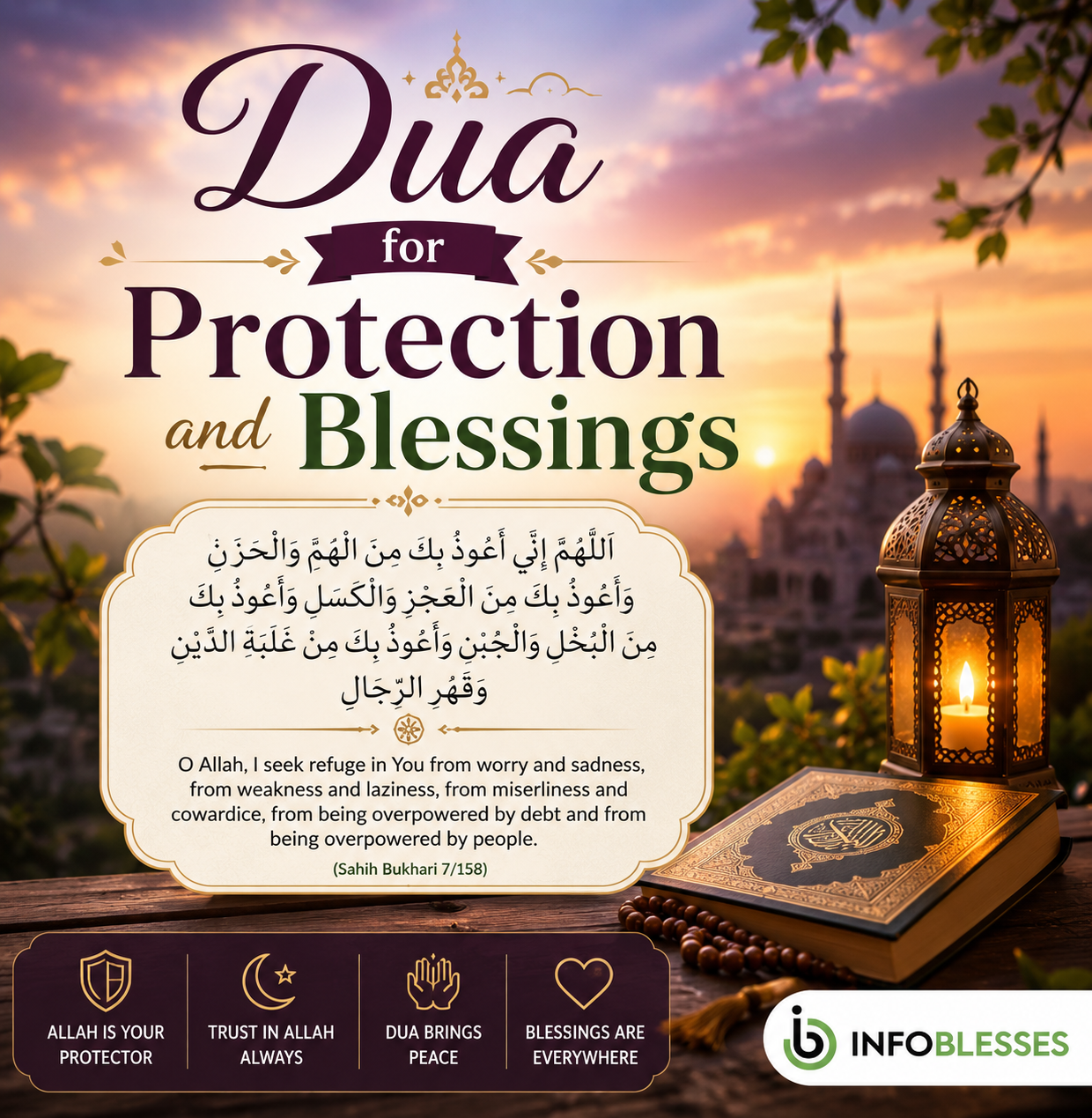
Life brings moments of happiness, uncertainty, fear, success, and difficulty. As Muslims, we know that Allah is the ultimate source of protection, mercy, guidance, and blessing. This is why making a sincere dua for protection and blessings is an important part of a believer’s daily life.
Dua isn’t only something we make when a problem appears. It can be part of our morning, evening, prayer, travel, work, family life, and bedtime routine. We ask Allah to protect us from harm while also asking Him to place barakah in our faith, health, family, wealth, knowledge, and time.
The Qur’an teaches believers to call upon Allah, and the Sunnah contains many authentic supplications for seeking refuge and goodness. A beautiful example is the instruction to seek refuge in Allah from the whisperings of Shaytan in Qur’an 23:97–98.
The power word for this article is Tawakkul, which means relying upon Allah while taking appropriate means. The number is 3, which provides a useful reminder of the three short surahs commonly recited together for protection: Al-Ikhlas, Al-Falaq, and An-Nas.
Most importantly, Muslims should avoid treating dua as a magical formula. Dua is an act of worship. We ask Allah sincerely, follow the Qur’an and Sunnah, take reasonable precautions, and trust His wisdom.
What Is a Dua for Protection and Blessings?

A dua for protection and blessings is a sincere supplication asking Allah for safety from harm and goodness in our lives. Protection may include safety from physical danger, temptation, sin, harmful influences, fear, and spiritual difficulties.
Blessings, or barakah, involve asking Allah to put lasting goodness into what He has already given us.
A Muslim can ask Allah for:
- Protection from evil and harm
- Protection from temptation and sin
- Guidance during difficult decisions
- Safety for family members
- Halal and blessed income
- Beneficial knowledge
- Good health and strength
- Peace within the home
- Forgiveness and mercy
- Strong faith
- A righteous ending
There is no need to use complicated words when making personal dua. Allah knows what is hidden in our hearts. We can learn authentic supplications from the Qur’an and Sunnah and also ask Allah personally for what is good.
One important point is worth remembering: not every dua found online is a hadith. Sometimes a beautiful sentence is simply a personal supplication. That’s perfectly fine, as long as we don’t falsely claim that the Prophet ﷺ specifically taught those exact words.
Why Should Muslims Ask Allah for Protection?

Allah is the ultimate Protector. Human beings can take sensible precautions, but we cannot control every event in life.
We lock our doors, take care while traveling, protect our finances, seek medical care when needed, and make responsible decisions. These actions don’t contradict tawakkul. Instead, they are part of taking appropriate means while relying upon Allah.
The Qur’an reminds believers that Allah is near and responds to those who call upon Him. This gives dua a special place in the life of a Muslim.
When you make a dua for protection and blessings, you are recognizing your dependence upon Allah. You’re saying, in effect, that you need His guidance, mercy, and protection.
This doesn’t mean that a believer will never experience difficulty. Prophets and righteous people also faced trials. Protection can take different forms. Allah may remove a hardship, give someone strength to face it, guide them away from a harmful choice, or reward them for patience.
Therefore, don’t measure the value of dua only by whether a problem disappears immediately.
Sometimes the blessing is the strength Allah places in your heart while you are going through the difficulty.
Ayat al-Kursi and Protection

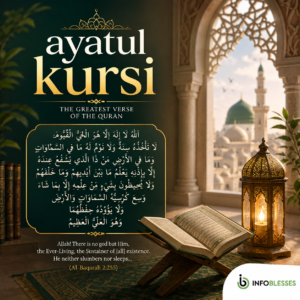
Ayat al-Kursi is Qur’an 2:255 and is one of the most well-known verses associated with remembrance and protection.
The verse describes Allah’s perfect life, knowledge, authority, and power. It states that neither slumber nor sleep overtakes Him and that His preservation of the heavens and earth does not tire Him.
You can read the verse directly on Quran.com — Surah Al-Baqarah 2:255.
The meaning of Ayat al-Kursi is especially powerful when a person feels afraid or uncertain. It reminds us that Allah’s knowledge is complete and that His power is greater than every difficulty.
Muslims commonly include Ayat al-Kursi in their remembrance, particularly before sleeping. Authentic hadith literature contains reports about its virtue and nighttime recitation.
However, the greatest benefit comes from understanding and believing in what the verse teaches. Don’t simply rush through the words. Reflect upon Allah’s greatness.
When you recite it, remember:
- Allah never becomes tired.
- Allah’s knowledge encompasses everything.
- Allah owns the heavens and earth.
- Allah’s authority is perfect.
- Allah’s preservation of creation does not burden Him.
This understanding can strengthen tawakkul and bring peace to the heart.
The Three Quls for Protection

The Three Quls are:
- Surah Al-Ikhlas
- Surah Al-Falaq
- Surah An-Nas
These short surahs carry powerful meanings.
Surah Al-Ikhlas teaches the absolute oneness and uniqueness of Allah. Surah Al-Falaq teaches us to seek refuge in the Lord of daybreak from different forms of created harm, including the harm of an envier when he envies. Surah An-Nas teaches us to seek refuge in the Lord, King, and God of humanity from harmful whispers.
The number 3 in this article refers to these three surahs and is not meant to suggest that the number itself has supernatural power.
The Sunnah provides guidance regarding reciting these surahs as part of regular remembrance. They are especially familiar in morning, evening, and bedtime practices.
A Muslim should learn their meanings rather than treating them as words to repeat without thought.
When you recite Al-Falaq, remember that Allah is the One whose protection you seek from harm.
When you recite An-Nas, remember that Allah knows the hidden whispers and thoughts that can disturb the heart.
And when you recite Al-Ikhlas, remember the foundation of Islamic belief: Allah is One and has no equal.
Morning and Evening Protection Through Adhkar

Morning and evening adhkar help Muslims begin and end the day with remembrance of Allah.
A simple morning routine can include:
- Fajr prayer
- Qur’an recitation
- Morning adhkar
- Recitation of the Three Quls
- Personal dua
- Asking Allah for guidance and protection
An evening routine can include:
- Maghrib or Isha prayer
- Evening adhkar
- Recitation of recommended Qur’anic passages
- Dua for yourself and your family
- Asking Allah for forgiveness
One well-known supplication reported in hadith begins:
“Bismillahil-ladhi la yadurru ma’asmihi shay’un fil-ardi wa la fis-sama’i wa huwas-Sami’ul-‘Alim.”
Its meaning is approximately:
“In the name of Allah, with whose name nothing on earth or in heaven can cause harm, and He is the All-Hearing, All-Knowing.”
When using specific adhkar, it is wise to learn their wording and recommended frequency from reliable hadith sources rather than changing them based on random social-media posts.
Consistency matters. A short authentic routine that you maintain every day is better than an enormous routine that you abandon after a few days.
Dua for Family Protection and Blessing
Family is one of Allah’s great blessings, so it’s natural to ask Him to protect our loved ones.
Parents can make dua for their children. Children can pray for their parents. Husbands and wives can ask Allah to strengthen their marriage and protect their homes from conflict and harmful influences.
You can ask Allah for:
- Strong faith for your family
- Protection from harmful influences
- Righteous children
- Good character
- Halal provision
- Peace in the home
- Protection during travel
- Forgiveness
- Beneficial knowledge
- Success in the Hereafter
The Qur’an includes beautiful supplications concerning righteous families. One well-known Qur’anic dua asks Allah to grant spouses and offspring who are a comfort to the eyes and to make the believers examples for those who are mindful of Him.
This shows us that Islamic family dua should not focus only on money or worldly achievement.
A parent might say:
“O Allah, protect my family, strengthen our faith, guide our hearts, keep us upon what pleases You, provide for us through halal means, and bless our home with peace and righteousness.”
This is a personal supplication. It shouldn’t be presented as a specific prophetic hadith.
Asking Allah for Barakah and Blessings

Protection is only part of what we should ask Allah for. We should also seek barakah.
Barakah means blessing and lasting goodness from Allah. It isn’t necessarily the same thing as having more.
For example, a person might have a modest income but find that it meets their needs and allows them to help others. Another person might earn much more but experience constant stress and dissatisfaction.
Therefore, asking Allah for barakah is a meaningful part of a dua for protection and blessings.
Ask Allah to place barakah in:
| Area | Dua for Blessing |
|---|---|
| Faith | Sincerity and stronger iman |
| Family | Love, peace, and righteousness |
| Wealth | Halal income and contentment |
| Work | Honest and beneficial success |
| Time | Productive and meaningful use |
| Knowledge | Understanding and beneficial learning |
| Health | Strength and well-being |
| Home | Peace and remembrance |
| Children | Guidance and good character |
A beautiful personal dua could be:
“O Allah, place barakah in my faith, family, health, work, time, knowledge, and provision. Make what You have given me beneficial and help me use it in ways that please You.”
Again, this is a personal supplication rather than a claim that these exact words are a prophetic narration.
Protection From Fear, Anxiety, and Difficulties

Every person experiences fear and worry. A Muslim isn’t expected to be emotionless. Islam teaches us how to respond to difficult emotions by turning toward Allah while also taking practical steps.
The Qur’an contains supplications for seeking refuge from the whispers of Shaytan. One such prayer appears in Qur’an 23:97–98:
“My Lord, I seek refuge in You from the whisperings of the devils. And I seek refuge in You, my Lord, lest they come near me.”
This dua reminds us that when disturbing thoughts or spiritual temptations arise, we can seek Allah’s protection.
A believer can also make personal dua:
“O Allah, bring peace to my heart, give me patience during hardship, guide me toward what is good, and protect me from choices that will harm my faith and my life.”
Alongside dua, practical help matters. If someone is facing serious emotional, financial, family, or health problems, they can seek appropriate support from trustworthy and qualified people.
Tawakkul isn’t ignoring problems.
Tawakkul means facing them while knowing that Allah is greater than them.
Protection From Envy and Harm

Surah Al-Falaq specifically teaches believers to seek refuge in Allah from different forms of harm, including the harm associated with an envier when he envies.
This doesn’t mean Muslims should become suspicious of everyone around them.
A healthy Islamic approach is to seek Allah’s protection without falling into constant fear or accusations.
You can strengthen your daily spiritual routine by:
- Maintaining the five daily prayers
- Reciting Qur’an
- Learning authentic adhkar
- Making sincere dua
- Avoiding superstition
- Keeping good company
- Practicing gratitude
- Taking sensible precautions
- Trusting Allah
Don’t automatically blame every problem on the evil eye, envy, magic, or an unseen cause. Sometimes a problem has an ordinary explanation.
Islam teaches believers to seek refuge in Allah while remaining balanced and responsible.
Nighttime Dua and Protection

Night is a beautiful opportunity for remembrance and reflection.
Before sleeping, Muslims can establish a simple Sunnah-based routine. This may include reciting Ayat al-Kursi, the Three Quls, and other established bedtime adhkar.
The Prophet ﷺ also taught the virtue of the final two verses of Surah Al-Baqarah at night. A hadith in Sahih al-Bukhari reports that whoever recites them at night, they are sufficient for him.
The goal is not to become anxious about missing a particular practice. Instead, build a peaceful habit of remembering Allah before sleep.
A simple routine could be:
- Complete Isha prayer.
- Make sincere repentance.
- Recite established bedtime adhkar.
- Recite Ayat al-Kursi.
- Recite the Three Quls.
- Recite the final two verses of Al-Baqarah.
- Make personal dua.
- Sleep with trust in Allah.
Nighttime worship can turn the final moments of the day into an opportunity for gratitude and spiritual renewal.
How to Make a Dua for Protection and Blessings

Making dua doesn’t require complicated language. Sincerity is more important than impressive vocabulary.
You can follow several helpful principles.
1. Praise Allah
Begin by recognizing Allah’s greatness, mercy, and power.
2. Send Blessings Upon the Prophet ﷺ
Sending salawat upon the Prophet ﷺ is part of the etiquette of dua.
3. Ask Clearly
Tell Allah what you need. Ask for protection, guidance, forgiveness, health, halal provision, and blessings.
4. Ask for What Is Good
Don’t ask for something sinful or harmful. Ask Allah to choose what is best for you.
5. Have Hope
Don’t assume that a delayed answer means Allah has ignored you.
6. Be Patient
A believer continues making dua while trusting Allah’s wisdom.
7. Take Appropriate Action
If you ask Allah for success in work, work honestly. If you ask for protection while traveling, take reasonable safety measures.
Dua and action belong together.
Common Mistakes When Searching for Protection Duas

The internet contains thousands of Islamic quotes, duas, images, and videos. Some are reliable, while others contain weak or unsupported claims.
Here are common mistakes to avoid.
Mistake 1: Believing numbers are magical
A number doesn’t have supernatural power simply because it appears repeatedly online. Follow specific numbers only when supported by reliable Islamic evidence.
Mistake 2: Calling every dua a hadith
A personal dua can be beautiful without being a prophetic narration. Don’t attribute words to the Prophet ﷺ without evidence.
Mistake 3: Ignoring practical action
Tawakkul doesn’t mean refusing to take reasonable precautions.
Mistake 4: Becoming obsessed with unseen harm
Protection should strengthen faith, not create constant fear.
Mistake 5: Using unreliable sources
When possible, check Qur’anic verses and hadith through reliable Islamic references.
For Qur’anic study, Quran.com provides searchable Qur’an text and translations.
For hadith research, it’s also useful to check established collections and consult qualified scholars when a religious issue is complicated.
A Simple Daily Protection and Blessings Routine

You don’t need a complicated routine to begin.
Morning
After Fajr:
- Thank Allah for a new day.
- Read morning adhkar.
- Recite the Three Quls according to the established practice.
- Ask Allah for protection and guidance.
- Ask for halal provision and barakah.
During the Day
Before important tasks:
- Say Bismillah.
- Make a short personal dua.
- Work honestly.
- Avoid sinful choices.
- Remember Allah throughout the day.
Evening
After the day’s activities:
- Perform evening adhkar.
- Ask Allah to forgive mistakes.
- Make dua for your family.
- Thank Allah for His blessings.
Before Sleep
- Complete your prayers.
- Recite established bedtime adhkar.
- Recite Ayat al-Kursi.
- Recite the Three Quls.
- Recite the final two verses of Surah Al-Baqarah.
- Make personal dua.
- Sleep while trusting Allah.
The key is consistency.
A small routine that you maintain every day can become a meaningful part of your relationship with Allah.
Frequently Asked Questions About Dua for Protection and Blessings
What is the best dua for protection?
There isn’t one single supplication that should automatically be called the best for every situation. The Qur’an and authentic Sunnah contain several powerful forms of seeking refuge in Allah, including Ayat al-Kursi, the Three Quls, and established morning and evening adhkar.
Can I make dua in my own language?
Yes. Personal supplication can be made in a language you understand, especially outside the formal prayer. Understanding your request can help increase sincerity and focus.
How many times should I repeat a protection dua?
Follow the number established for a particular authentic supplication when there is reliable evidence. Don’t assume that repeating any dua a certain number of times guarantees a specific result.
What is the power word in this article?
The power word is Tawakkul. It means relying upon Allah while taking appropriate means. Tawakkul combines faith with responsible action.
What is the number in this article?
The number is 3, used as a reminder of the Three Quls: Al-Ikhlas, Al-Falaq, and An-Nas. The number itself has no independent supernatural power.
Can I make dua for my parents and children?
Yes. Muslims can ask Allah to protect, guide, forgive, and bless their parents, children, spouses, relatives, and other believers.
Is Ayat al-Kursi a dua?
Ayat al-Kursi is a Qur’anic verse from Surah Al-Baqarah 2:255. It is not simply a personal dua, but Muslims recite it as part of Qur’an recitation and remembrance, and authentic reports establish virtues connected with its recitation.
What are the Three Quls?
The Three Quls commonly refer to Surah Al-Ikhlas, Surah Al-Falaq, and Surah An-Nas. They are short Qur’anic surahs that are widely included in Islamic remembrance and protection practices.
Can dua protect me from every hardship?
A believer should ask Allah for protection while understanding that life includes tests. Protection doesn’t necessarily mean never experiencing hardship. Allah may protect a person by removing difficulty, giving them patience, guiding them toward good, or rewarding them for perseverance.
Should I take practical precautions if I trust Allah?
Absolutely. Tawakkul doesn’t mean abandoning sensible action. A Muslim can lock their home, travel safely, seek medical care, manage finances responsibly, and take other reasonable precautions while relying upon Allah.
What blessings should I ask Allah for?
Ask for strong iman, forgiveness, beneficial knowledge, righteous family, halal provision, good health, useful work, good character, peace, barakah, and success in the Hereafter.
Conclusion:
A sincere dua for protection and blessings can bring a believer closer to Allah and help build a life centered on faith, gratitude, and trust.
The central lesson is Tawakkul: rely upon Allah while taking appropriate action. Ask Him for protection from harm, guidance during uncertainty, forgiveness for mistakes, and barakah in every good part of your life.
Remember the number 3 as a simple reminder of the Three Quls: Al-Ikhlas, Al-Falaq, and An-Nas. Learn their meanings, recite them according to the Sunnah, and allow their message to strengthen your heart.
Most importantly, don’t treat dua as magic. Dua is worship. It is a conversation of humility, hope, dependence, and trust between the servant and Allah.
May Allah protect us and our families from harm, strengthen our iman, forgive our sins, grant us halal and blessed provision, put barakah in our time and homes, guide our hearts toward righteousness, and grant us goodness in this world and the Hereafter.
Ameen.