Introduction to the Namaz Rakat Chart
Namaz, also known as Salah, is one of the five pillars of Islam. Muslims perform five obligatory prayers every day to maintain their connection with Allah, seek forgiveness, and develop discipline in their daily lives.
Understanding the correct number of rakats in each prayer is important for every Muslim. Whether you’re a beginner or someone who has been praying for years, a reliable Namaz Rakat Chart makes it easier to remember the structure of daily Salah.
Each of the five obligatory prayers has a specific number of Fard rakats. In addition, Muslims may perform Sunnah, Nafl, and Witr prayers to increase their worship.
This guide explains the daily prayer schedule, the different types of rakats, and the basic structure of Salah in simple English.
1. What Is a Rakat in Namaz?
A rakat is one complete unit of Islamic prayer. Every rakat includes specific actions and recitations performed in a particular order.
A standard rakat consists of:
- Qiyam: Standing while reciting Surah Al-Fatihah and additional Quranic verses where required.
- Ruku: Bowing before Allah.
- Qawmah: Standing upright after bowing.
- Sajdah: Prostrating twice with the forehead and nose touching the ground.
- Jalsa: Sitting briefly between the two prostrations.
After completing these movements, the worshipper either stands for another rakat or sits for the concluding portion of the prayer.
Why Is Understanding Rakats Important?
Knowing the number of rakats helps Muslims:
- Perform their daily prayers correctly.
- Avoid confusion during Salah.
- Teach children the basics of Islamic worship.
- Understand the difference between obligatory and optional prayers.
- Develop consistency in their daily religious routine.
A clear understanding of rakats makes learning Salah much easier.
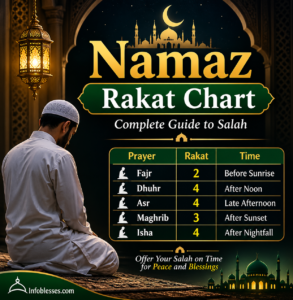
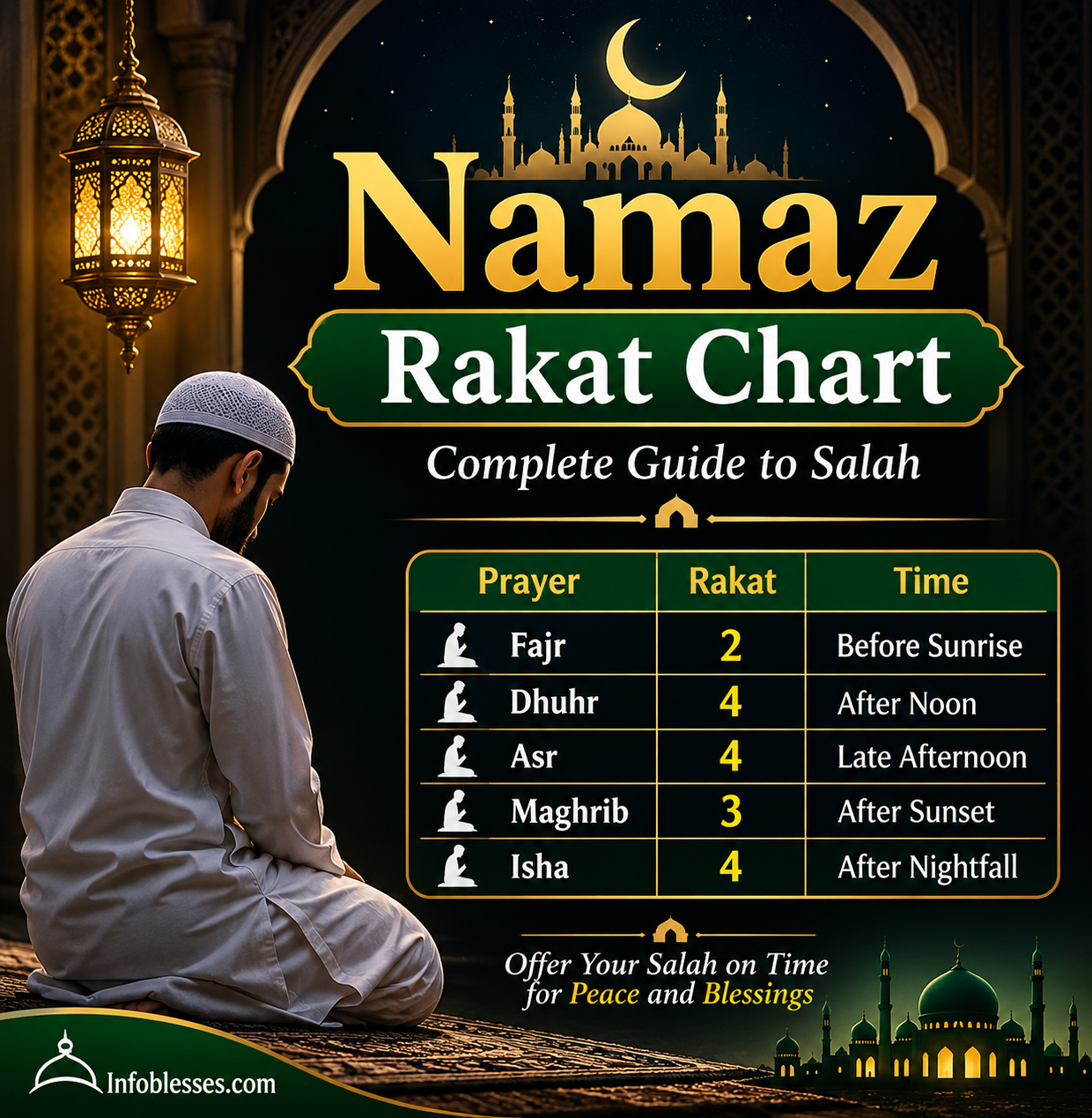
2. Complete Namaz Rakat Chart for Five Daily Prayers
The following table provides a commonly taught Hanafi arrangement of daily prayers, including Sunnah, Fard, and Witr rakats.
Daily Namaz Rakat Chart
| Daily Prayer | Sunnah Before | Fard | Sunnah After | Witr | Nafl |
|---|---|---|---|---|---|
| Fajr | 2 | 2 | — | — | — |
| Dhuhr | 4 | 4 | 2 | — | 2 optional |
| Asr | 4 optional | 4 | — | — | — |
| Maghrib | — | 3 | 2 | — | 2 optional |
| Isha | 4 optional | 4 | 2 | 3 | 2 optional |
Important: This is a commonly taught Hanafi arrangement, not a universal chart for every Islamic school of jurisprudence. The classification and recommended number of optional prayers can differ between schools.
Total Daily Rakats
Using the arrangement above:
| Category | Number of Rakats |
|---|---|
| Fard | 17 |
| Sunnah Muakkadah | 12 |
| Witr | 3 |
| Sunnah Ghair Muakkadah | 8 |
| Optional Nafl shown | 6 |
| Total | 46 |
The 46-rakat total includes the optional prayers listed in this table. It isn’t the number of obligatory rakats.
The most important number to remember is 17 Fard rakats daily.
3. Fajr Prayer: 4 Rakats
Fajr is the first of the five daily prayers. It is performed before sunrise and offers Muslims an opportunity to begin their day with remembrance of Allah.
The Fajr prayer consists of four commonly taught rakats:
- 2 Sunnah Muakkadah
- 2 Fard
Importance of Fajr Sunnah
The two Sunnah rakats before Fajr are highly emphasized in Islamic teachings.
The Prophet Muhammad (peace be upon him) strongly encouraged Muslims to observe these two rakats.
How to Perform Fajr
- Make the intention for Fajr prayer.
- Perform two Sunnah rakats.
- Complete the prayer with Tashahhud and Salam.
- Stand again and perform two Fard rakats.
- Finish with Salam.
Fajr is a beautiful way to establish a peaceful and spiritually focused beginning to the day.
4. Dhuhr Prayer: 12 or More Rakats
Dhuhr is the midday prayer performed after the sun passes its highest point.
In the commonly taught Hanafi arrangement, the regular structure is:
- 4 Sunnah Muakkadah before Fard
- 4 Fard
- 2 Sunnah Muakkadah after Fard
- 2 optional Nafl
This gives a total of 12 rakats when the two optional Nafl rakats are included.
Importance of Dhuhr Prayer
Dhuhr reminds Muslims to pause their daily responsibilities and remember Allah.
Whether you’re working, studying, or managing household activities, taking time for Salah helps create balance between worldly responsibilities and spiritual duties.
Dhuhr Prayer Sequence
| Order | Type | Rakats |
|---|---|---|
| 1 | Sunnah Muakkadah | 4 |
| 2 | Fard | 4 |
| 3 | Sunnah Muakkadah | 2 |
| 4 | Nafl | 2 |
| Total | 12 |
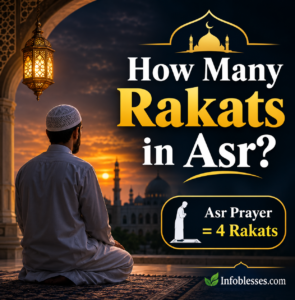
5. Asr Prayer: 8 Rakats in the Common Optional Arrangement
Asr is the afternoon prayer. It is performed before sunset.
The commonly taught Hanafi arrangement includes:
- 4 Sunnah Ghair Muakkadah before Fard
- 4 Fard
The four Sunnah rakats before Asr are optional and less strongly emphasized than the regular Sunnah prayers associated with Fajr and Dhuhr.
Importance of Asr
Asr is especially important because it falls during a busy part of the day.
Many people are occupied with work, business, school, or family responsibilities at this time. Nevertheless, Muslims are encouraged to protect their prayer times.
Asr Prayer Chart
| Type | Rakats |
|---|---|
| Sunnah Ghair Muakkadah | 4 |
| Fard | 4 |
| Total | 8 |
Remember that only the four Fard rakats are obligatory.
6. Maghrib Prayer: 7 Rakats in the Common Arrangement
Maghrib is performed immediately after sunset.
It consists of:
- 3 Fard
- 2 Sunnah Muakkadah
- 2 optional Nafl
How to Perform Maghrib
- Perform three Fard rakats.
- Complete the obligatory prayer with Salam.
- Perform two Sunnah Muakkadah rakats.
- If desired, perform two additional Nafl rakats.
Why Is Maghrib Different?
Unlike the other four obligatory daily prayers, Maghrib has three Fard rakats.
In the third rakat of Maghrib, the worshipper recites Surah Al-Fatihah and completes the prayer according to the established rules of Salah.
The relatively short period between sunset and the disappearance of twilight makes it important to perform Maghrib on time.
7. Isha Prayer: 17 Rakats in the Common Arrangement
Isha is the final obligatory prayer of the day. It is performed after night begins.
In the commonly taught Hanafi arrangement, the prayer includes:
- 4 Sunnah Ghair Muakkadah before Fard
- 4 Fard
- 2 Sunnah Muakkadah after Fard
- 2 optional Nafl
- 3 Witr
- 2 optional Nafl after Witr
This arrangement totals 17 rakats.
What Is Witr Prayer?
Witr is an important prayer performed after Isha. In Hanafi jurisprudence, Witr is considered Wajib.
It consists of three rakats and includes the recitation of Dua Qunoot in the third rakat.
Other Islamic schools generally classify Witr as a highly emphasized Sunnah and may teach different ways of performing it.
Isha Prayer Chart
| Type | Rakats |
|---|---|
| Sunnah Ghair Muakkadah | 4 |
| Fard | 4 |
| Sunnah Muakkadah | 2 |
| Nafl | 2 |
| Witr | 3 |
| Nafl | 2 |
| Total | 17 |
8. Different Types of Rakats in Islam
Understanding the different categories of prayer is essential for using a Namaz Rakat Chart correctly.
There are four commonly discussed categories: Fard, Sunnah, Witr, and Nafl.
8.1 Fard Rakats
Fard prayers are obligatory.
Every adult Muslim who meets the relevant religious conditions must perform the five daily obligatory prayers.
The daily Fard rakats are:
- Fajr: 2
- Dhuhr: 4
- Asr: 4
- Maghrib: 3
- Isha: 4
Total: 17 Fard rakats.
Deliberately neglecting obligatory prayers is a serious matter in Islam.
8.2 Sunnah Muakkadah
Sunnah Muakkadah refers to highly emphasized practices of the Prophet Muhammad (peace be upon him).
Muslims are strongly encouraged to perform these prayers regularly.
Examples include:
- 2 before Fajr
- 4 before Dhuhr
- 2 after Dhuhr
- 2 after Maghrib
- 2 after Isha
These are commonly counted as 12 daily Sunnah Muakkadah rakats in the Hanafi arrangement.
8.3 Sunnah Ghair Muakkadah
These are Sunnah prayers that are recommended but not emphasized to the same degree.
Examples include:
- 4 before Asr
- 4 before Isha
Performing these prayers can increase one’s voluntary worship.
8.4 Witr Prayer
Witr is performed after Isha.
In Hanafi jurisprudence, it consists of three rakats and is Wajib. Other schools have different classifications and methods.
8.5 Nafl Prayer
Nafl prayers are voluntary acts of worship.
They allow Muslims to perform additional prayers beyond the obligatory and emphasized Sunnah prayers.
Examples include:
- Additional prayers after Dhuhr.
- Additional prayers after Maghrib.
- Additional prayers after Isha.
- Tahajjud during the night.
- Duha prayer during the morning.
Nafl prayers are a valuable way to strengthen one’s relationship with Allah.
9. How to Perform Namaz Step by Step
Learning the number of rakats is only one part of understanding Salah. It’s also important to know the basic prayer sequence.
Step 1: Perform Wudu
Wudu is the Islamic purification performed before prayer.
It includes washing the face, arms, wiping the head, and washing the feet according to the prescribed method.
Step 2: Face the Qiblah
Stand facing the direction of the Kaaba in Makkah.
Step 3: Make the Intention
Make the intention in your heart for the specific prayer you’re performing.
Step 4: Begin with Takbeer
Raise your hands as prescribed and say:
Allahu Akbar.
Step 5: Recite Quranic Verses
While standing, recite Surah Al-Fatihah and the additional Quranic recitation where required.
Step 6: Perform Ruku
Bow and glorify Allah.
Step 7: Perform Two Sajdahs
After returning to the standing position, perform two prostrations with a brief sitting between them.
Step 8: Complete the Required Rakats
Repeat the prayer movements until you’ve completed the required number of rakats.
Step 9: Finish the Prayer
Sit for Tashahhud and complete the prayer with Salam according to the prayer’s structure.
For a complete practical lesson, learn the recitations and detailed movements from a qualified Islamic teacher.
10. Common Mistakes to Avoid When Counting Rakats
Even regular worshippers sometimes become confused about prayer arrangements.
Here are some common mistakes to avoid.
Confusing Fard and Sunnah
Remember that Fard prayers are obligatory, whereas Sunnah prayers have a different religious classification.
Don’t assume that all rakats in a daily prayer schedule have the same status.
Forgetting Witr
Witr is an important part of the Isha prayer routine, particularly in Hanafi jurisprudence.
Rushing Through Salah
Prayer should be performed calmly and with proper composure.
Rushing through Ruku or Sajdah can affect the correctness of Salah.
Ignoring Prayer Times
Each obligatory prayer has its prescribed time.
Use a reliable local prayer timetable to avoid missing Salah.
Following Different Methods Without Understanding Them
Islamic schools of jurisprudence may differ in certain prayer details.
Learn the method taught by a qualified scholar or reliable Islamic institution.
11. Importance of Performing Five Daily Prayers
Salah is more than a daily religious obligation. It is an important source of spiritual development and personal discipline.
Strengthens the Relationship with Allah
Regular prayer reminds Muslims that Allah is always worthy of worship, gratitude, and remembrance.
Develops Discipline
The five daily prayers encourage people to organize their time around meaningful spiritual commitments.
Provides Spiritual Comfort
Salah offers an opportunity to pause, reflect, seek forgiveness, and turn to Allah during difficult moments.
Encourages Good Character
Prayer reminds Muslims of their responsibility to behave honestly, show kindness, and avoid wrongdoing.
Creates a Daily Routine
The five prayer times provide a natural structure for the day:
- Morning: Fajr
- Midday: Dhuhr
- Afternoon: Asr
- Sunset: Maghrib
- Night: Isha
This regular pattern encourages consistency in worship.
12. Easy Tips to Memorize the Namaz Rakat Chart
If you’re new to Salah, remembering all the rakats may seem difficult at first. However, a few simple learning techniques can make the process easier.
Memorize the 17 Fard Rakats First
Start with the obligatory prayers:
| Prayer | Fard |
|---|---|
| Fajr | 2 |
| Dhuhr | 4 |
| Asr | 4 |
| Maghrib | 3 |
| Isha | 4 |
Once you remember these numbers, learn the Sunnah and Witr arrangements.
Use a Printed Prayer Chart
Keep a Namaz Rakat Chart somewhere visible, such as near your prayer area.
Review it daily until the numbers become familiar.
Practice One Prayer at a Time
Instead of learning everything in one day, focus on one prayer.
For example:
- Day 1: Fajr
- Day 2: Dhuhr
- Day 3: Asr
- Day 4: Maghrib
- Day 5: Isha
Teach Children Through Repetition
Children often learn best through simple explanations and regular practice.
Use a colorful prayer chart and explain the difference between obligatory and optional rakats.
13. Islamic Resources for Learning Salah
Learning from reliable Islamic sources helps ensure that your understanding of prayer is accurate.
Useful resources include:
- The Quran, particularly its teachings about establishing Salah.
- Authentic Hadith collections.
- Recognized Islamic educational institutions.
- Qualified local scholars and teachers.
For further reading, visit the Quran.com website, where you can explore Quranic verses and translations.
You can also consult a qualified scholar regarding differences between Hanafi, Shafi’i, Maliki, and Hanbali prayer practices.
Frequently Asked Questions About the Namaz Rakat Chart
1. How many Fard rakats are there in five daily prayers?
There are 17 obligatory Fard rakats in the five daily prayers:
- Fajr: 2
- Dhuhr: 4
- Asr: 4
- Maghrib: 3
- Isha: 4
2. How many total rakats are there in daily Namaz?
The total depends on which Sunnah and Nafl prayers are included.
In the commonly taught Hanafi arrangement in this article, the full listed schedule contains 46 rakats, including optional prayers.
The obligatory portion is always 17 Fard rakats.
3. How many rakats are in Fajr Namaz?
Fajr consists of four commonly taught rakats: two Sunnah Muakkadah followed by two Fard rakats.
4. How many rakats are in Dhuhr Namaz?
The commonly taught arrangement includes four Sunnah before Fard, four Fard, two Sunnah after Fard, and two optional Nafl rakats.
5. How many rakats are in Asr Namaz?
Asr consists of four obligatory Fard rakats. Four additional Sunnah Ghair Muakkadah rakats are commonly recommended before them in the Hanafi tradition.
6. How many rakats are in Maghrib Namaz?
Maghrib consists of three Fard rakats, followed by two Sunnah Muakkadah rakats. Two additional Nafl rakats may also be performed.
7. How many rakats are in Isha Namaz?
The commonly taught Hanafi arrangement includes 17 rakats when the Sunnah, Fard, Witr, and optional Nafl prayers listed in this article are included.
8. Is Witr prayer compulsory?
The classification differs among Islamic schools. Hanafi scholars consider Witr Wajib, while other schools generally consider it a highly emphasized Sunnah.
9. Can I perform only the 17 Fard rakats?
The five obligatory prayers consist of 17 Fard rakats. However, Muslims are strongly encouraged to observe the emphasized Sunnah prayers as well.
10. What is the easiest way to remember daily Namaz rakats?
Start by memorizing the 17 Fard rakats. Then gradually learn the Sunnah and Witr prayers using a daily prayer chart.
Conclusion:
Understanding the daily Namaz Rakat Chart is an important step toward performing Salah with confidence and consistency.
The five obligatory prayers contain 17 Fard rakats in total:
- Fajr: 2
- Dhuhr: 4
- Asr: 4
- Maghrib: 3
- Isha: 4
In addition to these obligatory prayers, Sunnah, Witr, and Nafl prayers provide opportunities for additional worship.
Remember that the exact recommended arrangement can vary according to Islamic jurisprudence. The chart in this article follows a commonly taught Hanafi arrangement.
Most importantly, don’t focus only on counting rakats. Learn the correct movements, understand the recitations, and perform your prayers with sincerity and devotion.
May Allah guide us all toward consistent Salah and accept our prayers. Ameen.

Welcome to Info Blesses I am Rana Ahtasham an AI Powered SEO and Content Writer With 3 year experience.I help websites rank highter, grow traffic, and look amazing. My goal is to make SEO and web design simple and effective for everyone.Lets achieve more togather!