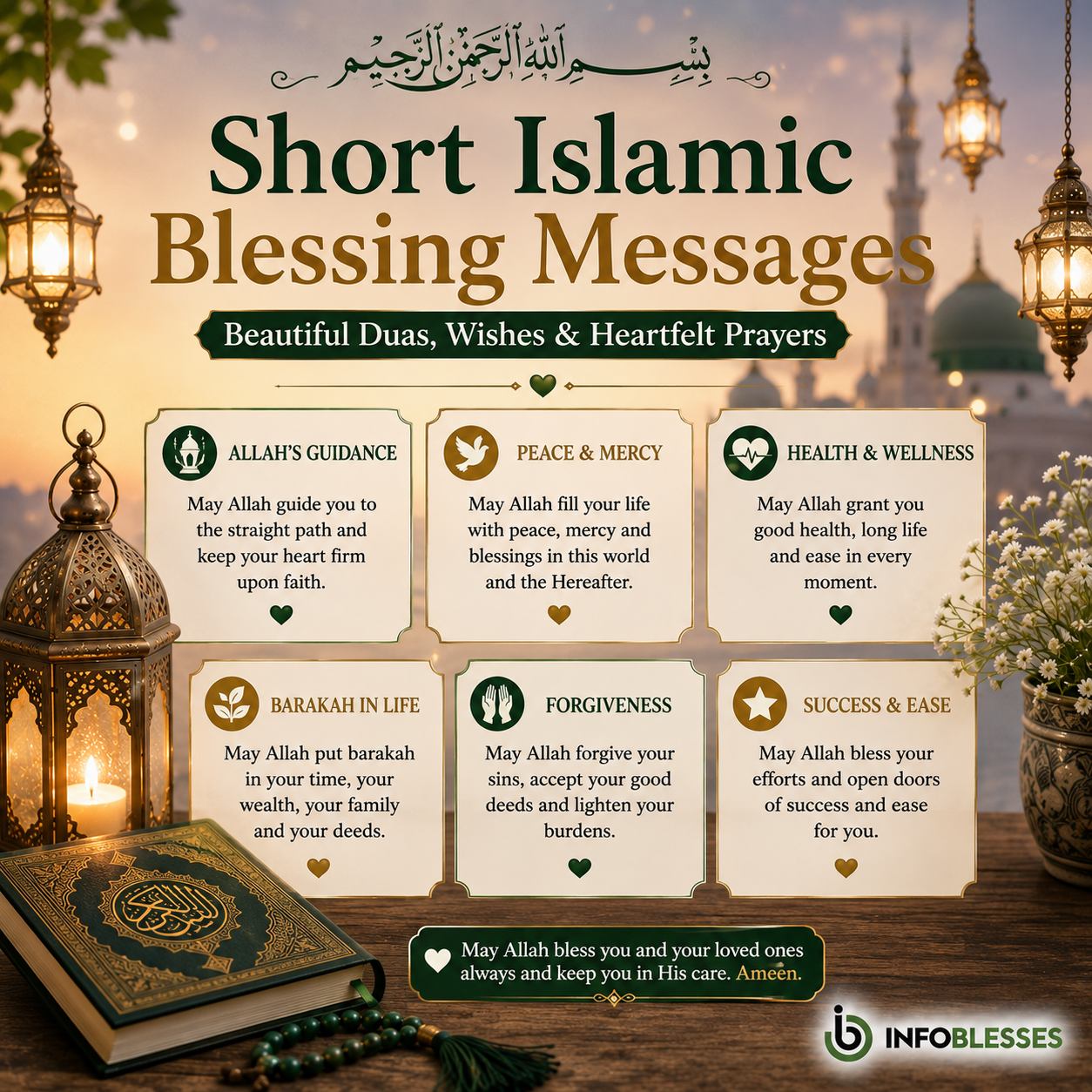
In Islam, words have the power to comfort a heart, strengthen faith, encourage patience, and remind a person of Allah’s mercy. A simple blessing message can become much more than a kind sentence when it carries a sincere dua. Whether you are sending a message to a family member, friend, colleague, student, or someone going through a difficult time, Short Islamic Blessing Messages can express love, hope, faith, and good wishes in only a few meaningful words.
Islam teaches Muslims to turn to Allah in every situation. Happiness is an opportunity to be grateful, difficulty is a reason to seek patience and help, and uncertainty is a reminder to place trust in Allah. The Qur’an repeatedly encourages believers to remember Allah, ask Him for mercy, and remain hopeful. For example, Allah says that with hardship comes ease, reminding believers that difficulties are never outside His knowledge and wisdom.
Beautiful Islamic messages do not need to be complicated. A sincere “May Allah bless you,” “May Allah grant you peace,” or “May Allah guide your heart” can carry deep meaning when it comes from genuine concern. The most beautiful messages are those that encourage people toward faith while offering emotional support.
This article brings together meaningful Islamic blessing messages, heartfelt duas, messages for different occasions, and reflections on how these short words can strengthen relationships and inspire hope.
What Are Islamic Blessing Messages?

Islamic blessing messages are short expressions of goodwill that contain a dua, reminder, encouragement, or prayer for another person. They can be shared through text messages, social media posts, greeting cards, emails, or personal conversations.
Unlike ordinary greetings, Islamic blessings often direct the heart toward Allah. Instead of simply wishing someone success, for example, you might say, “May Allah bless your efforts and grant you success that brings goodness into your life.”
These messages can mention blessings such as:
- Allah’s guidance
- Peace of heart
- Good health
- Halal provision
- Family happiness
- Forgiveness
- Protection
- Patience
- Knowledge
- Success
- Barakah
- Mercy
- Strong faith
- Ease during hardship
A blessing message is most meaningful when it is sincere. Islam places great value on intention, kindness, and remembering Allah. A few words written with genuine love can sometimes comfort someone more than a long conversation.
Islamic blessing messages are also a beautiful way to maintain relationships. When you send a dua to someone, you are not only communicating affection; you are also expressing hope that Allah grants them what is good.
Why Short Islamic Blessing Messages Matter

Modern communication is often fast. People send short texts, status updates, comments, and social media messages every day. Because of this, a short Islamic blessing can be a simple way to bring faith into ordinary communication.
A thoughtful message can remind someone that they are remembered and cared for. Someone facing an examination may need encouragement. Someone beginning a new job may appreciate a prayer for success. Someone experiencing sadness may need a reminder that Allah’s mercy is near.
The Qur’an gives believers powerful reassurance during difficult moments. Surah Ash-Sharh states, “So, surely with hardship comes ease.”
This message of hope can inspire the way Muslims communicate with one another. Rather than allowing someone to feel alone in difficulty, a short dua can remind them to remain patient and trust Allah.
Similarly, Surah Al-Baqarah 2:286 includes the powerful reminder that Allah does not charge a soul beyond its capacity and concludes with prayers for pardon, forgiveness, mercy, and help.
Therefore, a short blessing message can carry a profound spiritual reminder:
“May Allah give you strength for today, patience for tomorrow, and ease after every hardship. Ameen.”
The message is short, but its meaning can remain in someone’s heart for a long time.
Beautiful Short Islamic Blessing Messages

Here are some original short Islamic blessing messages that can be shared with loved ones:
- May Allah fill your heart with iman, your home with peace, and your life with barakah. Ameen.
- May Allah guide you toward everything that is good and protect you from everything that harms your faith.
- May Allah bless every step you take and make your journey toward goodness easy.
- May Allah grant you a peaceful heart, a grateful soul, and a life filled with halal blessings.
- May Allah open doors of mercy, guidance, and success for you wherever you go.
- May Allah protect you, strengthen your faith, and keep your heart connected to Him.
- May Allah turn your worries into peace, your difficulties into strength, and your hopes into beautiful outcomes.
- May Allah bless your family with love, unity, good health, and lasting happiness.
- May Allah accept your duas, forgive your shortcomings, and increase you in goodness.
- May Allah place barakah in your time, work, health, relationships, and daily life.
- May Allah guide your heart whenever you feel lost and give you light whenever the path seems unclear.
- May Allah make today better than yesterday and tomorrow better than today.
- May Allah grant you success in this world and eternal goodness in the Hereafter.
- May Allah protect your heart from sadness and replace every hardship with something better.
- May Allah give you sabr during difficult days and shukr during beautiful ones.
- May Allah keep you under His mercy and surround you with people who remind you of Him.
- May Allah bless your dreams when they are good for you and guide you toward what is best.
- May Allah grant you strength when you are tired and hope when you feel discouraged.
- May Allah make your heart content with His decree and grateful for His blessings.
- May Allah always be your source of guidance, comfort, protection, and hope.
These messages can be personalized according to the person and occasion. A blessing for a student may focus on knowledge and success, while a message for someone experiencing hardship may focus on patience, mercy, and ease.
Short Islamic Duas for Peace, Guidance & Protection

One of the most beautiful purposes of an Islamic blessing is to ask Allah for peace and protection. Life can become overwhelming because of responsibilities, uncertainty, family concerns, financial pressure, studies, work, or personal challenges.
A simple dua can help redirect the heart toward Allah.
Here are some short messages:
For peace:
“May Allah place tranquility in your heart and remove every worry that keeps you awake at night.”
For guidance:
“May Allah guide you toward the straight path and give you wisdom in every decision.”
For protection:
“May Allah protect you and your loved ones from harm, hardship, and anything that threatens your peace.”
For strength:
“May Allah strengthen your heart when life becomes difficult and increase you in patience.”
For forgiveness:
“May Allah forgive your mistakes, accept your repentance, and cover you with His mercy.”
For a worried heart:
“May Allah replace your anxiety with peace and your uncertainty with trust in Him.”
For difficult circumstances:
“May Allah make your difficult situation easier and open a door that you never expected.”
These messages should not be understood as guarantees that a particular worldly outcome will happen. Rather, they are expressions of sincere dua and hope in Allah. A Muslim asks Allah for what is good while trusting His wisdom and decree.
The final verses of Surah Al-Baqarah contain a beautiful collection of prayers asking Allah for forgiveness, mercy, and help.
Islamic Blessing Messages for Family & Loved Ones

Family relationships are among the most valuable blessings in life. Parents, children, siblings, spouses, and relatives can support one another through both happiness and hardship.
Sending a short Islamic blessing to a family member is a simple way to express love while remembering Allah.
For Parents
“May Allah reward you for every sacrifice you have made and bless you with health, peace, mercy, and happiness.”
For Children
“May Allah protect you, guide you, increase you in beneficial knowledge, and make you a source of goodness.”
For a Brother
“May Allah bless your path, strengthen your iman, protect you from harm, and grant you success in everything good.”
For a Sister
“May Allah fill your life with happiness, modesty, faith, peace, and countless blessings.”
For a Husband
“May Allah bless our marriage with mercy, understanding, love, patience, and barakah.”
For a Wife
“May Allah reward you for your kindness, bless your heart with peace, and place lasting barakah in our home.”
For the Whole Family
“May Allah keep our family united in faith, protect us from hardship, forgive our shortcomings, and fill our home with peace.”
The most meaningful family messages are not necessarily the longest. A few sincere words can remind family members that they are valued and remembered in dua.
Islamic Blessing Messages for Success, Work & Studies

Students, professionals, business owners, and anyone working toward a goal often need encouragement. Islam encourages believers to make effort while relying upon Allah.
A blessing message can combine motivation with dua:
“May Allah increase you in beneficial knowledge and make your studies easy and successful.”
“May Allah bless your efforts and grant you success in ways that are good for your dunya and Akhirah.”
“May Allah give you focus, wisdom, patience, and confidence throughout your journey.”
“May Allah put barakah in your work and make your efforts beneficial to yourself and others.”
“May Allah open doors of halal opportunities and protect you from choices that would harm your faith.”
“May Allah reward your hard work and guide you toward opportunities that bring goodness and peace.”
Islamic encouragement should not promote success at the expense of faith. True success includes maintaining honesty, fulfilling responsibilities, earning through halal means, and remembering Allah.
A person may achieve wealth or recognition yet still feel spiritually empty. On the other hand, someone who works sincerely, remains grateful, avoids wrongdoing, and trusts Allah can find deeper meaning in their efforts.
That is why an Islamic blessing for success should ideally include both worldly and spiritual goodness.
Islamic Messages for Hard Times, Sadness & Difficult Days

There are moments when a person does not need advice. They simply need someone to remind them that they are not forgotten.
A short Islamic message can offer comfort without minimizing someone’s pain.
Try messages such as:
“May Allah ease the burden on your heart and replace your sadness with peace.”
“May Allah give you sabr through this difficult chapter and guide you toward better days.”
“Never lose hope in Allah’s mercy. May He make your hardship easier and your heart stronger.”
“May Allah hear the dua you cannot put into words and give you what is truly best.”
“May Allah bring relief to every problem, comfort to every sorrow, and light to every dark moment.”
“May Allah strengthen you today and give you hope for tomorrow.”
The Qur’anic reminder that hardship is accompanied by ease is especially powerful in such circumstances.
However, Islamic encouragement should be offered with compassion. A person experiencing grief or serious difficulty may need practical support as well as spiritual encouragement. A message should never suggest that someone’s suffering is insignificant or that they simply need to “have more faith.”
Instead, kindness, presence, dua, and practical assistance can work together.
Heartfelt Islamic Prayers for Health, Happiness & Barakah

Health, happiness, and barakah are blessings that people often appreciate most when they realize how valuable they are.
A heartfelt prayer for someone’s well-being can be simple:
“May Allah grant you good health, a peaceful heart, and a life filled with halal happiness.”
“May Allah bless your body with strength, your heart with iman, and your home with peace.”
“May Allah place barakah in your time, wealth, health, family, and every good thing He has given you.”
“May Allah protect you from illness and grant you patience, healing, and strength whenever you face difficulty.”
“May Allah make your happiness a means of gratitude and your blessings a means of drawing closer to Him.”
Barakah is particularly important in Islamic thought. It is not simply about having more possessions or more hours in a day. It refers to goodness and blessing that Allah places in something.
A person may have limited resources but experience remarkable contentment and benefit. Another may possess much but find little peace. Therefore, asking Allah for barakah is a meaningful way to ask for goodness, benefit, and contentment.
The Qur’an also connects gratitude with increased favor: “If you are grateful, I will surely increase you in favor.”
This teaches an important lesson: blessing should lead to gratitude rather than arrogance.
Short Islamic Blessing Messages for Special Occasions

Different occasions provide opportunities to share meaningful Islamic wishes. Instead of sending the same generic greeting every time, you can choose words that fit the moment.
For a Birthday
“May Allah bless your new year of life with stronger faith, good health, beneficial opportunities, and endless barakah.”
For a Wedding
“May Allah bless your marriage with love, mercy, patience, understanding, and lasting happiness.”
For Eid
“May Allah accept your worship, forgive your shortcomings, and fill your Eid with peace, joy, and barakah.”
For Graduation
“May Allah bless your knowledge, guide your future, and make your education beneficial for you and others.”
For a New Job
“May Allah bless your new work, provide you with halal income, and make this opportunity a source of goodness.”
For a New Home
“May Allah fill your new home with peace, love, remembrance, and abundant barakah.”
For Someone Traveling
“May Allah protect you throughout your journey, make your travel easy, and bring you home safely.”
For Ramadan
“May Allah bless your Ramadan with sincere worship, forgiveness, peace, and a heart that grows closer to Him.”
These messages can be sent privately or used as captions for Islamic greeting images.
How to Write a Meaningful Islamic Blessing Message

Writing a good Islamic blessing message does not require complicated Arabic or long paragraphs. What matters most is sincerity, appropriateness, and a sound Islamic meaning.
1. Begin With a Sincere Dua
Start by asking Allah for something beneficial.
For example:
“May Allah guide you and bless your journey.”
2. Make the Message Personal
If you know the person’s situation, mention it.
For a student:
“May Allah make your exams easy and increase you in beneficial knowledge.”
For someone starting a business:
“May Allah bless your efforts and grant you halal success.”
3. Include Faith and Hope
A strong Islamic message can remind someone that Allah is near and that hope should remain alive.
4. Avoid Making Uncertain Promises
It is better to say “May Allah grant you…” rather than claiming that something will definitely happen.
5. Keep It Simple
A short message can be more powerful than a complicated one.
6. Use Authentic Islamic Teachings Carefully
When quoting the Qur’an or Hadith, verify the wording and source. For Qur’anic references, Quran.com is a useful authority resource for reading verses, translations, and tafsir. For example, its material on Surah Ash-Sharh 94:5 records the message that ease accompanies hardship.
7. End With Ameen When Appropriate
Adding “Ameen” can make a personal dua feel warm and sincere.
For example:
“May Allah protect your family, increase your blessings, and keep your hearts firm upon faith. Ameen.”
25 More Short Islamic Blessing Messages to Share

Here are additional messages suitable for texts, cards, captions, and social media:
- May Allah bless your heart with sincere faith and lasting peace.
- May Allah guide every decision you make and protect you from regret.
- May Allah make your future brighter than your past.
- May Allah grant you patience when tested and gratitude when blessed.
- May Allah place light in your heart and goodness in your path.
- May Allah protect your family and keep your home filled with mercy.
- May Allah accept your prayers and reward your sincere efforts.
- May Allah make every difficulty a means of growth and every blessing a reason for gratitude.
- May Allah grant you halal rizq and place barakah in everything you receive.
- May Allah forgive your sins and increase you in righteousness.
- May Allah keep your heart attached to the Qur’an and His remembrance.
- May Allah give you courage to face today and hope for tomorrow.
- May Allah bless you with friends who encourage you toward goodness.
- May Allah make your home a place of peace, love, and remembrance.
- May Allah protect you from envy, harm, and every difficulty.
- May Allah grant you wisdom to recognize what is good for you.
- May Allah bless your family with unity and understanding.
- May Allah reward every good deed you perform, even those no one else sees.
- May Allah make your heart content with His decree.
- May Allah give you strength to leave what is harmful and courage to choose what is right.
- May Allah increase you in knowledge that benefits your faith and your life.
- May Allah bless your journey and make every step beneficial.
- May Allah answer your duas in the best way and at the best time.
- May Allah fill your days with gratitude and your nights with peaceful remembrance.
- May Allah bless you in this life and grant you goodness in the Hereafter.
The Spiritual Beauty Behind Giving Blessings

Giving someone a blessing is a beautiful expression of compassion. It allows us to step outside our own concerns and remember the needs of another person.
When you sincerely make dua for someone, you are expressing hope that Allah grants them goodness. This can strengthen friendships, family relationships, and community bonds.
It also encourages positive communication. Instead of spreading negativity, criticism, or unnecessary arguments, Islamic blessing messages can spread hope and remembrance of Allah.
The Qur’an teaches believers to remain connected to gratitude, patience, mercy, and trust. The message that Allah does not burden a soul beyond its capacity offers reassurance during difficult moments, while the repeated Qur’anic reminder of ease alongside hardship encourages believers not to surrender to despair.
This is why even a very short Islamic blessing can have a meaningful spiritual purpose.
A message such as:
“May Allah make things easy for you.”
may appear simple, but for someone facing a difficult day, it can be a reminder that another person cares and that turning toward Allah is always possible.
Frequently Asked Questions About Short Islamic Blessing Messages

What is a good short Islamic blessing message?
A good message is sincere, positive, and consistent with Islamic values. For example: “May Allah bless your life with peace, guidance, good health, and barakah. Ameen.”
Can Islamic blessing messages be sent on social media?
Yes. Muslims can use social media to share beneficial reminders, duas, and kind messages. The message should be respectful and should not attribute unsupported statements to the Qur’an or Sunnah.
What should I say to someone going through hardship?
You can say: “May Allah make your hardship easy, strengthen your heart, and grant you patience and relief.” The Qur’an emphasizes that hardship is accompanied by ease.
Can I write my own dua?
Yes, you can make personal supplications to Allah. A personal dua can be expressed in your own language, especially when asking Allah for personal needs.
What does barakah mean?
Barakah generally refers to blessing, goodness, and beneficial increase that Allah places in something. Asking Allah for barakah means asking Him to place lasting goodness and benefit in one’s life.
Are short duas less meaningful than long duas?
No. The length of a dua does not determine its sincerity or value. A short dua made sincerely can be deeply meaningful.
Can I send a blessing message to a non-Muslim?
You can communicate kindness and goodwill respectfully. However, the wording of explicitly Islamic religious supplications should be appropriate to the relationship and circumstances.
Should I use Arabic in every Islamic blessing?
No. Arabic is not required for every personal message. A sincere dua can be expressed in a language the recipient understands. When quoting Qur’anic verses or established supplications, however, it is wise to verify the wording and source.
How can I make an Islamic message more personal?
Mention the person’s specific situation. For example, instead of simply saying “May Allah bless you,” say, “May Allah bless your new journey, make your work successful, and provide you with halal opportunities.”
Why are Islamic blessing messages important?
They encourage kindness, remembrance of Allah, hope, patience, gratitude, and positive relationships. They can also provide emotional comfort when someone is experiencing difficulty.
Conclusion: Share Words That Carry Faith, Hope & Dua
Short Islamic blessing messages may contain only a few words, but their meaning can reach deeply into the heart. A sincere dua can remind someone that they are cared for, that their struggles are not unseen, and that Allah’s mercy is greater than their difficulties.
The best Islamic messages are not simply beautiful phrases. They are reminders of faith. They encourage gratitude when life is easy, patience when life is difficult, and trust in Allah in every situation.
Whether you are wishing someone success, praying for their health, comforting a friend, blessing your family, celebrating an important occasion, or simply sending a thoughtful morning message, a short Islamic dua can make your words more meaningful.
Remember the Qur’anic encouragement that Allah does not burden a soul beyond its capacity, and that hardship is accompanied by ease. Also remember the importance of gratitude: Allah promises increase in favor for those who are grateful.
So, let your messages carry kindness rather than negativity, hope rather than despair, and sincere dua rather than empty words.
A simple message such as “May Allah bless you, protect you, guide you, forgive you, and fill your life with barakah. Ameen” can become a beautiful reminder of faith.
In a world where communication is often rushed, taking a moment to send someone a heartfelt Islamic blessing is a small act of kindness with beautiful spiritual meaning.
May Allah bless every reader with sincere iman, peaceful hearts, halal rizq, good health, beneficial knowledge, righteous relationships, forgiveness, protection, and abundant barakah. May He accept our duas, guide us toward what pleases Him, make our difficulties easy, and grant us goodness in this life and the Hereafter. Ameen.