
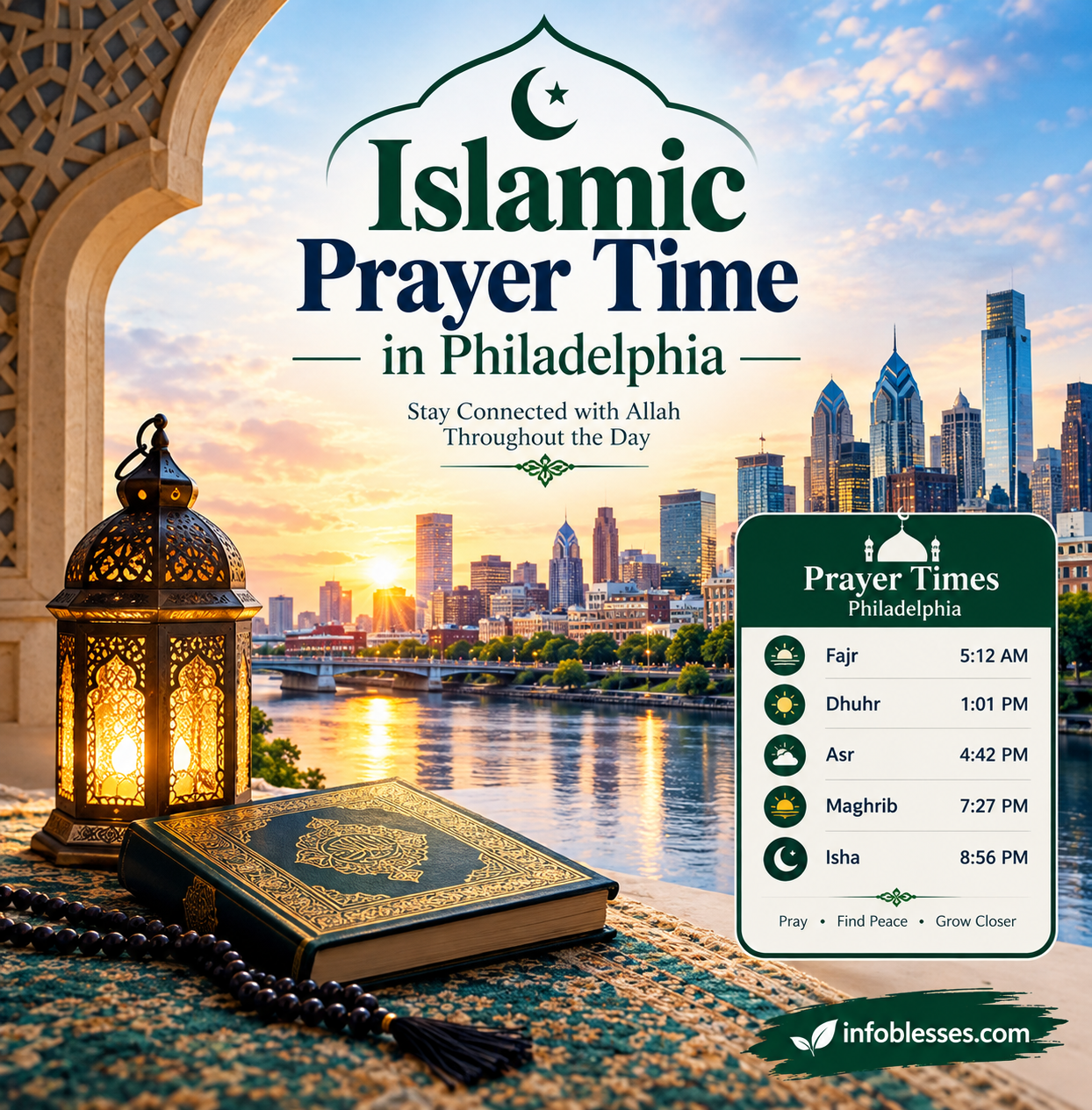
Finding the correct Islamic Prayer Time in Philadelphia is an important part of maintaining a consistent daily Salah routine. Because Philadelphia sits at a northern latitude and experiences significant seasonal changes in sunrise and sunset, prayer times can shift considerably throughout the year. A schedule that works in summer may look very different in winter.
For Muslims living, studying, working, or traveling in Philadelphia, knowing when Fajr, Dhuhr, Asr, Maghrib, and Isha begin helps make worship easier to organize. It also reduces uncertainty, especially when prayer falls during school, work, commuting, or family activities.
This guide explains how Islamic Prayer Time in Philadelphia is determined, what each prayer means, how seasonal changes affect Salah, and how to build a reliable daily prayer routine.
Why Islamic Prayer Time in Philadelphia Matters
Salah is one of the central acts of worship in Islam. The five obligatory prayers are tied to specific periods of the day rather than simply being five events that can happen at any convenient hour.
That distinction matters.
The beginning and ending of each prayer period are connected to astronomical signs such as dawn, the sun’s highest position, shadow length, sunset, and the disappearance of twilight. Therefore, Islamic Prayer Time in Philadelphia changes naturally as the position of the sun changes.
Philadelphia’s location in the northeastern United States makes seasonal variation especially noticeable. During summer, daylight lasts much longer, while winter brings shorter days and earlier sunsets.
The Five Daily Prayers
Muslims perform five obligatory prayers every day:
- Fajr — the dawn prayer
- Dhuhr — the midday prayer
- Asr — the afternoon prayer
- Maghrib — the sunset prayer
- Isha — the night prayer
Each has its own prescribed time window.
| Prayer | General Time |
|---|---|
| Fajr | From true dawn until sunrise |
| Dhuhr | After solar noon until the beginning of Asr |
| Asr | Afternoon, based on the relevant shadow calculation |
| Maghrib | Shortly after sunset |
| Isha | After evening twilight disappears according to the selected method |
These descriptions are intentionally general. Exact clock times depend on the date, geographic coordinates, calculation convention, and in some cases the jurisprudential method selected.
Why Times Differ Between Calendars
You may notice that two websites or mosque calendars sometimes show slightly different times.
That doesn’t automatically mean one is wrong.
Differences can come from:
- Different calculation methods
- Different Asr shadow-ratio settings
- Different definitions of twilight for Isha
- Rounding rules
- Geographic coordinates
- Local adjustments
- High-latitude considerations
- Mosque-specific conventions
For that reason, Muslims should generally follow a trusted local mosque, Islamic organization, or established prayer-time service consistently rather than switching between sources every day.
How Islamic Prayer Time in Philadelphia Is Calculated
Modern prayer calendars use astronomical calculations to estimate when the sun reaches the positions associated with each Salah.
The calculation begins with Philadelphia’s geographic location and the date. From there, astronomical equations estimate solar noon, sunrise, sunset, and the sun’s angle below the horizon.
Fajr Calculation
Fajr begins with true dawn, often called astronomical twilight in calculation systems. This occurs before sunrise.
Many prayer calendars define Fajr using a solar depression angle. Common conventions may use different angles, which can produce different times.
For example, one calculation method may place Fajr earlier than another because it defines dawn at a different solar angle.
Dhuhr Calculation
Dhuhr begins after the sun passes its local meridian, commonly described as solar noon.
Importantly, solar noon isn’t necessarily 12:00 p.m.
The exact time depends on longitude, the equation of time, and the time zone. That’s why Dhuhr can occur at different clock times throughout the year.
Asr Calculation
Asr is especially important when comparing different Islamic calendars.
Two widely recognized approaches use different shadow-length criteria. One method generally begins Asr when an object’s shadow reaches a particular multiple of its height, while another uses a longer shadow ratio.
As a result, an Asr timetable can vary depending on the selected jurisprudential calculation.
Maghrib Calculation
Maghrib begins after sunset. This makes it one of the easiest prayer times to understand astronomically.
However, local prayer schedules may include a small precautionary adjustment after the calculated sunset.
Isha Calculation
Isha begins after evening twilight has sufficiently disappeared. Like Fajr, Isha can vary depending on the solar-angle convention used.
This is particularly noticeable in locations with long summer evenings.
Understanding Philadelphia’s Seasonal Prayer Changes
Seasonal changes are one of the most important things to understand when following Islamic Prayer Time in Philadelphia.
Philadelphia experiences four distinct seasons, and the length of daylight changes substantially throughout the year.
Spring
In spring, Fajr gradually becomes earlier while sunrise moves earlier. Dhuhr also shifts according to the changing position of the sun.
Maghrib becomes progressively later as the days lengthen.
Summer
Summer produces some of the biggest differences from winter.
Fajr can occur very early, while Maghrib may occur late in the evening. Isha can also be relatively late because twilight takes longer to disappear.
This can make a full five-prayer schedule challenging for people with early work or school commitments.
Autumn
During autumn, the pattern reverses. Sunrise becomes later, sunset becomes earlier, and evening prayer gradually moves earlier.
This can make the schedule feel easier for people who prefer earlier evening worship.
Winter
Winter brings short daylight hours.
Fajr tends to be later than in summer, while Maghrib can occur surprisingly early. Dhuhr and Asr also occur earlier in the afternoon.
For many Muslims, the biggest practical challenge is remembering that Maghrib may arrive while they’re still at work, school, shopping, or commuting.
Fajr: The Dawn Prayer
Fajr is the first obligatory prayer of the day.
Its time begins at true dawn and ends at sunrise. Because Fajr is connected to dawn rather than a fixed clock hour, its timing changes throughout the year.
For someone following Islamic Prayer Time in Philadelphia, this means an alarm that works well in January may be far too late in June.
Practical Fajr Tips
A reliable routine can make early prayer much easier:
- Check the next day’s Fajr before sleeping.
- Set an alarm based on your chosen prayer calendar.
- Keep your phone away from the bed if you tend to snooze.
- Prepare clothing and prayer space in advance.
- Avoid assuming yesterday’s Fajr time will be similar tomorrow.
- Leave enough time for wudu and prayer.
Fajr is also closely connected with fasting during Ramadan. Muslims observing the fast generally stop eating and drinking by the beginning of the fasting period, according to the timetable and religious guidance they follow.
Dhuhr: The Midday Prayer
Dhuhr begins after the sun has passed its highest point in the sky.
For people with regular daytime schedules, Dhuhr can be one of the easiest prayers to plan because it occurs during normal working hours.
Still, planning is useful.
Dhuhr at Work or School
If Dhuhr falls during work, consider identifying a clean, private location where prayer is possible.
Depending on your circumstances, this could be:
- A designated prayer room
- A quiet office
- A suitable unused room
- A private area at a mosque
- Another clean and appropriate location
Muslims should also consider workplace or school policies and plan respectfully around them.
Asr: The Afternoon Prayer
Asr occurs later in the day and is particularly sensitive to the calculation method used.
If you’re comparing Islamic Prayer Time in Philadelphia calendars, Asr may be the prayer that shows the most obvious difference between two schedules.
Why Asr Can Differ
The underlying issue is the definition of shadow length.
Different schools of Islamic jurisprudence use different criteria for determining when Asr begins. Therefore, Muslims should follow the method accepted by their mosque, imam, or religious authority.
The key is consistency.
If your local mosque uses one method, repeatedly changing between methods simply because another website lists an earlier or later Asr time can create unnecessary confusion.
Maghrib: The Sunset Prayer
Maghrib begins after the sun sets.
This prayer can arrive surprisingly early during Philadelphia’s winter months. In summer, by contrast, sunset can be much later.
Because the Maghrib window is relatively short compared with some other prayer periods, it helps to know the approximate time before leaving home.
Maghrib During a Busy Evening
If you’re driving, shopping, attending an event, or caring for children, plan ahead.
A few simple habits help:
- Check sunset before starting a trip.
- Keep a prayer schedule accessible.
- Know where nearby mosques are located.
- Avoid delaying unnecessarily.
- If traveling, learn the relevant rules for your circumstances.
The exact religious rulings for combining or shortening prayers while traveling depend on circumstances and jurisprudential guidance, so questions about those matters are best directed to a qualified scholar or imam.
Isha: The Night Prayer
Isha begins after evening twilight has disappeared according to the calculation convention being used.
In Philadelphia, Isha can be quite late during the summer months. That can be challenging for families with children or people who need to wake early.
Building a Sustainable Isha Routine
Rather than waiting until you’re exhausted, consider making Isha part of your evening schedule.
For example:
- Finish dinner with enough time for prayer.
- Reduce unnecessary screen time late at night.
- Prepare for sleep after Isha.
- Set a consistent bedtime.
- Keep your prayer area ready.
A predictable routine makes worship less dependent on willpower.
Daily Islamic Prayer Time in Philadelphia Schedule
There isn’t one fixed five-prayer timetable that can accurately represent every day of the year. Exact times must be calculated for the specific date.
A useful daily schedule looks like this:
| Salah | What Determines the Start |
|---|---|
| Fajr | True dawn |
| Dhuhr | Sun passes the meridian |
| Asr | Prescribed shadow relationship |
| Maghrib | Sunset |
| Isha | Disappearance of evening twilight |
For an exact daily schedule, use a reliable Philadelphia prayer calendar and confirm the calculation method.
An established resource such as IslamicFinder can be useful for checking prayer times, Qibla information, and Islamic calendar information. Your local mosque’s published timetable may be preferable when it uses a calculation convention that your community follows.
Qibla Direction in Philadelphia
Prayer time isn’t the only practical consideration. Muslims also face the Qibla, the direction of the Kaaba in Makkah, Saudi Arabia, during Salah.
From Philadelphia, the Qibla is generally toward the southeast, although the precise bearing depends on the exact location.
A Qibla compass or reputable smartphone application can provide a more precise direction.
Improving Qibla Accuracy
Indoor magnetic compasses can be affected by:
- Metal structures
- Electronic equipment
- Vehicles
- Magnets
- Reinforced concrete
- Nearby electrical devices
If accuracy matters, compare your phone’s Qibla feature with a known mosque direction or another trusted reference.
Prayer at Philadelphia Mosques
Philadelphia has a substantial Muslim community, with mosques and Islamic centers serving people from many cultural and linguistic backgrounds.
Congregational prayer offers several benefits beyond simply knowing the correct time. It creates community, encourages consistency, and gives worshippers an opportunity to learn from imams and other knowledgeable Muslims.
If you’re new to Philadelphia, finding a nearby mosque can also make it easier to establish a regular prayer routine.
Local Mosque Timetables
Mosques sometimes publish their own daily schedules. These may include adjustments designed for the local congregation.
For that reason, if your mosque publishes an official timetable, it’s sensible to ask the imam or mosque administration which calculation method the schedule follows.
Islamic Prayer Time in Philadelphia During Ramadan
Ramadan makes accurate prayer timing especially important.
Muslims fast from dawn until sunset, so the Fajr and Maghrib times become particularly relevant.
Suhoor and Fajr
Suhoor is the pre-dawn meal eaten before fasting begins.
Because the fasting period is linked to dawn, families should use a reliable Ramadan timetable and understand whether the listed time represents Fajr itself or an additional precautionary cutoff.
Different communities may adopt slightly different practices.
Iftar and Maghrib
Iftar begins at sunset, making Maghrib timing especially important.
Many families prepare food before sunset so they don’t have to rush. Mosques may also organize communal iftars followed by Maghrib, dinner, and sometimes additional prayers.
Taraweeh
Taraweeh is a special Ramadan night prayer traditionally performed after Isha.
Its schedule depends on the mosque. Since Isha can be relatively late, especially early in Ramadan depending on the season, checking the local mosque timetable is useful.
Daylight Saving Time and Prayer Schedules
Philadelphia observes daylight-saving time.
This means the relationship between the sun’s position and the clock changes when the local time standard shifts.
Prayer calculations themselves are based on astronomical events. The clock time displayed on a timetable, however, reflects the local time zone and daylight-saving rules.
A Simple Rule
Don’t manually add or subtract an hour from a prayer schedule unless you’re certain the source has a time-zone problem.
Most modern prayer calendars automatically account for daylight-saving changes.
If a mosque timetable suddenly appears one hour different from an online calendar around the spring or autumn time change, check the date, time zone, and source before assuming there’s an error.
Apps and Online Prayer Calendars
Technology makes it easier than ever to check Islamic Prayer Time in Philadelphia.
Prayer apps can provide:
- Daily Salah times
- Monthly calendars
- Fajr and sunrise alerts
- Qibla direction
- Ramadan schedules
- Hijri dates
- Prayer notifications
However, convenience shouldn’t replace judgment.
If two apps disagree, investigate their calculation settings rather than simply selecting the one with the more convenient time.
What to Check in an App
Look for settings related to:
- Calculation method
- Fajr angle
- Isha angle
- Asr method
- Location
- Time zone
- Daylight-saving adjustment
Once you’ve selected the method recommended by your local religious authority, keep it consistent.
Common Mistakes When Checking Prayer Times
Even with modern technology, several simple mistakes can cause confusion.
Using the Wrong Location
A timetable calculated for New York City, Baltimore, or another nearby city isn’t necessarily identical to Philadelphia.
Small geographic differences can affect the calculation.
Mixing Calculation Methods
Switching methods from one day to another can create unnecessary inconsistencies.
Ignoring the Asr Setting
Asr is particularly likely to vary between calculation systems.
Forgetting Seasonal Changes
Prayer times don’t remain fixed throughout the year.
Relying on an Old Screenshot
A prayer schedule saved months ago isn’t a substitute for today’s timetable.
Confusing Sunrise With Fajr
Fajr begins before sunrise. Sunrise marks the end of the Fajr prayer period.
This distinction is especially important for people planning morning prayer.
Seven Practical Tips for Staying Consistent
Maintaining five daily prayers becomes easier when you treat them as anchors in the day.
1. Check Times the Night Before
A quick glance at tomorrow’s schedule can help you prepare.
2. Use Reliable Notifications
Prayer alerts can prevent you from losing track of time during busy days.
3. Keep a Prayer Space Ready
A clean, convenient prayer area removes unnecessary friction.
4. Plan Around Work and School
Know when Dhuhr and Asr occur so you can arrange appropriate breaks.
5. Follow One Trusted Calculation Method
Consistency is more useful than constantly comparing competing apps.
6. Know Your Local Mosque’s Schedule
A mosque can provide both practical information and religious guidance.
7. Recheck During Seasonal Transitions
Pay particular attention when the clocks change and when the seasons shift rapidly.
How to Choose a Reliable Philadelphia Prayer Schedule
When evaluating a timetable, don’t focus only on whether the numbers look familiar.
Instead, ask:
- Does it use the correct Philadelphia location?
- Does it clearly state the calculation method?
- Does it explain its Asr method?
- Does it adjust for daylight saving time?
- Is it updated for the correct date?
- Does your local mosque use the same convention?
A good timetable should be transparent about how its numbers are produced.
For religious questions beyond astronomical timing—such as combining prayers, missed Salah, fasting rules, or differences between schools of jurisprudence—consult a qualified imam or scholar.
Frequently Asked Questions
What is the Islamic Prayer Time in Philadelphia today?
There isn’t one permanent answer because Salah times change every day. Fajr, Dhuhr, Asr, Maghrib, and Isha should be checked using a current Philadelphia timetable for the specific date.
Why do Philadelphia prayer times change every day?
Prayer times are connected to the sun’s position. Since sunrise, sunset, solar noon, and twilight change throughout the year, the corresponding Salah times also change.
Why do two prayer apps show different times?
They may use different astronomical calculation methods, Fajr or Isha angles, Asr shadow conventions, geographic coordinates, or local adjustments. Small differences are therefore possible.
Which Asr calculation should Muslims in Philadelphia use?
There isn’t one universal setting for every Muslim. Different schools and organizations use different Asr shadow criteria. The best practical approach is to follow the method used by your trusted local mosque or religious authority.
Is Fajr the same as sunrise?
No. Fajr begins before sunrise, at true dawn. Sunrise marks the end of the Fajr period.
Why is Isha so late in Philadelphia during summer?
Summer days are long at Philadelphia’s latitude. The sun sets later, and evening twilight can remain for a significant period afterward. Since Isha is linked to the disappearance of twilight, it can occur quite late.
Does daylight saving time affect prayer times?
It affects the clock time displayed for astronomical events, but it doesn’t change the underlying position of the sun. Modern prayer calendars normally account for daylight-saving time automatically.
Can I use an online prayer timetable instead of a mosque timetable?
Yes, an online timetable can be useful. However, if your local mosque publishes an official schedule, especially one tied to a particular calculation method, following that community schedule can help maintain consistency.
How can I find the Qibla direction in Philadelphia?
The Qibla from Philadelphia is generally toward the southeast. For a precise bearing, use a reliable Qibla compass or application and verify that your device’s compass is calibrated.
Are Philadelphia prayer times the same throughout Pennsylvania?
No. Prayer times depend on geographic location. Cities across Pennsylvania can have different sunrise, sunset, and solar-noon times, so use the timetable calculated for your actual location.
Conclusion:
Understanding Islamic Prayer Time in Philadelphia doesn’t have to be complicated. The essential idea is simple: the five daily prayers are connected to natural astronomical events, and those events change with the date and season.
Fajr begins at dawn, Dhuhr follows solar noon, Asr occurs in the afternoon according to the selected shadow method, Maghrib begins at sunset, and Isha follows the disappearance of evening twilight.
Because Philadelphia experiences substantial seasonal variation, Muslims should avoid relying on fixed clock times. Instead, use a current, location-specific timetable and pay attention to the calculation method behind it.
Most importantly, consistency matters. Choose a trusted source, understand its settings, follow your local mosque when appropriate, and make Salah a dependable part of your daily rhythm.

Welcome to Info Blesses I am Rana Ahtasham an AI Powered SEO and Content Writer With 3 year experience.I help websites rank highter, grow traffic, and look amazing. My goal is to make SEO and web design simple and effective for everyone.Lets achieve more togather!