Health is among the greatest blessings Allah ﷻ has bestowed upon humanity. Every breath we take, every heartbeat, every moment of strength, and every opportunity to worship Allah is made possible because of His mercy and countless favors. Islam teaches Muslims to appreciate these blessings, protect them, and constantly seek Allah’s help for maintaining good health.
Many people remember Allah only during illness. However, Islam encourages believers to remember their Creator in both times of ease and hardship. The Prophet Muhammad ﷺ regularly made supplications asking Allah for well-being before sickness ever arrived. This teaches Muslims that asking for health is itself an act of worship.
Good health in Islam is not limited to physical fitness. Rather, it includes the wellness of the heart, mind, body, soul, and character. A healthy believer is one who strengthens his relationship with Allah while taking care of the body entrusted to him.
The Qur’an repeatedly reminds believers that Allah alone grants healing. Medicines, doctors, healthy food, and exercise are important means, but ultimate cure comes only by Allah’s permission. Therefore, Muslims combine practical efforts with sincere prayers and complete trust in their Lord.
Throughout Islamic history, believers have relied upon authentic duas from the Qur’an and Sunnah whenever they sought protection, recovery, or continued health. These supplications bring peace to the heart and strengthen one’s faith regardless of life’s circumstances.
In this comprehensive guide, you will discover authentic Islamic duas for good health, daily prayers, Qur’anic verses about healing, Sunnah practices that promote wellness, and practical ways to live a healthier life while remaining devoted to Allah.
Why Good Health Is a Great Blessing in Islam

Islam places tremendous value on health because it enables believers to fulfill their religious responsibilities and serve humanity. A healthy body allows Muslims to pray, fast, perform Hajj, earn lawful income, care for family, and engage in acts of charity.
The Prophet Muhammad ﷺ reminded his companions that many people fail to appreciate the blessings of health until they lose them.
He said:
“There are two blessings which many people waste: health and free time.”
— Sahih al-Bukhari
This profound hadith reminds Muslims not to take their physical well-being for granted. Every healthy day is an opportunity to increase worship, perform righteous deeds, and draw closer to Allah.
Good health also allows believers to:
- Perform the five daily prayers comfortably.
- Fast during Ramadan.
- Care for parents and family.
- Help those in need.
- Seek Islamic knowledge.
- Earn halal sustenance.
- Strengthen the Muslim community.
When a Muslim realizes that health is a divine blessing rather than merely a personal achievement, gratitude naturally increases.
Allah says in the Qur’an:
“And if you should count the favors of Allah, you could not enumerate them.”
— Surah Ibrahim (14:34)
Among those countless favors, good health stands as one of the greatest.
The Islamic View of Physical and Spiritual Health

Islam presents a beautifully balanced understanding of health. Unlike worldly philosophies that focus solely on physical appearance or athletic performance, Islam teaches that true wellness consists of harmony between body, soul, and heart.
A believer should care for the body because it is an amanah (trust) from Allah.
The Prophet Muhammad ﷺ encouraged moderation in eating, cleanliness, physical strength, and maintaining personal hygiene. At the same time, he warned against excessive attachment to worldly pleasures.
A healthy Muslim therefore strives to maintain:
Physical Health
- Eating halal and wholesome food.
- Sleeping adequately.
- Remaining physically active.
- Maintaining cleanliness.
- Seeking medical treatment when necessary.
Spiritual Health
- Daily Salah.
- Qur’an recitation.
- Dhikr (remembrance of Allah).
- Making dua regularly.
- Sincere repentance.
Emotional Health
Islam recognizes sadness, grief, fear, and anxiety as natural human emotions. The Qur’an provides comfort by reminding believers that Allah is always near.
When both physical and spiritual health are nurtured together, Muslims experience true peace and contentment.
Allah Is the Ultimate Healer (Ash-Shafi)

One of Allah’s beautiful names is Ash-Shafi, meaning The Healer.
No doctor, medicine, or treatment possesses independent power. Every cure comes only through Allah’s permission.
Prophet Ibrahim (peace be upon him) declared:
“And when I am ill, it is He who cures me.”
— Surah Ash-Shu’ara (26:80)
This verse teaches complete reliance upon Allah while also encouraging believers to seek lawful treatment.
Islam never instructs Muslims to abandon medicine. Rather, the Prophet ﷺ advised seeking treatment while understanding that Allah alone grants healing.
This balance between effort and trust is one of Islam’s most beautiful teachings.
Whenever Muslims fall ill, they should remember:
- Allah knows their pain.
- Every illness removes sins.
- Patience earns enormous rewards.
- Healing comes from Allah alone.
- Every hardship has wisdom.
Keeping this belief strengthens faith even during difficult times.
The Importance of Making Dua for Good Health

Dua is among the greatest acts of worship in Islam.
Rather than waiting until illness strikes, Muslims should regularly ask Allah for continued health and protection.
The Prophet Muhammad ﷺ frequently asked Allah for Al-‘Afiyah, meaning complete well-being, safety, protection, and health.
This comprehensive blessing includes:
- Physical health
- Mental peace
- Strong faith
- Family safety
- Financial stability
- Protection from trials
- Inner tranquility
Few supplications encompass as many blessings as asking Allah for Afiyah.
Scholars explain that receiving Afiyah is among the greatest gifts a believer can receive because it protects both worldly life and the Hereafter.
Powerful Dua for Good Health
One of the most authentic supplications taught by the Prophet ﷺ is:
Arabic
اللَّهُمَّ إِنِّي أَسْأَلُكَ الْعَفْوَ وَالْعَافِيَةَ
Transliteration
Allahumma inni as’alukal-‘afwa wal-‘afiyah.
Meaning
O Allah, I ask You for forgiveness and complete well-being.
This short dua can be recited:
- Every morning
- Every evening
- After Salah
- During Tahajjud
- Before sleeping
- While traveling
- Whenever remembering Allah
Its simplicity makes it easy to memorize while carrying immense spiritual value.
Benefits of Asking Allah for Good Health
Regularly making dua for health offers many spiritual and emotional benefits, including:
- Strengthening trust in Allah.
- Increasing gratitude for existing blessings.
- Developing patience during illness.
- Reducing anxiety through reliance on Allah.
- Encouraging consistent worship.
- Bringing peace to the heart.
- Protecting believers from arrogance.
- Reminding Muslims that every blessing comes from Allah.
These benefits extend beyond physical healing and nurture the believer’s overall relationship with the Creator.
Gratitude: The Key to Preserving Health
Allah promises an increase in blessings for those who are grateful.
He says:
“If you are grateful, I will surely increase you.”
— Surah Ibrahim (14:7)
Expressing gratitude for health is not limited to saying Alhamdulillah. It also means using one’s strength in ways that please Allah, such as performing prayers, helping others, earning lawful income, and avoiding sinful actions.
A believer who thanks Allah during times of wellness is more likely to remain patient and hopeful during times of illness.
Quranic Verses About Healing

The Holy Qur’an is not only a book of guidance but also a source of spiritual healing, comfort, and mercy. Allah describes His revelation as a cure for what resides within the hearts and as guidance for the believers.
1. The Qur’an Is a Healing for Believers
Allah says:
“And We send down of the Qur’an that which is healing and mercy for the believers.”
(Surah Al-Isra 17:82)
This verse teaches that the Qur’an heals hearts from doubt, fear, sadness, anxiety, and spiritual weakness. Its recitation brings peace, strengthens faith, and reminds believers that Allah’s mercy is always near.
2. Allah Alone Grants Healing
Allah says through Prophet Ibrahim (peace be upon him):
“And when I am ill, it is He who cures me.”
(Surah Ash-Shu’ara 26:80)
Muslims seek treatment, visit doctors, and take medicine, but they always remember that healing ultimately comes from Allah alone.
3. The Qur’an Is Guidance and Mercy
Allah says:
“O mankind, there has come to you instruction from your Lord and healing for what is in the hearts.”
(Surah Yunus 10:57)
Regular Qur’an recitation nourishes the soul and fills the believer’s heart with hope, patience, and trust in Allah.
Daily Duas for Good Health

The Prophet Muhammad ﷺ regularly supplicated for protection, wellness, and strength. Making these duas part of your daily routine is a beautiful Sunnah.
Dua for Well-Being (Al-‘Afiyah)
Arabic
اللَّهُمَّ إِنِّي أَسْأَلُكَ الْعَفْوَ وَالْعَافِيَةَ
Transliteration
Allahumma inni as’alukal-‘afwa wal-‘afafiyah.
Meaning
O Allah, I ask You for forgiveness and complete well-being.
Dua for Strength
Arabic
اللهم أعني على ذكرك وشكرك وحسن عبادتك
Transliteration
Allahumma a’inni ‘ala dhikrika wa shukrika wa husni ‘ibadatik.
Meaning
O Allah, help me to remember You, thank You, and worship You in the best manner.
Good health is not only about physical strength but also about having the ability to worship Allah consistently.
Morning and Evening Adhkar for Protection

Morning and evening remembrance (Adhkar) is among the greatest means of seeking Allah’s protection.
The Prophet ﷺ encouraged believers to remember Allah every morning and evening because these moments protect the heart and strengthen faith.
Benefits include:
- Protection from harm
- Inner peace
- Increased remembrance of Allah
- Spiritual strength
- Greater reliance upon Allah
A Muslim who consistently practices morning and evening Adhkar begins and ends each day with Allah’s remembrance.
Prophetic Dua for Healing the Sick

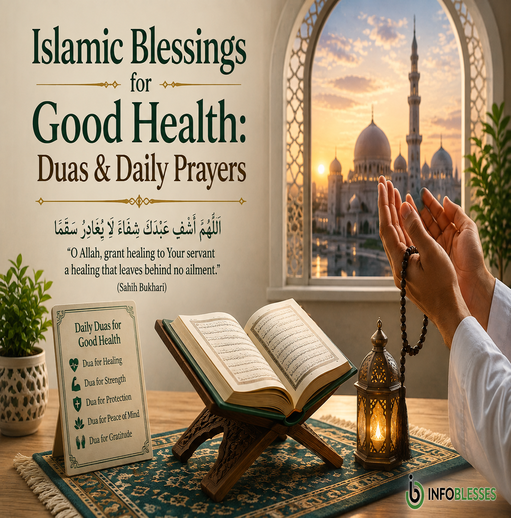
One of the most famous healing supplications taught by the Prophet Muhammad ﷺ is:
Arabic
اللهم رب الناس أذهب البأس واشف أنت الشافي لا شفاء إلا شفاؤك شفاء لا يغادر سقما
Transliteration
Allahumma Rabban-naas, adhhibil-ba’s, washfi anta Ash-Shafi, la shifa’a illa shifa’uk, shifa’an la yughadiru saqama.
Meaning
O Allah, Lord of mankind, remove the suffering and grant healing. You are the Healer. There is no healing except Your healing—a healing that leaves behind no illness.
This dua beautifully reminds believers that Allah is Ash-Shafi, the One who grants complete healing.
Sunnah Habits That Promote Good Health

Islam promotes a healthy lifestyle through practical daily habits taught by the Prophet ﷺ.
1. Moderation in Eating
The Prophet ﷺ discouraged overeating.
He taught believers to leave space in the stomach rather than eating until completely full.
Moderation benefits both physical and spiritual health.
2. Maintaining Cleanliness
Purification is an important part of Islam.
Daily Wudu, bathing, oral hygiene, and clean clothing contribute to overall health while preparing believers for worship.
3. Physical Activity
The Prophet ﷺ encouraged beneficial physical activities.
Walking, traveling, horseback riding, archery, and swimming were appreciated forms of exercise during his time.
Remaining physically active helps maintain strength for worship and daily responsibilities.
4. Proper Sleep
The Sunnah encourages sleeping early after the night prayer when possible and waking early for Fajr.
Healthy sleep supports both physical well-being and spiritual discipline.
Foods Mentioned in the Qur’an and Sunnah

Islam encourages consuming wholesome and lawful foods.
Some foods praised or mentioned in Islamic sources include:
Dates
The Prophet ﷺ frequently ate dates.
Dates provide natural energy, fiber, and essential nutrients.
Honey
Allah says regarding honey:
“In it is healing for mankind.”
Honey has long been valued for its nourishing and beneficial properties.
Olive Oil
The Prophet ﷺ encouraged using olive oil for eating and external application.
Olives are also mentioned in the Qur’an as a blessed food.
Figs
Figs are mentioned in Surah At-Tin, highlighting one of Allah’s remarkable creations.
Black Seed
The Prophet ﷺ said that black seed contains healing for many ailments, except death, by Allah’s permission.
Patience During Illness

Illness is never meaningless in Islam.
Every hardship carries wisdom known to Allah.
The Prophet ﷺ taught that illness removes sins and elevates the believer’s rank when endured with patience.
Rather than despairing, Muslims respond to sickness with:
- Patience (Sabr)
- Dua
- Hope
- Gratitude
- Trust in Allah
Even moments of pain become opportunities for reward.
How Consistent Istighfar Invites Allah’s Blessings and Well-Being
Seeking forgiveness (Istighfar) is one of the most rewarding acts of worship in Islam. It is not only a means of having sins forgiven but also a source of Allah’s mercy and countless blessings. The Qur’an teaches that those who sincerely seek Allah’s forgiveness are blessed with increased provision, mercy, and ease in their lives. A believer who regularly says Astaghfirullah develops a humble heart, strengthens their faith, and experiences greater inner peace. This spiritual peace can positively influence emotional well-being and help a person face life’s challenges with patience and hope. While Istighfar is not a replacement for medical treatment, it reminds Muslims that every blessing, including good health, comes from Allah alone. Making Istighfar a daily habit allows believers to remain connected to their Creator, seek His forgiveness, and live with confidence in His endless mercy and compassion.
The Importance of Halal Living for a Healthy Body and Soul
Islam teaches that a healthy life begins with living according to Allah’s guidance. A halal lifestyle includes eating lawful and wholesome food, earning an honest livelihood, maintaining cleanliness, and avoiding anything that harms the body or soul. The Qur’an encourages believers to consume what is pure and lawful because physical nourishment should always be accompanied by spiritual purity. Choosing halal in every aspect of life strengthens a Muslim’s relationship with Allah and brings blessings into daily living. It also promotes self-discipline, gratitude, and moderation, which are essential for long-term well-being. When Muslims follow Islamic principles in their food, income, and daily behavior, they not only protect their physical health but also nurture a peaceful heart and a stronger connection with their faith.
Finding Inner Peace Through Dhikr: An Islamic Path to Emotional Wellness
In today’s busy world, many people experience stress, anxiety, and emotional exhaustion. Islam offers a powerful solution through the remembrance of Allah (Dhikr). Allah says in the Qur’an, “Indeed, in the remembrance of Allah do hearts find rest” (Surah Ar-Ra’d 13:28). Regularly reciting phrases such as SubhanAllah, Alhamdulillah, Allahu Akbar, and La ilaha illallah helps calm the heart and strengthens a believer’s trust in Allah. Dhikr reminds Muslims that every challenge is under Allah’s control and that His mercy is always near. By remembering Allah consistently during both times of ease and hardship, believers develop patience, gratitude, and emotional resilience. This daily act of worship not only brings spiritual rewards but also fills the heart with peace, hope, and confidence in Allah’s wisdom and care.
Trust Allah While Seeking Treatment
Islam teaches balance.
A believer should:
- Visit qualified healthcare professionals.
- Take prescribed medication when appropriate.
- Maintain healthy habits.
- Continue making sincere dua.
- Place complete trust in Allah.
Seeking treatment is part of relying upon Allah—not a contradiction to it.
Conclusion:
Good health is among Allah’s greatest blessings, and every Muslim should strive to preserve it through gratitude, healthy living, sincere worship, and regular supplication. The Qur’an and the Sunnah remind us that true wellness is not only freedom from illness but also a heart filled with faith, patience, and remembrance of Allah.
Whether we are healthy or facing illness, our first refuge should always be Allah. By reciting authentic duas, maintaining daily Adhkar, following the Sunnah, eating wholesome halal foods, and trusting Allah while seeking proper medical care, we strengthen both our bodies and our souls.
May Allah ﷻ bless us with lasting health, protect us from illness, forgive our sins, and grant us complete Al-‘Afiyah in this world and the Hereafter. Ameen.
Frequently Asked Questions (FAQs)
1. What is the best Islamic dua for good health?
One of the best authentic supplications is:
Allahumma inni as’alukal-‘afwa wal-‘afiyah.
Meaning: O Allah, I ask You for forgiveness and complete well-being.
2. Does the Qur’an mention healing?
Yes. Allah says:
“And We send down of the Qur’an that which is healing and mercy for the believers.” (Surah Al-Isra 17:82)
3. Can Muslims take medicine?
Yes. Islam encourages seeking lawful medical treatment while believing that ultimate healing comes from Allah alone.
4. Which name of Allah relates to healing?
Ash-Shafi — The Healer.
5. What should Muslims do during illness?
They should:
- Make sincere dua.
- Be patient.
- Continue remembrance of Allah.
- Seek appropriate medical treatment.
- Trust Allah’s wisdom and mercy.