
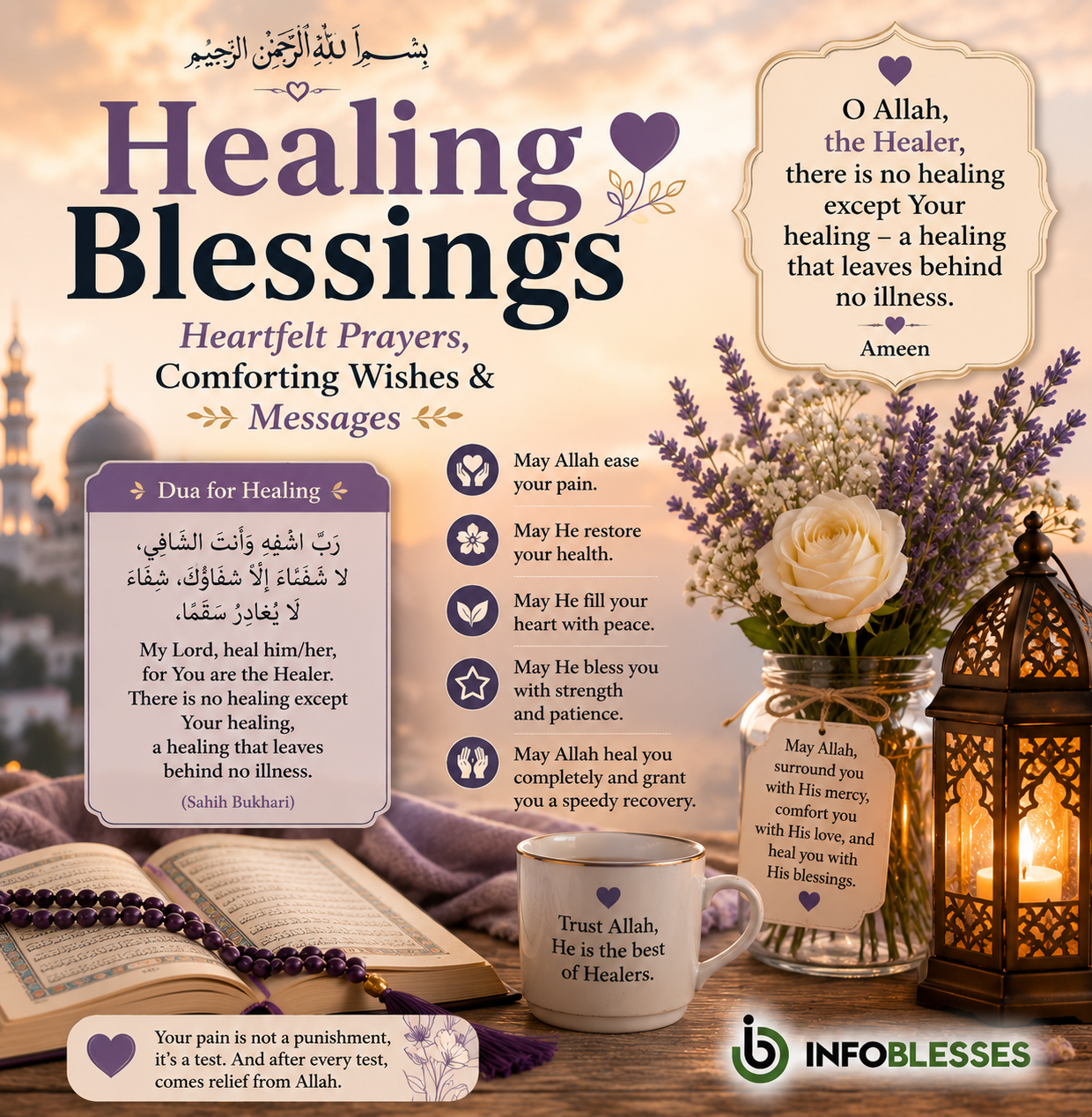
Healing Blessings are heartfelt expressions of hope, compassion, and sincere prayer for someone experiencing illness, weakness, sadness, or a difficult season of life. In Islam, asking Allah for healing is an act of faith because Muslims believe that Allah is the ultimate source of cure, mercy, strength, and relief.
When someone we love is suffering, sometimes ordinary words do not feel enough. We may want to say something that gives comfort without making unrealistic promises. A sincere Islamic prayer can be a beautiful way to remind a sick or struggling person that they are not alone and that Allah knows their pain.
The Qur’an gives believers a profound reminder about its healing and mercy. Allah says that He sends down from the Qur’an that which is “healing and mercy for the believers.” This does not mean that every illness will immediately disappear, but it reminds believers of the spiritual comfort, guidance, and mercy found in revelation.
Healing in Islam can therefore be understood through several dimensions: turning to Allah, making dua, practicing patience, seeking permissible treatment, supporting the sick, and maintaining hope in Allah’s mercy.

What Do Healing Blessings Mean in Islam?
Healing Blessings are not simply beautiful sentences written for someone who is sick. They can represent sincere duas asking Allah to provide relief, strength, patience, protection, and recovery.
Islam teaches Muslims to turn toward Allah in times of both ease and difficulty. When illness enters someone’s life, a believer can respond with dua while also taking practical steps to seek appropriate care.
A healing message can therefore contain several elements:
- A prayer for recovery.
- A request for Allah’s mercy.
- Words of patience and hope.
- A reminder that Allah knows the person’s condition.
- Encouragement to continue trusting Allah.
- A sincere wish for comfort and strength.
One of the beautiful aspects of Islamic prayer is that it does not require complicated language. A person can speak to Allah sincerely and ask for what they need.
For someone experiencing illness, even a short message can provide emotional comfort:
“May Allah surround you with His mercy, ease your pain, strengthen your heart, and grant you complete and beneficial healing. Ameen.”
Such words do not promise a specific medical outcome. Instead, they express hope while leaving the result in Allah’s wisdom.
The Prophet Muhammad ﷺ also taught supplications for the sick, showing that praying for healing is an established part of Islamic practice.

Powerful Islamic Dua for Healing
One of the most beautiful supplications reported from the Prophet Muhammad ﷺ when visiting someone who was ill asks Allah, the Lord of humanity, to remove the difficulty and grant healing.
The supplication includes the meaning:
“Remove the harm, O Lord of mankind, and heal; You are the Healer. There is no healing except Your healing.”
This dua carries a powerful spiritual message. Muslims may seek doctors, medicine, rest, and other appropriate means, while recognizing that ultimate healing is from Allah.
Another narration in Sahih Muslim records a supplication used when the Prophet ﷺ visited a sick person.
A person can also make a personal dua in their own language:
“Ya Allah, You know the pain that this person is experiencing. Grant them strength, ease their difficulty, give them patience, and bless them with healing that is good for their body, heart, and faith. Ameen.”
Personal dua can be especially meaningful because it allows you to mention the person’s specific situation.
When making dua for someone, it is wise to avoid claiming certainty about what Allah will do. Instead, ask sincerely, maintain hope, and trust Allah’s wisdom.

Healing Blessings from the Qur’an
The Qur’an occupies a central place in Islamic spirituality, and believers turn to it for guidance, reflection, reassurance, and spiritual comfort.
Allah says in Surah Al-Isra:
“We send down the Qur’an as a healing and mercy for the believers.”
This verse is particularly meaningful when discussing healing because it connects the Qur’an with both shifa and rahmah—healing and mercy.
Reading Qur’an should not be treated as a replacement for appropriate medical care. Rather, spiritual practices and responsible treatment can exist together. A Muslim can make dua, recite Qur’an, seek ruqyah that conforms to Islamic principles, and also consult qualified healthcare professionals when needed.
The Qur’an can provide a sense of spiritual grounding during periods when a person feels frightened or uncertain.
A comforting message inspired by this verse could be:
“May Allah make His Book a source of peace for your heart, strengthen you through every difficult moment, and surround you with His mercy and care.”
The goal is not merely to repeat words but to reflect on their meaning and allow them to encourage patience, hope, and trust in Allah.

Heartfelt Healing Blessings for Someone Who Is Sick
When someone close to us becomes ill, we often want to send a message that feels personal rather than generic.
A good Islamic healing message should communicate genuine care while remembering Allah.
Here are some original Healing Blessings you can share:
May Allah ease every moment of discomfort you are experiencing, strengthen your body and heart, and bless you with recovery, patience, and peace. Ameen.
May Allah surround you with His mercy, protect you from fear, and give you strength through every stage of your healing journey.
May Allah turn your difficult days into days of renewed hope and grant you relief in ways you never expected.
May Allah give you patience during treatment, courage during difficult moments, and comfort whenever your heart feels tired.
May Allah remove your hardship, bless your efforts toward recovery, and grant you goodness in both this life and the Hereafter.
May every moment of difficulty become an opportunity for patience, reflection, and closeness to Allah. May He grant you ease and strength.
These messages are appropriate for text messages, greeting cards, social media posts, or personal conversations.

Healing Blessings for Family Members
Illness can affect an entire family. When a parent, spouse, child, sibling, or another relative becomes sick, family members may experience worry and emotional exhaustion.
During such moments, sincere dua can become a source of spiritual strength.
For a parent, you might say:
“May Allah protect my beloved parent, ease every difficulty, grant comfort and strength, and reward them with abundant mercy.”
For a child:
“Ya Allah, protect my child, ease their suffering, strengthen their body, and surround them with Your mercy. Grant them beneficial healing and a peaceful heart.”
For a husband or wife:
“May Allah strengthen my spouse, ease every difficulty, grant healing and patience, and place tranquility and mercy in our home.”
For a sibling:
“May Allah watch over my brother/sister, remove their hardship, grant them strength, and open the doors of relief and goodness.”
The important thing is sincerity. A short dua made with a genuine heart can be more meaningful than a long message written without feeling.

Healing Blessings for Emotional and Spiritual Comfort
Not every form of suffering is visible. A person may look perfectly healthy while carrying grief, fear, loneliness, disappointment, or deep emotional exhaustion.
Islamic comfort should therefore include compassion for the heart as well as concern for the body.
A comforting prayer could be:
“May Allah bring peace to your heart, remove the weight of worries you carry, and give you strength for the days ahead.”
Another message could say:
“May Allah replace your sadness with hope, your uncertainty with trust, and your fear with peace. May He guide you toward people and circumstances that bring goodness into your life.”
These are not promises that every emotional struggle will disappear immediately. Instead, they are sincere wishes for support and divine mercy.
The Qur’an repeatedly encourages believers not to surrender to despair. This spiritual perspective can help someone remember that hardship is only one part of their journey.
When comforting someone, avoid dismissing their feelings with statements such as “Just stop worrying” or “Everything will be fine.” Instead, listen, show compassion, make dua, and encourage them to seek appropriate support when needed.

The Sunnah of Visiting and Praying for the Sick
Visiting a sick person is an important expression of compassion. The Prophet Muhammad ﷺ demonstrated care for those experiencing illness and taught supplications for them.
Sahih Muslim records that when the Prophet ﷺ visited a sick person, he would make a dua asking Allah to remove the illness and grant healing.
This teaches us that visiting the sick should not merely be a social obligation. It can be an opportunity to offer genuine emotional and spiritual support.
When visiting someone who is ill:
- Speak gently.
- Do not stay too long if they are exhausted.
- Avoid frightening them with unnecessary stories.
- Make sincere dua.
- Offer practical help when appropriate.
- Respect their privacy.
- Encourage hope without making unrealistic promises.
- Remember that rest may be more important than conversation.
Sometimes the most meaningful thing you can say is simply:
“I am making dua for you. May Allah make this easy for you.”
That short sentence can remind a person that someone remembers them.

Ruqyah and Healing in Islam
Ruqyah refers to recitations and supplications used for protection and seeking healing. Islamic sources contain examples of the Prophet ﷺ using supplications for illness.
Sahih Muslim records that the Prophet ﷺ would recite a healing supplication when someone was sick.
The important principle is that a Muslim should place trust in Allah rather than believing that words or objects have independent supernatural power.
Islamic ruqyah should remain within sound religious principles. It should not involve practices that contradict Islamic beliefs, unknown formulas, superstition, or claims of guaranteed results.
There is also evidence in Sahih Muslim concerning ruqyah with Qur’anic recitation, including an account involving the recitation of Surah Al-Fatihah.
For someone interested in ruqyah, learning from reliable Islamic scholarship is better than following random social-media claims.
At the same time, spiritual practices should not be used as an excuse to avoid appropriate medical treatment. Seeking qualified medical help is compatible with placing trust in Allah.

Short Healing Blessings to Share
Sometimes you need a short message that can be sent immediately. Here are several original options:
- May Allah grant you complete and beneficial healing. Ameen.
- May Allah ease your pain and fill your heart with peace.
- May Allah surround you with mercy and strength during this difficult time.
- May Allah remove your hardship and open the doors of relief.
- May Allah bless your recovery with patience, strength, and hope.
- May Allah protect you and grant you comfort every day.
- May Allah make your healing journey easier and more peaceful.
- May Allah give you courage when the days feel difficult.
- May Allah bless you with renewed strength and lasting goodness.
- May Allah answer your sincere duas and grant you what is best.
- May Allah bring tranquility to your heart and ease to your life.
- May Allah make every difficult moment a means of reward and spiritual growth.
These short Healing Blessings can work well in WhatsApp messages, Facebook posts, greeting cards, emails, or personal notes.

How to Write a Personal Healing Prayer
A personalized healing prayer can feel much more meaningful than a generic message.
Begin by thinking about the person and their situation. You do not need to mention private details. Simply consider what they may need most.
Perhaps they need:
- Physical strength
- Emotional comfort
- Patience
- Hope
- Protection
- Family support
- Peace of mind
- Courage
- Beneficial treatment
- Guidance
- Mercy
Then turn those needs into a dua.
For example:
“Ya Allah, You know what my loved one is experiencing even when words cannot explain it. Please give them strength, ease their difficulty, guide them toward beneficial treatment, surround them with caring people, and bless them with healing and peace. Ameen.”
You can also make a shorter prayer:
“Ya Allah, make this hardship easy, grant healing, and keep this person close to Your mercy.”
A personal dua does not need impressive language. Allah knows what is inside the heart.

The Importance of Patience During Difficult Times
Illness can test a person’s patience. Treatment may take time, recovery may be unpredictable, and some conditions may not have quick solutions.
Islam teaches the value of sabr, or patience. Patience does not mean pretending that pain does not exist. It means continuing to turn toward Allah while dealing with difficulty.
A person can feel tired and still have faith.
They can cry and still trust Allah.
They can seek medical help and still place their ultimate reliance upon Allah.
They can ask why something is difficult while continuing to hope for Allah’s mercy.
This balanced understanding is important because spiritual encouragement should never shame someone for experiencing fear, sadness, or exhaustion.
A beautiful healing message could therefore be:
“May Allah give you the patience to face today, the strength to face tomorrow, and the hope to believe that His mercy is always greater than our difficulties.”
Such words offer comfort without pretending that recovery is always immediate.

Healing Through Faith, Dua, and Responsible Care
Islam encourages believers to rely upon Allah while taking appropriate means.
This is especially important when discussing health. Dua is deeply valuable, but it should not be presented as a substitute for professional medical care.
If someone has concerning symptoms, a serious illness, or an emergency, they should seek appropriate medical attention.
At the same time, the spiritual dimension of healing can remain important. A person may pray before an appointment, ask family members to make dua, recite Qur’an, practice patience, and remember Allah while following their treatment plan.
This combination can help a person approach illness with both responsibility and faith.
The Prophet ﷺ taught healing supplications, demonstrating that turning to Allah during illness is part of Islamic practice.
The key is balance:
Take the means, make the dua, remain hopeful, and trust Allah with the outcome.

Frequently Asked Questions About Healing Blessings
What are Healing Blessings?
Healing Blessings are sincere wishes and Islamic duas asking Allah to grant a person healing, comfort, patience, strength, protection, and mercy.
What is a powerful Islamic dua for a sick person?
The Prophet Muhammad ﷺ used a supplication asking Allah to remove the illness and grant healing, emphasizing that Allah is the ultimate Healer.
Can I make my own dua for healing?
Yes. You can ask Allah sincerely in your own words for yourself or another person.
Does Islam encourage visiting sick people?
Yes. Caring for sick people and making dua for them are strongly connected with Islamic compassion and the example of the Prophet ﷺ.
Is the Qur’an described as healing?
Yes. Qur’an 17:82 describes the Qur’an as healing and mercy for believers.
Can Healing Blessings be sent through WhatsApp?
Absolutely. A short, sincere dua can be shared through WhatsApp, text messages, social media, or greeting cards.
Should Islamic dua replace medical treatment?
No. A person can make dua and seek appropriate medical care at the same time. Spiritual practice should not be used as a reason to avoid necessary professional treatment.
What should I say to someone who is seriously ill?
Keep your words gentle and hopeful. You can say: “May Allah ease your hardship, grant you strength, surround you with His mercy, and bless you with healing. Ameen.”

Conclusion: Sending Healing With Faith and Compassion
Healing Blessings can transform a simple message into an expression of sincere care. When someone is sick or struggling, they may not need perfect words. They may simply need to know that someone remembers them, cares about them, and is praying for them.
Islam gives believers a beautiful framework for responding to illness. We turn toward Allah, make dua, remember His mercy, practice patience, support those who are suffering, and take appropriate practical steps toward care.
The Qur’an reminds believers that it contains healing and mercy. The Sunnah also gives us examples of supplications for the sick, including the prayer asking Allah to remove the illness and grant healing.
A simple message can therefore carry deep meaning:
“May Allah ease your pain, strengthen your heart, protect you from harm, and grant you healing, peace, patience, and abundant mercy. May He make every difficult moment easier and bless you with what is best in this life and the Hereafter. Ameen.”
May Allah grant healing to every person who is suffering, comfort every worried heart, strengthen every family caring for a loved one, and reward every person who offers kindness during another person’s difficult days.
May Allah make our words a source of comfort, our duas sincere, our actions compassionate, and our hearts patient.
May Allah bless you and your loved ones with health, peace, mercy, strength, and beneficial healing. Ameen.