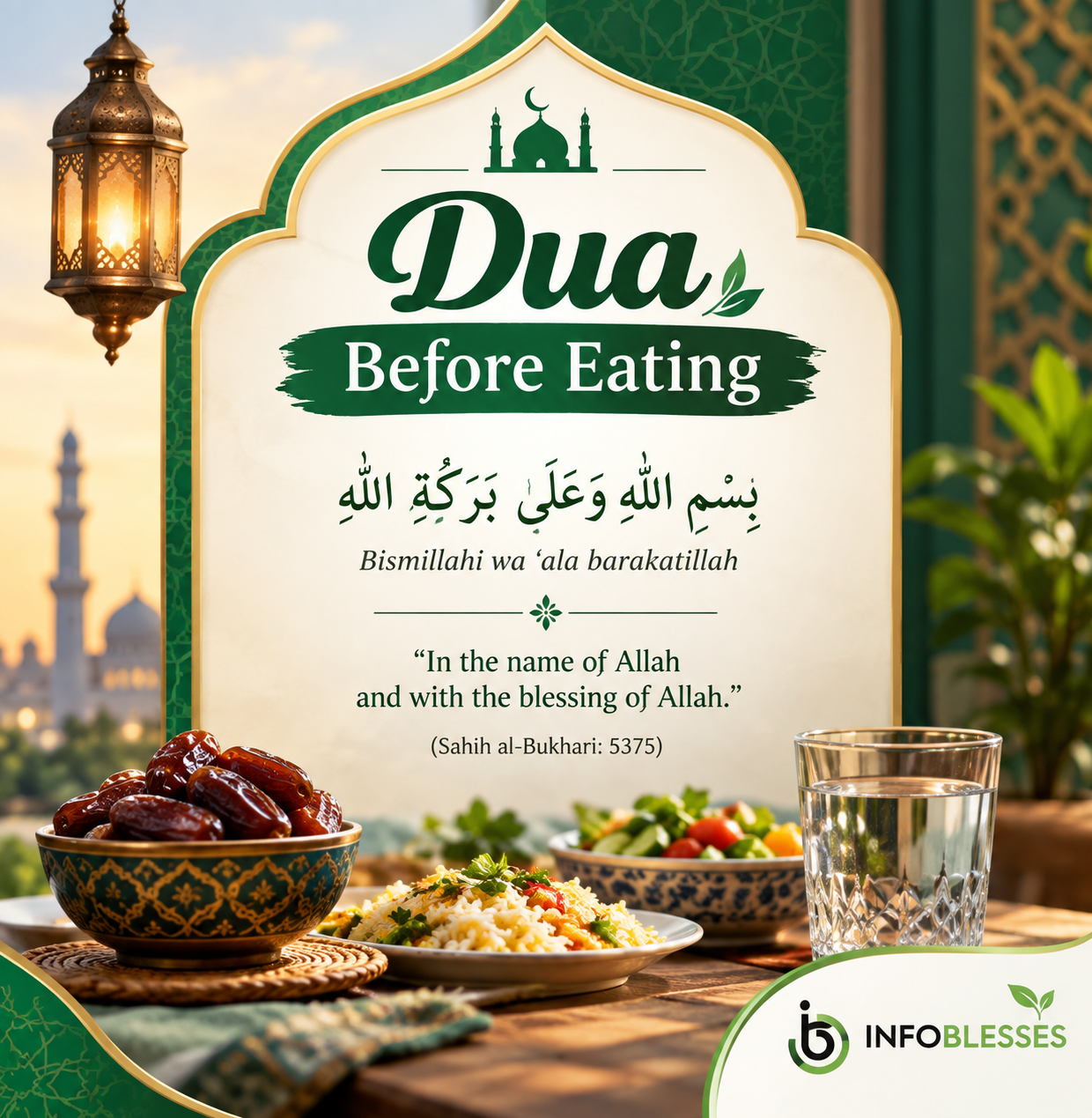
The dua before eating is one of the simplest daily practices in Islam. Before taking the first bite, a Muslim remembers Allah by saying “Bismillah”, meaning “In the name of Allah.” Although the words are short, this practice connects an ordinary meal with worship, gratitude, and awareness of Allah.
The basic dua before eating is:
بِسْمِ اللهِ
Bismillah
Meaning: “In the name of Allah.”
The Prophet Muhammad ﷺ taught Muslims to mention Allah’s name when beginning a meal. A well-known narration from Aishah رضي الله عنها also explains what to say if someone forgets at the beginning: “Bismillahi awwalahu wa akhirahu”—“In the name of Allah at its beginning and its end.” This narration is recorded in Sunan Abi Dawud 3767 and is graded sahih by Al-Albani on the cited source.
The practice is therefore easy to remember: say Bismillah before eating, and if you forget, say the longer phrase when you remember.
What Is the Dua Before Eating?
In everyday Islamic practice, the dua before eating commonly refers to saying Bismillah immediately before starting food.
The phrase is:
بِسْمِ اللهِ
Bismillah
The expression literally means “In the name of Allah.”
It isn’t necessary to use a long supplication before every meal. The established hadith specifically instructs a person to mention Allah’s name when eating. This makes the short phrase particularly easy for children and adults to learn and use consistently.
The purpose isn’t simply to repeat Arabic words. Saying Bismillah reminds a person that food is a blessing from Allah and that eating can be part of a life lived with gratitude and remembrance.
Arabic Text of the Dua Before Eating
The standard short form is:
بِسْمِ اللهِ
Transliteration: Bismillah
English meaning: In the name of Allah.
If a person forgets to say it at the beginning and remembers while eating, the reported phrase is:
بِسْمِ اللهِ أَوَّلَهُ وَآخِرَهُ
Transliteration: Bismillahi awwalahu wa akhirahu
Meaning: In the name of Allah at its beginning and at its end.
This longer form is directly supported by the narration in Sunan Abi Dawud 3767.
Transliteration of the Dua Before Eating
For someone learning Arabic pronunciation, transliteration can be helpful:
Bismillah
Pronounce it approximately as:
Bis-mil-laah
For the phrase used after forgetting:
Bismillahi awwalahu wa akhirahu
A simple pronunciation guide is:
Bis-mil-laa-hi aw-wa-la-hu wa aa-khi-ra-hu
Transliteration should be treated as a learning aid rather than a replacement for learning the Arabic words. If possible, listen to a reliable Arabic recitation and practice slowly.
English Meaning
The meaning of Bismillah is straightforward:
“In the name of Allah.”
It expresses that the person is beginning the action while remembering Allah.
The longer phrase, Bismillahi awwalahu wa akhirahu, means:
“In the name of Allah at its beginning and at its end.”
The meaning is especially relevant when someone has already started eating and then remembers that they did not say Bismillah.
How to Recite the Dua Before Eating
The dua before eating doesn’t require a complicated procedure.
Follow these simple steps:
- Sit down for your meal.
- Remember Allah before taking the first bite.
- Say “Bismillah.”
- Begin eating.
- If you forget and remember later, say “Bismillahi awwalahu wa akhirahu.”
- Continue eating normally.
The key is consistency. You don’t need to make the practice difficult. A short phrase said sincerely can become a powerful daily reminder.
When to Say the Dua Before Eating
The ideal time is before you begin eating.
For example, if dinner is placed in front of you, you can say Bismillah just before taking your first bite. The same principle applies to breakfast, lunch, snacks, dates, fruit, or other permissible food.
You don’t need to wait for a special occasion. One of the beautiful aspects of Islamic remembrance is that it can be incorporated into ordinary activities.
If you’re eating with family, each person can remember Allah individually. Parents can also gently remind children to say Bismillah without turning the moment into a source of embarrassment or stress.
What If You Forget?
Forgetting happens. Islam provides a clear answer.
If you begin eating and suddenly remember that you didn’t say Bismillah, say:
بِسْمِ اللهِ أَوَّلَهُ وَآخِرَهُ
Bismillahi awwalahu wa akhirahu
This means:
“In the name of Allah at its beginning and at its end.”
The wording comes from the narration of Aishah رضي الله عنها recorded by Abu Dawud.
So, don’t think that missing the first moment means the opportunity has completely passed. Remember Allah when you remember.
Why Muslims Say Bismillah Before Food
The dua before eating is more than a phrase attached to a meal. It is a small act of remembrance.
Remembering Allah
People can easily become distracted during meals. We may be talking, watching television, checking a phone, or thinking about work. Saying Bismillah creates a brief pause.
That pause has spiritual value.
It reminds the believer:
- Allah provides sustenance.
- Food is a blessing.
- Eating should be done in a responsible way.
- Everyday activities can involve remembrance of Allah.
- Gratitude should accompany blessings.
In this sense, the dua before eating helps connect physical nourishment with spiritual awareness.
Showing Gratitude
Food is something people often take for granted. Saying Bismillah encourages a person to recognize its source and value.
The Qur’an also teaches moderation in eating and drinking. In Surah Al-A’raf 7:31, believers are told to eat and drink without excess. This broader principle shows that Islamic eating etiquette involves both remembrance and responsible behavior.
The dua before eating, therefore, fits naturally into a larger Islamic approach to food: remember Allah, eat permissible food, practice good manners, avoid excess, and be grateful.
Dua Before Eating in the Hadith
One of the clearest references comes from Sunan Abi Dawud 3767.
The narration reports that the Prophet ﷺ instructed a person who eats to mention Allah’s name. It then gives the special wording to use if the person forgets at the beginning.
This hadith is important because it answers two practical questions:
What should I say before eating?
Say Bismillah.
What if I forget?
Say Bismillahi awwalahu wa akhirahu when you remember.
The narration makes the practice easy to understand and apply.
Another narration concerning eating etiquette describes the Prophet ﷺ teaching a young companion to say Bismillah, eat with the right hand, and eat from what is directly in front of him. These teachings demonstrate that Islamic manners around food involve both remembrance and behavior.
For readers who want to examine the primary hadith source, see the relevant entry in Sunan Abi Dawud 3767 on Sunnah.com.
Bismillah or Bismillahir-Rahmanir-Rahim?
A common question is whether someone should say:
Bismillah
or:
Bismillahir-Rahmanir-Rahim
The established wording specifically reported for starting food is Bismillah. Some scholars have also considered saying Bismillahir-Rahmanir-Rahim permissible.
For someone who wants to follow the wording explicitly mentioned in the hadith, simply saying:
Bismillah
is sufficient.
This is useful because it keeps the dua before eating simple and easy to remember.
There is no need to worry that a meal is invalid because you didn’t pronounce a longer formula. The essential practice is remembering Allah’s name.
Eating Etiquette in Islam
The dua before eating is one part of a wider set of Islamic manners.
Food etiquette in Islam encourages respect, cleanliness, gratitude, moderation, and remembrance.
Eat With the Right Hand
A well-known hadith reports the Prophet ﷺ teaching Umar ibn Abi Salamah رضي الله عنه to say Bismillah, eat with the right hand, and eat from what is directly in front of him.
This demonstrates that Islamic food manners combine the spiritual and practical.
The instruction isn’t only about what a person says. It also concerns how a person behaves at the meal.
Eat From What Is In Front of You
When people share a common dish, Islamic etiquette includes eating from the portion directly in front of oneself rather than reaching across the entire dish.
This encourages consideration for other people at the table.
It is especially relevant in communal meals, where good manners help everyone eat comfortably.
Avoid Excess
The Qur’an states that people should eat and drink but not be excessive.
This principle can be applied thoughtfully to modern eating habits. Islam doesn’t require a person to reject enjoyable food. Instead, it teaches balance and responsible consumption.
Saying the dua before eating can serve as a mental reminder that food is a blessing rather than something to waste.
Dua Before Eating for Children
Teaching the dua before eating to children is an excellent way to introduce everyday Islamic manners.
Start with the easiest phrase:
Bismillah.
Don’t overwhelm a young child with complicated explanations. First, help the child associate the phrase with the beginning of a meal.
Parents can use simple reminders such as:
“What do we say before eating?”
After the child learns Bismillah, explain its meaning:
“It means we begin in the name of Allah.”
As children grow, parents can introduce the longer phrase for situations where they forget.
The goal should be encouragement rather than fear. Children learn habits through repetition, example, and positive reinforcement.
If parents say Bismillah consistently themselves, children are more likely to copy the practice naturally.
Common Mistakes to Avoid
Even a simple Sunnah can become confusing when too many rules are attached to it.
Here are some common mistakes to avoid.
1. Thinking the Dua Must Be Long
The basic dua before eating is simply:
Bismillah.
You don’t need a lengthy supplication.
2. Giving Up After Forgetting
If you forgot, don’t assume there’s nothing you can do. Say the reported phrase when you remember:
Bismillahi awwalahu wa akhirahu.
3. Focusing Only on Pronunciation
Correct pronunciation is valuable, but understanding the meaning matters too.
Know what you’re saying: “In the name of Allah.”
4. Treating Food as Something Ordinary
The practice is designed to cultivate remembrance and gratitude. Don’t rush through it without understanding why you’re doing it.
5. Making Children Afraid of Mistakes
Children need patient teaching. A gentle reminder is usually more productive than harsh criticism.
Is the Dua Before Eating Obligatory or Sunnah?
There is scholarly discussion about the legal status of saying Allah’s name before eating, including whether it should be regarded as obligatory or Sunnah and how different schools interpret the relevant evidence.
For general educational purposes, the safest practical point is clear: the Prophet ﷺ instructed Muslims to mention Allah’s name when eating, and saying Bismillah before food is an established Islamic practice.
People seeking a detailed fiqh ruling should consult a qualified scholar familiar with their madhhab and circumstances.
This distinction is important because a short article shouldn’t present a nuanced matter of Islamic jurisprudence as though every scholar has used exactly the same terminology.
What is universally easy to practice is the remembrance itself: before eating, say Bismillah.
Dua Before Eating and Daily Spiritual Habits
One reason the dua before eating is so valuable is its simplicity.
Some acts of worship require a specific time, place, preparation, or extended concentration. Bismillah takes only a moment.
That makes it ideal for building consistency.
Consider how many times a person eats or drinks during a normal day. Each occasion can become an opportunity to remember Allah.
Over time, a tiny habit can influence the way a person thinks about ordinary blessings.
A meal becomes a reminder.
A snack becomes a reminder.
A family dinner becomes a reminder.
Even a glass of water can prompt gratitude.
The practice also encourages mindfulness. Instead of immediately reaching for food, a person pauses and remembers the One who provides it.
That pause can shape the atmosphere of the entire meal.
7 Key Facts About the Dua Before Eating
Here are seven points worth remembering:
| # | Key Fact | Practical Lesson |
|---|---|---|
| 1 | The basic phrase is Bismillah | Keep it simple |
| 2 | It means “In the name of Allah” | Understand what you say |
| 3 | It is taught in hadith | Follow the Prophetic guidance |
| 4 | You should say it before eating | Make it a regular habit |
| 5 | There is a phrase for forgetting | Say Bismillahi awwalahu wa akhirahu |
| 6 | It connects food with remembrance | Practice gratitude |
| 7 | It belongs to wider eating etiquette | Combine remembrance with good manners |
FAQs About the Dua Before Eating
What is the dua before eating?
The basic dua before eating is:
بِسْمِ اللهِ
Bismillah
It means “In the name of Allah.”
The Prophet Muhammad ﷺ instructed Muslims to mention Allah’s name when beginning to eat.
What should I say if I forget the dua?
If you start eating and remember that you forgot to say Bismillah, say:
بِسْمِ اللهِ أَوَّلَهُ وَآخِرَهُ
Bismillahi awwalahu wa akhirahu
It means:
“In the name of Allah at its beginning and at its end.”
This wording is reported in Sunan Abi Dawud 3767.
Can I say Bismillahir-Rahmanir-Rahim before eating?
Yes, scholars have discussed the longer phrase Bismillahir-Rahmanir-Rahim, and it has been considered permissible by many scholars. However, the short wording explicitly reported in the relevant hadith is Bismillah.
For simplicity, saying Bismillah is sufficient.
Should I say the dua before every meal?
The practice is intended to accompany eating whenever a person begins a meal or food. Making it a consistent habit helps ensure that remembrance of Allah becomes part of everyday life.
The important thing is not to make the practice unnecessarily complicated.
What if I remember halfway through eating?
If you forgot to say Bismillah at the beginning, remember Allah when you recall it and say:
Bismillahi awwalahu wa akhirahu.
The hadith specifically provides this wording for someone who forgot at the beginning.
Is there a dua after eating?
Yes. Islamic tradition includes supplications and expressions of gratitude after eating as well. A well-known practice is to praise Allah after finishing food.
One commonly narrated supplication begins with Alhamdulillah, expressing praise and gratitude to Allah for the food and provision.
The broader lesson is that Islamic etiquette surrounds eating with remembrance before and after the meal.
Can children learn this dua?
Absolutely. In fact, Bismillah is one of the easiest Islamic phrases for children to learn.
Begin with the Arabic phrase and its meaning. Encourage children to say it before meals, and remind them gently when they forget.
As they become comfortable with the short phrase, parents can teach them the longer wording used when someone remembers after starting to eat.
Conclusion:
The dua before eating is wonderfully simple:
بِسْمِ اللهِ
Bismillah
“In the name of Allah.”
This short phrase can transform an ordinary meal into an opportunity for remembrance and gratitude. The Prophetic guidance also gives Muslims a practical solution for forgetting: say Bismillahi awwalahu wa akhirahu when you remember.
Beyond the words themselves, the practice teaches an important Islamic principle: everyday blessings should not make us forget the One who provides them.
So, before your next meal, pause for a moment, say Bismillah, and begin with gratitude. Small acts of remembrance can become meaningful habits when practiced consistently.

Welcome to Info Blesses I am Rana Ahtasham an AI Powered SEO and Content Writer With 3 year experience.I help websites rank highter, grow traffic, and look amazing. My goal is to make SEO and web design simple and effective for everyone.Lets achieve more togather!