Prayer, known as Salah or Namaz, is one of the most important acts of worship in Islam. It allows Muslims to connect with Allah five times every day, seek His guidance, express gratitude, and strengthen their faith.
However, the spiritual journey doesn’t end when a Muslim completes the prayer with Salam. The moments immediately following Salah offer an excellent opportunity to remember Allah, seek forgiveness, and make heartfelt supplications.
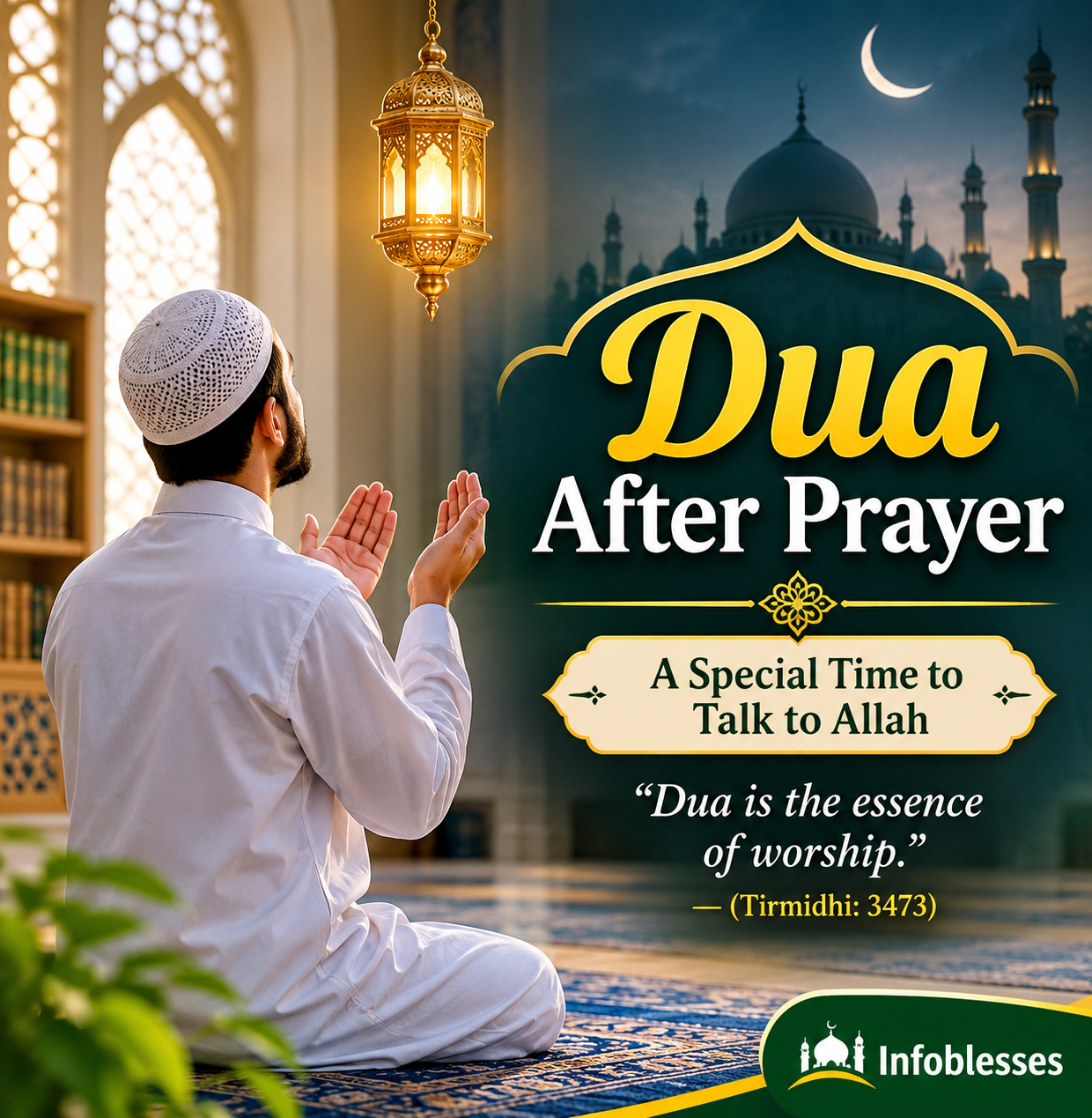
Reciting a Dua After Prayer is a beautiful way to continue worshipping Allah after completing the obligatory prayer. The Prophet Muhammad (peace and blessings be upon him) taught several forms of Dhikr and supplication that Muslims can incorporate into their daily routines.
These include asking Allah for forgiveness, praising Him, declaring His greatness, reciting Ayat al-Kursi, and seeking protection from harm.
Whether you’re a new Muslim, a regular worshipper, or someone hoping to improve your Islamic knowledge, this guide will help you understand important post-prayer supplications.
Let’s explore 15 meaningful duas and remembrances, their Arabic wording, transliteration, English meanings, and practical benefits.
1. Understanding the Importance of Dua After Prayer
Salah is more than a daily religious obligation. It’s an opportunity to pause, leave worldly distractions behind, and remember the Creator.
After completing Fard Salah, Muslims are encouraged to continue remembering Allah through authentic supplications and Dhikr.
The Quran repeatedly reminds believers to remember Allah. This remembrance helps develop gratitude, patience, humility, and awareness of our responsibilities.
Why Muslims Should Make Dua After Salah
There are several reasons to develop a regular habit of making supplications after prayer.
1. Strengthening your relationship with Allah
Every sincere supplication reminds you that Allah is always aware of your needs. You can ask Him for guidance, forgiveness, protection, and blessings.
2. Seeking forgiveness
Human beings make mistakes. Asking Allah for forgiveness after prayer is a reminder that everyone needs His mercy.
3. Developing gratitude
Expressions such as Alhamdulillah remind Muslims to appreciate their blessings, including health, family, food, and opportunities.
4. Finding peace and comfort
Remembering Allah can help calm the heart during difficult situations. It encourages believers to trust Allah rather than become overwhelmed by worldly worries.
5. Following the Sunnah
The Prophet Muhammad (peace be upon him) regularly remembered Allah after obligatory prayers. Following his example helps Muslims develop a meaningful worship routine.
Difference Between Dua and Dhikr
Although people sometimes use these terms interchangeably, they have different meanings.
| Term | Meaning | Example |
|---|---|---|
| Dua | Asking Allah for something | Asking for forgiveness |
| Dhikr | Remembering and praising Allah | SubhanAllah |
| Tasbih | Declaring Allah’s perfection | SubhanAllah |
| Tahmid | Praising Allah | Alhamdulillah |
| Takbir | Declaring Allah’s greatness | Allahu Akbar |
| Istighfar | Seeking forgiveness | Astaghfirullah |
Both Dua and Dhikr are important parts of Islamic worship.
A Muslim can praise Allah, thank Him, and ask Him for personal needs after completing Salah.
When Should You Recite Post-Prayer Supplications?
The recommended post-prayer adhkar are generally recited after completing the prayer with Salam.
You can remain seated for a few moments, remember Allah, and recite the established supplications.
There is no need to rush away immediately after Salah. Even a short period of sincere remembrance can make your daily worship more meaningful.
2. 15 Powerful Duas and Dhikr to Recite After Prayer
The following supplications and remembrances provide a practical collection for your daily routine.
Some are established post-prayer adhkar, while others are Quranic recitations and general supplications that Muslims can make at appropriate times.
The Arabic, transliteration, and English meanings are included to make learning easier.
1. Astaghfirullah – Asking Allah for Forgiveness
One of the first remembrances recommended after completing an obligatory prayer is seeking forgiveness.
Arabic:
أَسْتَغْفِرُ اللَّهَ
Transliteration:
Astaghfirullah.
English Meaning:
I seek forgiveness from Allah.
How many times?
Three times.
Importance:
The Prophet Muhammad (peace be upon him) used to seek Allah’s forgiveness three times after completing Salah.
This simple supplication reminds Muslims that nobody is free from mistakes. We should regularly turn to Allah with sincere repentance.
2. Allahumma Antas-Salam – Asking for Peace
After seeking forgiveness, Muslims can recite this beautiful supplication.
Arabic:
اللَّهُمَّ أَنْتَ السَّلَامُ وَمِنْكَ السَّلَامُ تَبَارَكْتَ يَا ذَا الْجَلَالِ وَالْإِكْرَامِ
Transliteration:
Allahumma Antas-Salamu wa minkas-salamu tabarakta ya Dhal-Jalali wal-Ikram.
English Meaning:
O Allah, You are Peace, and peace comes from You. Blessed are You, O Possessor of Majesty and Honour.
Importance:
This supplication teaches Muslims to recognize Allah as the source of peace and perfection.
It also encourages believers to seek peace in their hearts, homes, relationships, and daily lives.
3. SubhanAllah – Glorifying Allah
Arabic:
سُبْحَانَ اللَّهِ
Transliteration:
SubhanAllah.
English Meaning:
Glory be to Allah. Allah is free from every imperfection.
How many times?
33 times in one well-known post-prayer Dhikr routine.
Importance:
Tasbih is a beautiful way to glorify Allah and acknowledge His perfection.
It is also an easy remembrance that can be incorporated into every daily prayer.
4. Alhamdulillah – Praising Allah
Arabic:
الْحَمْدُ لِلَّهِ
Transliteration:
Alhamdulillah.
English Meaning:
All praise belongs to Allah.
How many times?
33 times in the commonly narrated 33-33-33 routine.
Importance:
This expression reminds Muslims that every blessing ultimately comes from Allah.
Whether life is comfortable or challenging, saying Alhamdulillah encourages gratitude and contentment.
5. Allahu Akbar – Declaring Allah’s Greatness
Arabic:
اللَّهُ أَكْبَرُ
Transliteration:
Allahu Akbar.
English Meaning:
Allah is the Greatest.
How many times?
33 times in the 33-33-33 routine.
Another authentic narration describes saying it 34 times in a different combination.
Importance:
This remembrance reminds believers that Allah is greater than every difficulty, worry, and worldly concern.
It helps develop humility and trust in Allah.
6. La Ilaha Illallah Wahdahu La Sharika Lah
This powerful declaration of faith is another important post-prayer remembrance.
Arabic:
لَا إِلَٰهَ إِلَّا اللَّهُ وَحْدَهُ لَا شَرِيكَ لَهُ لَهُ الْمُلْكُ وَلَهُ الْحَمْدُ وَهُوَ عَلَىٰ كُلِّ شَيْءٍ قَدِيرٌ
Transliteration:
La ilaha illallahu wahdahu la sharika lah, lahul-mulku wa lahul-hamdu wa huwa ala kulli shay’in qadir.
English Meaning:
There is no deity worthy of worship except Allah alone. He has no partner. To Him belongs the dominion and all praise, and He has power over everything.
How many times?
Once to complete the 100 remembrances in the well-known routine of 33 SubhanAllah, 33 Alhamdulillah, and 33 Allahu Akbar.
Importance:
This Dhikr reinforces Tawheed, the belief in the absolute oneness of Allah.
7. Ayat al-Kursi – A Powerful Quranic Verse
Ayat al-Kursi is verse 255 of Surah Al-Baqarah.
It describes Allah’s greatness, knowledge, power, and complete authority over the heavens and the earth.
Arabic opening:
اللَّهُ لَا إِلَٰهَ إِلَّا هُوَ الْحَيُّ الْقَيُّومُ
Transliteration:
Allahu la ilaha illa Huwal-Hayyul-Qayyum.
English Meaning:
Allah! There is no deity worthy of worship except Him, the Ever-Living, the Sustainer of all existence.
Recommended practice:
Recite the complete verse once after each obligatory prayer.
Importance:
A narration reported by An-Nasa’i and others mentions the virtue of reciting Ayat al-Kursi after obligatory prayers.
Its message reminds believers that Allah’s knowledge and power are unlimited.
Read the complete verse at Quran.com – Ayat al-Kursi.
8. Surah Al-Ikhlas – Affirming the Oneness of Allah
Arabic:
قُلْ هُوَ اللَّهُ أَحَدٌ اللَّهُ الصَّمَدُ لَمْ يَلِدْ وَلَمْ يُولَدْ وَلَمْ يَكُن لَّهُ كُفُوًا أَحَدٌ
Transliteration:
Qul Huwallahu Ahad. Allahus-Samad. Lam yalid wa lam yulad. Wa lam yakul-lahu kufuwan ahad.
English Meaning:
Say: He is Allah, the One. Allah, the Eternal Refuge. He neither begets nor is born, nor is there any equivalent to Him.
Recommended practice:
Recite it once after obligatory prayers as part of the established post-prayer recitations.
Importance:
This short chapter teaches the fundamental Islamic belief in the oneness and uniqueness of Allah.
9. Surah Al-Falaq – Seeking Protection from Evil
Arabic opening:
قُلْ أَعُوذُ بِرَبِّ الْفَلَقِ
Transliteration:
Qul A’udhu bi Rabbil-Falaq.
English Meaning:
Say: I seek refuge in the Lord of daybreak.
Recommended practice:
Recite the complete Surah Al-Falaq once after obligatory prayers.
Importance:
This chapter teaches Muslims to seek Allah’s protection from various forms of harm, including envy and evil.
10. Surah An-Nas – Seeking Protection from Whisperings
Arabic opening:
قُلْ أَعُوذُ بِرَبِّ النَّاسِ
Transliteration:
Qul A’udhu bi Rabbin-Nas.
English Meaning:
Say: I seek refuge in the Lord of mankind.
Recommended practice:
Recite the complete Surah An-Nas once after obligatory prayers.
Importance:
This chapter teaches believers to seek protection from harmful whisperings and spiritual temptations.
11. Allahumma A’inni Ala Dhikrika – Asking for Help in Worship
This is a beautiful supplication taught by the Prophet Muhammad (peace be upon him).
Arabic:
اللَّهُمَّ أَعِنِّي عَلَىٰ ذِكْرِكَ وَشُكْرِكَ وَحُسْنِ عِبَادَتِكَ
Transliteration:
Allahumma a’inni ala dhikrika wa shukrika wa husni ibadatik.
English Meaning:
O Allah, help me to remember You, thank You, and worship You in the best manner.
Importance:
This dua reminds Muslims that even worship requires Allah’s help.
It is especially meaningful for anyone trying to become more consistent with Salah and other acts of worship.
12. Rabbana Atina Fid-Dunya Hasanah – Asking for Goodness
Arabic:
رَبَّنَا آتِنَا فِي الدُّنْيَا حَسَنَةً وَفِي الْآخِرَةِ حَسَنَةً وَقِنَا عَذَابَ النَّارِ
Transliteration:
Rabbana atina fid-dunya hasanatan wa fil-akhirati hasanatan wa qina adhaban-nar.
English Meaning:
Our Lord, grant us goodness in this world and goodness in the Hereafter, and protect us from the punishment of the Fire.
Reference:
Surah Al-Baqarah, verse 201.
Importance:
This Quranic dua covers both worldly and spiritual needs.
Muslims can use it to ask Allah for a good life, beneficial opportunities, and success in the Hereafter.
13. Rabbighfir Li – Asking for Forgiveness and Mercy
Arabic:
رَبِّ اغْفِرْ لِي وَارْحَمْنِي
Transliteration:
Rabbighfir li warhamni.
English Meaning:
My Lord, forgive me and have mercy upon me.
Importance:
This short supplication expresses two essential needs: forgiveness and mercy.
It can be recited as a personal dua after Salah or at other appropriate times.
14. La Hawla Wa La Quwwata Illa Billah – Seeking Strength from Allah
Arabic:
لَا حَوْلَ وَلَا قُوَّةَ إِلَّا بِاللَّهِ
Transliteration:
La hawla wa la quwwata illa billah.
English Meaning:
There is no power and no strength except through Allah.
Importance:
This remembrance teaches Muslims that all strength and ability come from Allah.
It can provide spiritual encouragement when facing difficult circumstances and personal challenges.
15. Hasbunallahu Wa Ni’mal Wakeel – Trusting Allah
Arabic:
حَسْبُنَا اللَّهُ وَنِعْمَ الْوَكِيلُ
Transliteration:
Hasbunallahu wa ni’mal wakeel.
English Meaning:
Allah is sufficient for us, and He is the best Disposer of affairs.
Reference:
Surah Aal-Imran, verse 173.
Importance:
This Quranic expression teaches reliance upon Allah.
It reminds believers that they should make sincere efforts while placing their ultimate trust in their Creator.
Important note: Not all 15 entries above are separate prescribed post-prayer formulas. The first ten include established post-prayer remembrances, while the remaining supplications are Quranic or general duas that can be made without claiming a specific Sunnah count or fixed post-prayer sequence.
3. How to Make Dua After Salah Correctly
Knowing the words of supplication is important, but understanding how to incorporate them into your worship is equally valuable.
Islam encourages sincerity, humility, and consistency in remembering Allah.
Step 1: Complete Your Salah with Salam
After completing the final Tashahhud and sending Salam, remain seated if possible.
You can begin the post-prayer remembrance immediately.
Step 2: Seek Allah’s Forgiveness
Say Astaghfirullah three times.
This is a simple but meaningful way to begin your post-prayer adhkar.
Step 3: Recite the Supplication for Peace
Say:
Allahumma Antas-Salamu wa minkas-salamu tabarakta ya Dhal-Jalali wal-Ikram.
Reflect on its meaning and remember that peace comes from Allah.
Step 4: Perform Tasbih, Tahmid, and Takbir
One commonly narrated routine is:
| Dhikr | Number of repetitions |
|---|---|
| SubhanAllah | 33 |
| Alhamdulillah | 33 |
| Allahu Akbar | 33 |
| La ilaha illallahu wahdahu la sharika lah… | 1 |
Another authentic form is 33 SubhanAllah, 33 Alhamdulillah, and 34 Allahu Akbar.
Both forms are established in authentic narrations.
Step 5: Recite Ayat al-Kursi
Read the complete verse from Surah Al-Baqarah.
Take your time and reflect on its meaning rather than rushing through the words.
Step 6: Recite the Three Quls
Read:
- Surah Al-Ikhlas.
- Surah Al-Falaq.
- Surah An-Nas.
These chapters are important Quranic recitations for seeking Allah’s protection.
Step 7: Make Personal Dua
After completing the established adhkar, you can ask Allah for whatever lawful and beneficial things you need.
For example, you can ask for:
- Forgiveness for your sins.
- Good health and protection.
- Guidance in important decisions.
- Blessings in your home and family.
- Success in your studies and work.
- Relief from difficulties.
- A good ending and success in the Hereafter.
You can make dua in Arabic or in your own language.
Allah knows what is in every heart.
Best Time to Make Dua
There are several blessed times for supplication in Islam, including:
- During the final part of the night.
- Between the Adhan and Iqamah.
- During Sujood.
- On Fridays, during the period of special acceptance.
- After completing obligatory prayers, when performing the prescribed post-prayer remembrance.
It is important to distinguish between established post-Salah adhkar and other personal supplications. Not every supplication has a fixed time or prescribed number of repetitions.
Common Mistakes to Avoid
While developing a regular routine, keep these points in mind:
1. Rushing through Dhikr
Try to understand what you’re saying instead of reciting everything without attention.
2. Treating optional practices as obligatory
Post-prayer adhkar are highly recommended forms of remembrance, but they aren’t a replacement for the five obligatory prayers.
3. Assuming every dua has a fixed number
Only use specific repetition counts when supported by reliable Islamic evidence.
4. Neglecting sincerity
The purpose of remembrance isn’t simply to complete a list. It’s to remember Allah with a sincere heart.
5. Becoming discouraged
If you cannot complete every remembrance on a busy day, don’t abandon the habit completely. Start with the established basic adhkar and build consistency over time.
4. Benefits of Reciting Dua After Prayer
Making remembrance part of your daily routine can positively influence your spiritual life.
Here are some important benefits.
1. Greater Awareness of Allah
Regular Dhikr reminds believers that Allah is aware of their actions, intentions, and circumstances.
This awareness can encourage better decisions and stronger faith.
2. Increased Gratitude
Saying Alhamdulillah helps Muslims recognize their blessings.
Instead of focusing only on what is missing, believers learn to appreciate what Allah has already provided.
3. A Habit of Seeking Forgiveness
Reciting Astaghfirullah regularly develops humility and reminds Muslims to repent when they make mistakes.
4. Stronger Spiritual Discipline
Completing Salah and following it with Dhikr creates a consistent worship routine.
Over time, this routine can help Muslims become more mindful of their religious responsibilities.
5. Greater Trust in Allah
Supplications such as Hasbunallahu wa Ni’mal Wakeel remind Muslims to rely upon Allah while continuing to make responsible efforts.
6. Protection Through Quranic Remembrance
Reciting Ayat al-Kursi and the protective chapters of the Quran is an important part of Muslim devotional practice.
7. A More Meaningful Daily Routine
The five daily prayers provide regular opportunities to pause, reflect, and reconnect with Allah.
Adding a few minutes of remembrance makes those moments even more meaningful.
5. A Simple Daily Dua After Prayer Routine
If you’re unsure where to begin, follow this practical routine after your obligatory prayers.
| Order | Remembrance | Repetition |
|---|---|---|
| 1 | Astaghfirullah | 3 times |
| 2 | Allahumma Antas-Salam | Once |
| 3 | SubhanAllah | 33 times |
| 4 | Alhamdulillah | 33 times |
| 5 | Allahu Akbar | 33 times |
| 6 | Closing declaration of Tawheed | Once |
| 7 | Ayat al-Kursi | Once |
| 8 | Surah Al-Ikhlas | Once |
| 9 | Surah Al-Falaq | Once |
| 10 | Surah An-Nas | Once |
This is a practical selection of established remembrances. There are different authentic narrations and arrangements, so this table should not be understood as the only valid sequence.
Try learning one supplication at a time. You can write the Arabic wording in a notebook, listen to a reliable Quran recitation, and practise the pronunciation.
Most importantly, aim for consistency rather than perfection.
6. Frequently Asked Questions About Dua After Prayer
Q1. What is the best dua after prayer?
There isn’t just one best dua for every situation. Among the established post-prayer remembrances are Astaghfirullah three times and Allahumma Antas-Salam wa minkas-Salam.
The Prophet Muhammad (peace be upon him) also taught Muslims to remember Allah through Tasbih, Tahmid, and Takbir.
Q2. How many times should I say SubhanAllah after Salah?
A well-known authentic practice is to say SubhanAllah 33 times, Alhamdulillah 33 times, and Allahu Akbar 33 times, followed by a declaration of Allah’s oneness.
Another authentic narration gives 34 repetitions of Allahu Akbar after 33 repetitions each of the other two phrases.
Q3. Can I make dua in English after Namaz?
Yes. You can make personal supplications in English or another language after completing Salah.
You can ask Allah for guidance, forgiveness, health, family blessings, and help with personal difficulties.
Q4. Should I raise my hands when making dua after prayer?
There are different scholarly discussions about raising the hands after obligatory prayers. It should not be treated as an obligatory part of the established post-prayer adhkar.
Follow reliable scholarly guidance within your school of Islamic jurisprudence.
Q5. Is Ayat al-Kursi recited after every obligatory prayer?
Yes. Reciting Ayat al-Kursi after obligatory prayers is supported by a narration reported in the collections of An-Nasa’i and others.
Many Muslims include it in their daily post-prayer routine.
Q6. Can women recite dua after prayer?
Absolutely. Women and men can remember Allah and make supplications after Salah.
There is no general restriction preventing women from reciting these duas.
Q7. What should I recite after Fajr prayer?
You can recite the established post-prayer adhkar, including Astaghfirullah, Allahumma Antas-Salam, Tasbih, Tahmid, Takbir, and Ayat al-Kursi.
You can also recite the three short chapters of the Quran.
Q8. Can I make personal dua after every prayer?
Yes. You can ask Allah for your personal needs after completing Salah and the prescribed remembrance.
There is no need to limit your requests to a particular list of supplications.
Q9. What if I don’t know Arabic?
You can learn the supplications gradually using transliteration and reliable audio recitations.
You can also make personal dua in your native language. Understanding the meaning is an important part of developing a meaningful connection with Allah.
Q10. Is it necessary to recite all the duas after every Salah?
No. You aren’t required to recite every optional supplication after every obligatory prayer.
Begin with the established adhkar that you can remember and perform consistently. Add more as your knowledge and confidence grow.
Conclusion:
Developing a habit of remembering Allah after Salah is a beautiful way to strengthen your faith and make your daily worship more meaningful.
The supplications discussed in this guide include seeking forgiveness, praising Allah, declaring His greatness, reciting Quranic verses, and asking for guidance and protection.
You don’t need to memorize everything in one day. Start with Astaghfirullah, Allahumma Antas-Salam, and the basic Tasbih after prayer. Gradually learn the remaining supplications and their meanings.
Remember, the value of worship isn’t measured simply by the number of words you recite. Sincerity, understanding, and consistency are essential.
May Allah accept our prayers, forgive our shortcomings, bless our families, guide us towards righteousness, and grant us success in this life and the Hereafter.
Ameen.

Welcome to Info Blesses I am Rana Ahtasham an AI Powered SEO and Content Writer With 3 year experience.I help websites rank highter, grow traffic, and look amazing. My goal is to make SEO and web design simple and effective for everyone.Lets achieve more togather!