In Islam, barakah is one of the most beautiful blessings a believer can ask Allah for. The word is often translated as “blessing,” but its meaning goes deeper than simply having more of something. Barakah can mean that Allah places goodness, benefit, peace, usefulness, and lasting value into what we already have. A person may have limited wealth but feel content and find that it meets every important need. Someone may have a busy schedule yet accomplish meaningful things with a small amount of time. A family may not possess great riches but enjoy love, cooperation, peace, and mutual respect. These are examples of the kind of goodness Muslims seek through barakah.
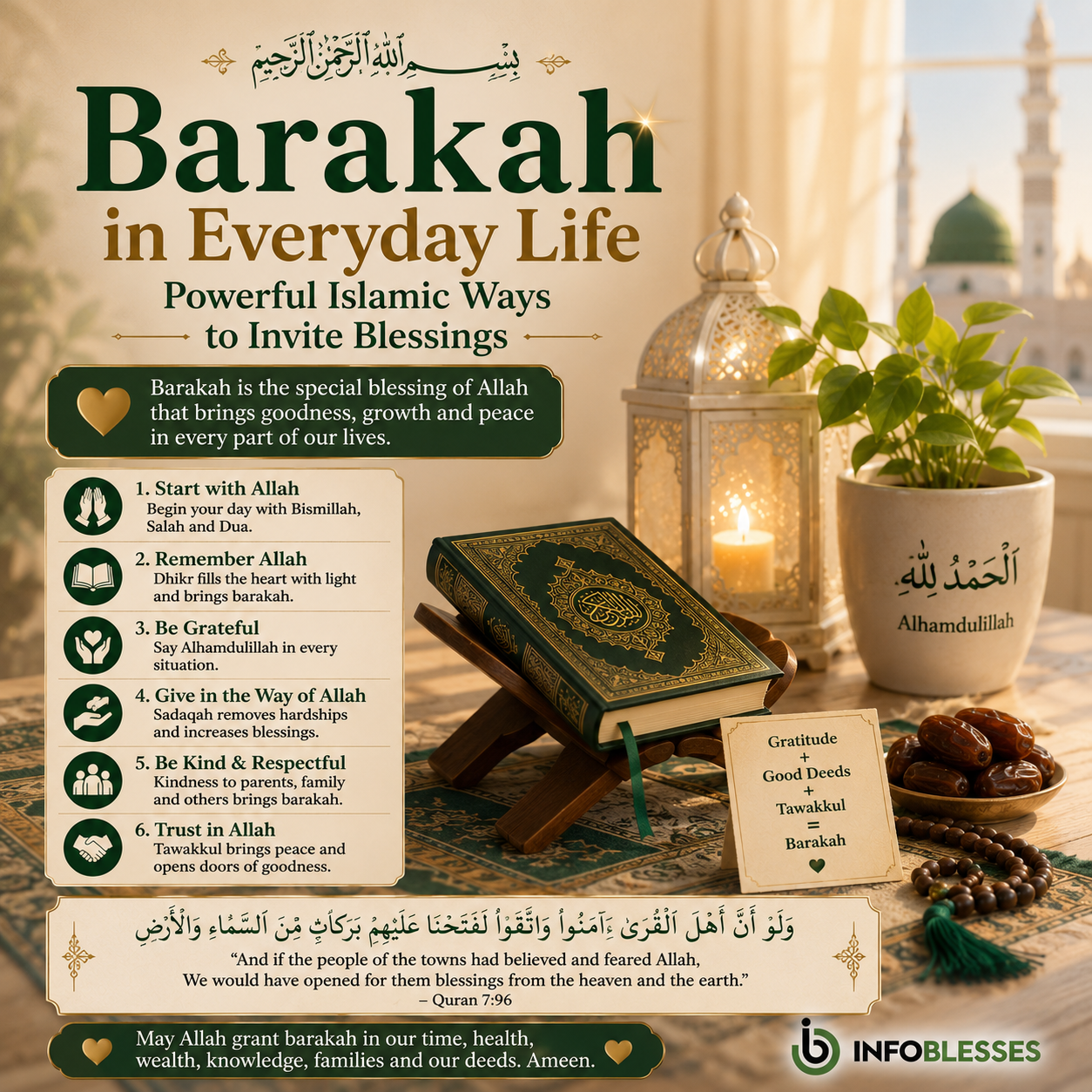
The Quran connects faith and taqwa with blessings from Allah. Allah says that if the people of the towns had believed and remained mindful of Him, He would have opened blessings for them from the heavens and the earth.
Barakah is therefore not merely about increasing possessions. It is about making our lives beneficial and meaningful while keeping our hearts connected to Allah. Islam teaches Muslims to seek this blessing through obedience, gratitude, honest living, remembrance, charity, good relationships, and sincere dua.
In this article, we will explore powerful Islamic ways to invite barakah into everyday life, including barakah in time, wealth, family, knowledge, work, food, worship, and personal relationships.
What Does Barakah Mean in Islam?

Barakah refers to goodness and blessing that Allah places into something. It does not necessarily mean that the quantity becomes larger. Sometimes the blessing appears through greater benefit, greater usefulness, increased peace, or lasting goodness.
For example, two people may earn the same amount of money. One person constantly feels that the money disappears without accomplishing much, while the other manages the same income responsibly, supports the family, gives charity, avoids unnecessary spending, and remains content. The difference is not necessarily the amount of money; it can be the goodness and benefit placed within it.
The same idea can apply to time. A person may have only a few hours available but accomplish important work, maintain prayers, spend time with family, read Quran, and help others. Another person may have many free hours but spend them without meaningful results.
This teaches an important Islamic lesson: more is not always better; blessed is better.
The Quran describes Allah’s blessings as something connected to faith and taqwa. Therefore, Muslims should not measure Allah’s favor only by wealth, possessions, popularity, or worldly success.
True barakah can be found in contentment, righteous actions, useful knowledge, peaceful relationships, halal provision, and closeness to Allah.
Strengthen Taqwa to Invite Barakah

One of the most important foundations of barakah is taqwa, meaning consciousness and fear of Allah that motivates a person to obey Him.
Allah says in the Quran:
“And if the people of the towns had believed and been mindful of Allah, We would have opened for them blessings from the heavens and the earth.” — Quran 7:96
This verse gives believers a powerful principle: faith and taqwa are closely connected with Allah’s blessings.
Taqwa means trying to live according to Allah’s guidance. It involves fulfilling obligatory acts of worship, avoiding what Allah has prohibited, repenting after mistakes, and being conscious that Allah knows what we do publicly and privately.
A person who wants barakah should therefore begin by examining the foundation of life.
Are the prayers being protected?
Is income halal?
Are people’s rights being respected?
Are relationships being maintained?
Are sins being taken seriously?
Is repentance part of everyday life?
Barakah should not be treated like a formula where a person performs a few actions simply to receive worldly benefits. Rather, it comes from sincerely turning toward Allah and trying to live according to His guidance.
Make Gratitude a Daily Habit

Shukr, or gratitude, is another powerful way to cultivate barakah.
Allah says:
“If you are grateful, I will surely increase you.” — Quran 14:7
The verse establishes a beautiful relationship between gratitude and increase.
Gratitude in Islam is more than simply saying Alhamdulillah. It involves the heart, the tongue, and actions.
A believer recognizes that every blessing ultimately comes from Allah. Health, family, food, shelter, knowledge, opportunities, safety, and even the ability to worship are gifts from Him.
The tongue expresses gratitude by praising Allah.
The heart recognizes the source of the blessing.
The actions demonstrate gratitude by using blessings in ways that please Allah.
For example, if Allah gives someone wealth, gratitude means using that wealth responsibly and helping others. If Allah gives knowledge, gratitude means using it beneficially rather than becoming arrogant. If Allah gives good health, gratitude means using the body for useful and righteous activities.
A simple daily habit can make gratitude more meaningful: before sleeping, think of three blessings Allah gave you that day and sincerely say Alhamdulillah for them.
Begin Your Day With Allah

The way a person begins the morning can influence the entire day.
For a Muslim, the day should begin with remembrance of Allah rather than immediately becoming overwhelmed by notifications, social media, news, or worldly concerns.
Protecting Fajr prayer is an important part of beginning the day with worship. After prayer, a believer can spend a few moments making dua, remembering Allah, and reading Quran.
Starting ordinary activities with Bismillah also helps a Muslim remember that every action should be connected to Allah.
Instead of thinking, “I must accomplish everything myself,” a believer can begin with the understanding that success ultimately comes from Allah.
This mindset can transform an ordinary morning into an act of worship.
Before beginning work, study, travel, cooking, or another activity, pause and remember Allah. Ask Him for guidance, ease, sincerity, and benefit.
The goal is not to turn every moment into something complicated. Rather, it is to bring Allah into the ordinary rhythm of life.
Protect Your Salah and Make Time for Worship

One of the clearest ways to seek barakah is to protect the obligations Allah has given us.
The five daily prayers are not interruptions to life. They are part of the structure of a Muslim’s life.
When prayer is neglected, the day can become dominated by work, entertainment, responsibilities, and worldly concerns. Salah brings the believer back to Allah repeatedly throughout the day.
Prayer teaches discipline. It creates moments of reflection. It reminds us that worldly responsibilities are not the ultimate purpose of existence.
A person seeking barakah should therefore organize daily activities around salah rather than constantly trying to fit salah into whatever time remains.
Even when life is busy, protecting prayer can help create spiritual balance.
Beyond obligatory prayers, voluntary worship such as Quran recitation, dhikr, dua, and additional salah can further strengthen the relationship between the believer and Allah.
The purpose is sincerity, consistency, and closeness to Allah—not simply counting religious activities.
Seek Barakah Through Halal Income

Money can become a source of great benefit when it is earned and spent in halal ways.
Islam places strong emphasis on honesty in financial dealings. A Muslim should avoid cheating, deception, fraud, exploitation, and prohibited financial practices.
The Prophet Muhammad ﷺ taught that when buyers and sellers are truthful and clearly disclose relevant information, blessing is placed in their transaction; dishonesty causes that blessing to be lost.
This principle applies far beyond traditional markets.
Whether someone is an employee, freelancer, business owner, online seller, consultant, or service provider, honesty matters.
Do not exaggerate results.
Do not hide important defects.
Do not take money for something you cannot deliver.
Do not deceive customers.
Do not manipulate people simply to make additional profit.
Halal income may sometimes appear smaller than money obtained through dishonest methods, but a believer seeks barakah rather than merely a larger number.
A small halal income with peace of heart can be better than wealth that brings anxiety, wrongdoing, or accountability before Allah.
Give Sadaqah and Help Those in Need

Charity is another beautiful way of living with barakah.
Sadaqah reminds Muslims that wealth is an amanah from Allah. We are not permanent owners of everything we possess; we are responsible for how we use what Allah has entrusted to us.
Giving does not have to mean donating a huge amount.
A small amount given sincerely can be valuable.
Providing food to someone hungry, helping a struggling neighbor, supporting an orphan, assisting a family member, contributing to a beneficial cause, or quietly helping someone in difficulty can all reflect generosity.
The Quran also contrasts riba with charity, stating that Allah destroys interest while increasing charitable giving.
Sadaqah should not be viewed only as a financial transaction for worldly gain. Its deeper purpose is worship, compassion, purification of the heart, and helping people.
Give sincerely for Allah.
Do not give merely to impress others.
Do not constantly remind people of what you gave them.
Let generosity become part of your character.
Maintain Family and Kinship Ties

Family relationships are another important area of barakah.
Islam strongly encourages maintaining ties of kinship. The Prophet Muhammad ﷺ taught that whoever wants increased provision and an extended legacy should maintain family ties. This narration is reported in Sahih al-Bukhari and Sahih Muslim.
In modern life, family relationships can easily become neglected because of work, business, social media, and personal responsibilities.
Sometimes barakah can begin with something very simple: calling a parent, visiting a relative, forgiving someone, checking on a family member, or helping someone who needs support.
Family relationships are not always easy. Disagreements happen, personalities differ, and misunderstandings occur.
Maintaining kinship does not mean accepting injustice or harmful behavior. It means trying to uphold appropriate relationships with patience, wisdom, forgiveness, and good character.
A home filled with respect, mercy, prayer, and cooperation can possess a type of richness that money cannot purchase.
Put Barakah in Your Food

Food is an everyday blessing that Muslims can easily overlook.
Islam teaches manners related to eating and drinking, including remembering Allah and beginning with His name.
Saying Bismillah before eating is a simple act that transforms an ordinary meal into an opportunity to remember Allah.
Food should also be halal and obtained through lawful means.
A Muslim should avoid wastefulness and should appreciate the effort involved in bringing food to the table.
Eating together with family can also strengthen relationships. Instead of everyone eating separately while looking at a screen, sharing a meal can create opportunities for conversation, gratitude, and connection.
The blessing of food is not measured only by quantity. A simple meal eaten peacefully with family can be more meaningful than an expensive meal consumed without gratitude.
Bring Barakah Into Your Work and Time

Time is one of the greatest blessings Allah gives human beings.
Yet time is also one of the blessings people often waste.
Barakah in time does not necessarily mean having more hours. It can mean using the available hours more effectively and productively.
A Muslim can seek this by establishing priorities.
Pray on time.
Complete important responsibilities before unnecessary entertainment.
Avoid excessive scrolling.
Set realistic goals.
Keep promises and appointments.
Use mornings productively.
Make time for family.
Reserve time for Quran and worship.
Rest properly so that the body can continue fulfilling its responsibilities.
Islam encourages purposeful living. When a person knows what matters most, it becomes easier to protect time from distractions.
Sometimes the most important productivity improvement is not adding another task. It is removing activities that provide little benefit.
Fill Your Home With Quran and Dhikr

The Quran should have a meaningful place in a Muslim’s everyday life.
Allah describes the Quran as a blessed revelation in several passages.
Reading Quran should not be limited to special occasions. Even a few verses every day can help develop a lasting relationship with Allah’s Book.
Try creating a simple Quran routine.
Read after Fajr.
Read before sleeping.
Listen to recitation while traveling.
Study the meaning of selected verses.
Reflect on how the Quran applies to your behavior.
The goal should not be speed. Understanding and reflection are important.
Dhikr is another powerful way to keep the heart connected to Allah. Saying SubhanAllah, Alhamdulillah, Allahu Akbar, and other authentic forms of remembrance helps the believer remember Allah throughout the day.
A home where Quran is recited, prayers are performed, and Allah is remembered can become spiritually meaningful for the people living there.
Practice Istighfar and Return to Allah

Every human being makes mistakes.
Islam does not teach believers to become hopeless after sin. Instead, Muslims are encouraged to return to Allah through sincere repentance.
Istighfar, seeking Allah’s forgiveness, should become part of everyday spiritual life.
The Quran records Prophet Nuh’s call to his people to seek forgiveness from their Lord, followed by mention of rain, increased wealth, children, gardens, and rivers.
This does not mean a person should treat istighfar as a mechanical formula for becoming wealthy. Rather, it shows the importance of turning back to Allah and seeking His forgiveness.
Sincere repentance includes recognizing wrongdoing, feeling regret, seeking forgiveness, and making a genuine effort not to return to the sin.
When someone makes a mistake, the answer is not despair.
Return to Allah.
Ask for forgiveness.
Correct the wrong where possible.
Improve your actions.
Continue moving forward.
Be Honest in Every Relationship

Barakah is also connected with character.
A person may pray regularly but still need to improve how they treat other people.
Islam emphasizes honesty, kindness, justice, patience, mercy, and good manners.
Speak truthfully.
Keep promises.
Avoid backbiting.
Do not spread rumors.
Do not humiliate others.
Forgive when forgiveness is appropriate.
Help people without constantly expecting something in return.
Good character can transform relationships.
The person who treats others well may find that family relationships become stronger, friendships become more trustworthy, and the heart becomes more peaceful.
Islamic spirituality is not separated from everyday behavior. Worship should influence how we treat the people around us.
Trust Allah While Taking the Right Means

Tawakkul, or reliance upon Allah, is an essential part of a believer’s life.
Trusting Allah does not mean refusing to work, plan, study, seek treatment, earn a living, or take sensible steps.
Rather, it means taking the appropriate means while recognizing that the final outcome is in Allah’s hands.
A student studies and then trusts Allah.
A business owner works honestly and then trusts Allah.
A person seeking employment applies for opportunities and then trusts Allah.
A family plans responsibly and then trusts Allah.
Tawakkul protects the heart from excessive attachment to outcomes.
You can work hard without believing that your success is entirely under your control.
You can make plans while accepting that Allah’s plan is greater.
You can experience disappointment without believing that your life has lost all meaning.
Sometimes barakah appears in receiving exactly what we asked for. At other times, it may appear through being protected from something we did not know would harm us.
Make Dua for Barakah in Your Life

Dua is one of the most beautiful ways a Muslim communicates directly with Allah.
Ask Allah to put barakah in your:
- Time
- Health
- Family
- Wealth
- Work
- Knowledge
- Home
- Food
- Children
- Relationships
- Worship
- Future
You can make dua in your own words as well as using authentic supplications from the Quran and Sunnah.
One simple personal dua could be:
“O Allah, place barakah in my time, my family, my provision, my knowledge, my health, and my deeds. Help me use every blessing in a way that pleases You. Keep me grateful, sincere, and close to You. Ameen.”
The most important part is sincerity.
Do not make dua only when facing difficulty. Make dua when things are going well too.
Ask Allah to preserve blessings, guide you in using them correctly, and protect you from becoming arrogant because of them.
What Barakah Really Looks Like

Barakah does not always look like extraordinary wealth or dramatic success.
Sometimes barakah looks like waking up with peace in your heart.
Sometimes it looks like a healthy relationship between parents and children.
Sometimes it looks like having enough money to meet your needs.
Sometimes it is having a few trustworthy friends.
Sometimes it is finding useful knowledge.
Sometimes it is being protected from a harmful opportunity.
Sometimes it is having the strength to worship Allah during a difficult period.
Sometimes it is being content with what you have.
This is why Muslims should be careful about comparing their lives with others.
Someone else’s abundance does not necessarily mean they have more barakah.
A person may have millions but no peace.
Another may have modest income but tremendous contentment.
One person may have a huge social network but few sincere relationships.
Another may have only a handful of people but deep love and trust.
Barakah is ultimately about goodness and benefit, not simply appearance.
A Simple Daily Routine for Seeking Barakah

A practical routine can help turn these principles into everyday habits.
Morning: Begin with Fajr, remember Allah, make dua, and read some Quran.
During work or study: Begin with Bismillah, work honestly, avoid unnecessary distractions, and ask Allah for beneficial results.
During meals: Remember Allah, eat halal food, avoid waste, and express gratitude.
With family: Speak kindly, maintain relationships, help others, and forgive when appropriate.
With money: Earn through halal means, avoid prohibited dealings, spend responsibly, and give charity.
During difficulty: Practice patience, make dua, seek forgiveness, and rely upon Allah.
At night: Reflect on your day, thank Allah for blessings, repent for mistakes, and prepare for the next day.
This routine does not require perfection. The goal is consistency.
Small righteous habits performed regularly can become an important part of a believer’s life.
Frequently Asked Questions About Barakah in Everyday Life

What is barakah in Islam?
Barakah refers to blessing, goodness, benefit, and lasting value that Allah places in something. It can appear in wealth, time, knowledge, health, family, food, worship, and other parts of life.
How can I invite barakah into my life?
A Muslim can seek barakah through faith, taqwa, obedience to Allah, gratitude, halal living, charity, maintaining family relationships, remembrance, repentance, good character, and sincere dua.
Does barakah always mean having more money?
No. Barakah is not limited to financial increase. A person can experience barakah through contentment, useful time, beneficial knowledge, peaceful relationships, good health, or the ability to accomplish meaningful things.
Does gratitude increase blessings?
The Quran states that Allah promises increase to those who are grateful in Surah Ibrahim 14:7.
Can charity bring barakah?
Charity is an important Islamic act of generosity and worship. Muslims are encouraged to spend from what Allah has given them, while the Quran contrasts charity with riba and states that Allah gives increase to charity.
How can I put barakah in my time?
Protect your prayers, prioritize important responsibilities, avoid wasting excessive time, maintain healthy routines, read Quran, help others, and ask Allah to bless your time.
Is halal income important for barakah?
Yes. Islam emphasizes lawful earnings and honest financial dealings. Dishonesty and prohibited transactions can remove blessing from wealth, while truthful and ethical dealings are associated with blessing.
What is the connection between taqwa and barakah?
The Quran directly connects belief and mindfulness of Allah with blessings from the heavens and earth in Surah Al-A’raf 7:96.
Conclusion: Invite Barakah by Living With Allah

Barakah in Everyday Life is not about finding a secret formula for obtaining more worldly possessions. It is about developing a life in which Allah’s guidance, mercy, goodness, and benefit become central to everything we do.
The Quran teaches that faith and taqwa are connected with blessings, while gratitude is connected with increase.
Therefore, the believer should begin with Allah.
Protect your salah.
Read and reflect upon the Quran.
Make dhikr.
Be grateful.
Earn halal income.
Give sadaqah.
Maintain family ties.
Treat people with kindness.
Seek forgiveness.
Use your time wisely.
Make sincere dua.
Trust Allah.
Most importantly, remember that barakah is ultimately from Allah. We can take righteous means and ask Him for blessings, but we should never become dependent on the means themselves.
A small home can be filled with barakah.
A simple meal can be filled with barakah.
A modest income can be filled with barakah.
A short amount of time can be filled with barakah.
A small act of kindness can carry enormous value.
May Allah place barakah in our time, wealth, health, families, knowledge, homes, work, worship, and deeds. May He make us grateful for what we have, protect us from using His blessings in sinful ways, and guide us toward actions that bring lasting goodness in this life and the Hereafter.
Ameen.
For an authoritative Quran reference, you can explore the Quran’s text and tafsir for Surah Al-A’raf 7:96 on Quran.com.