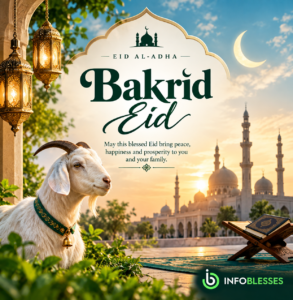
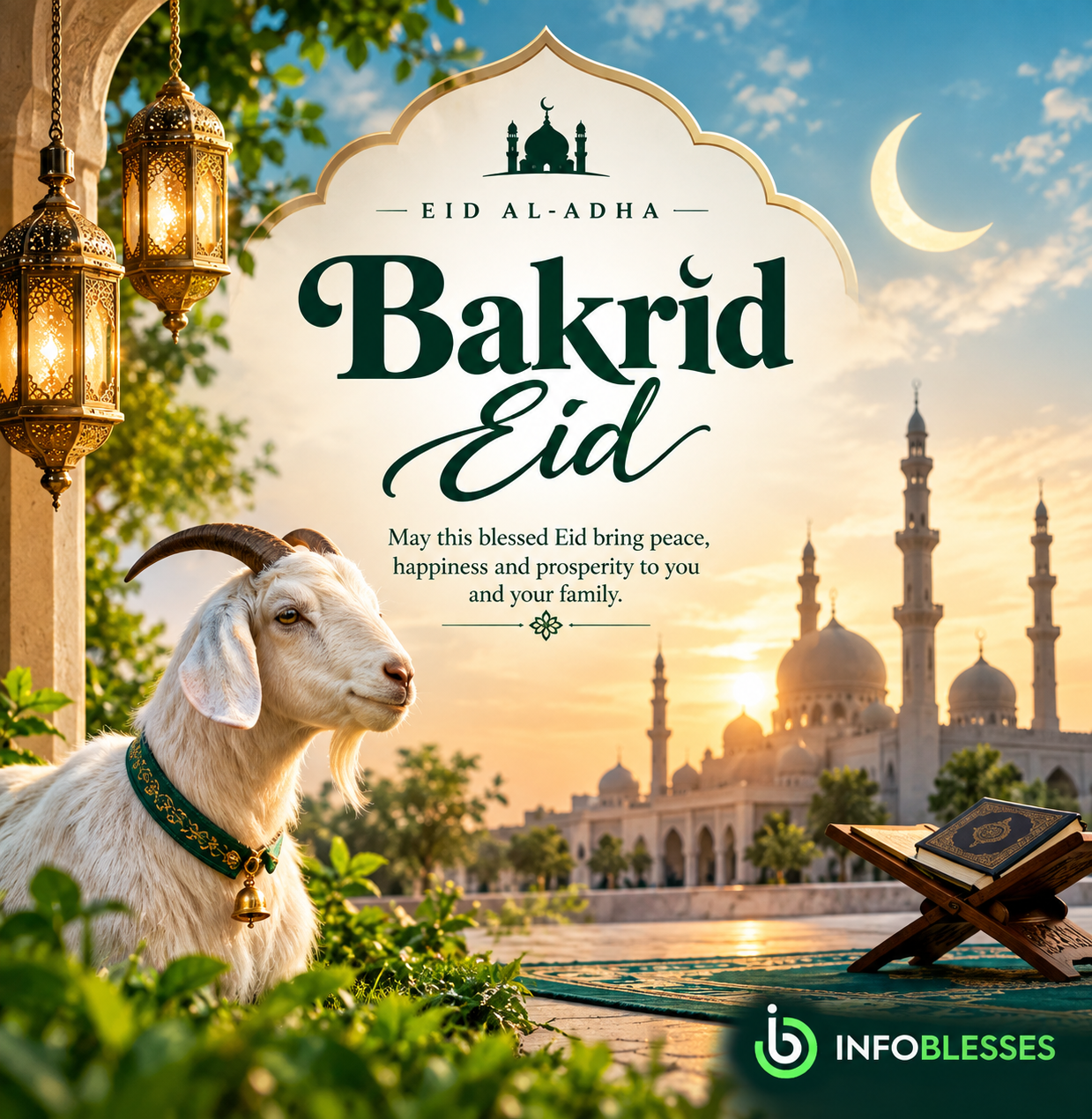
Bakrid Eid is one of the most meaningful celebrations in the Islamic calendar. Also known as Eid al-Adha, Eid ul-Adha, Bakra Eid, or Eid ul-Zuha, it is observed on the 10th day of Dhul Hijjah and is closely connected with Hajj, Qurbani, worship, generosity, and the story of Prophet Ibrahim (AS).
For Muslims around the world, Bakrid Eid isn’t simply a day of celebration. It’s a time to remember faith, obedience, patience, gratitude, and compassion. Families gather for Eid prayer, prepare special meals, visit relatives, exchange greetings, and, where applicable, perform Qurbani and share its meat with others.
What Is Bakrid Eid?

Bakrid Eid is another commonly used name for Eid al-Adha, one of the two major annual Islamic festivals. It takes place during Dhul Hijjah, the final month of the Islamic lunar calendar. The festival is observed on the 10th day of Dhul Hijjah and is associated with the completion of the major Hajj rituals.
The Arabic name Eid al-Adha is generally translated as the “Festival of Sacrifice.” The celebration remembers the devotion and obedience of Prophet Ibrahim (AS), who was willing to follow Allah’s command even when faced with an extremely difficult test.
The festival also brings together several important Islamic values:
- Faith in Allah
- Obedience and submission
- Patience during difficult tests
- Gratitude for blessings
- Charity and generosity
- Family relationships
- Community support
- Care for people in need
Bakrid Eid begins with worship rather than entertainment. Muslims commonly prepare for the day by performing Ghusl, wearing clean or their best clothes, going to Eid prayer, listening to the Khutbah, remembering Allah, and spending time with family and community.
Qurbani is another central practice for Muslims who offer a sacrifice. Islamic Relief explains that Qurbani commemorates Prophet Ibrahim’s devotion and involves sharing the resulting meat with people in need.
So, while Bakrid Eid is certainly a joyful occasion, its deeper message is about putting faith into action.
Why Is Eid al-Adha Called Bakrid?

The word Bakrid is a regional name associated with Eid al-Adha, especially in South Asian contexts. The festival itself is the same Islamic occasion known internationally as Eid al-Adha.
In South Asia, you’ll also hear terms such as Bakra Eid, Bakri Eid, Eid ul-Adha, and Eid ul-Zuha. The exact spelling and pronunciation can vary according to language and region.
The name Bakrid is strongly associated with the tradition of Qurbani, particularly the sacrifice of goats in South Asian communities. However, Qurbani isn’t limited to goats. Depending on Islamic guidelines, livestock such as sheep, goats, cattle, and camels may be used.
This regional naming is a good example of how Islamic celebrations can have different cultural expressions while keeping the same religious foundation.
For example:
| Name | Common Context |
|---|---|
| Eid al-Adha | Arabic and international usage |
| Eid ul-Adha | Common South Asian spelling |
| Bakrid | Regional South Asian usage |
| Bakra Eid | Common Urdu/Hindi expression |
| Eid ul-Zuha | Another traditional name |
| Feast of Sacrifice | English translation |
The name may change, but the central meaning remains connected with worship, sacrifice, obedience, and generosity.
The History and Meaning of Eid al-Adha

The history of Eid al-Adha is connected to Prophet Ibrahim (AS), whose life is remembered in Islam as an example of deep faith and submission to Allah.
According to the Qur’anic account, Ibrahim (AS) faced a profound test involving his son. He was prepared to obey Allah’s command, and his son Ismail (AS) also demonstrated submission. Before the sacrifice could take place, Allah provided a replacement sacrifice. The Qur’anic account is found in Surah As-Saffat, including verses 100–107.
The story teaches Muslims that sincere faith isn’t only something expressed with words. It also appears through actions, patience, trust, and willingness to obey Allah.
Eid al-Adha therefore encourages believers to ask themselves important questions:
- What am I willing to give up for Allah?
- Do I put faith into practice?
- Do I remember people who have less than I do?
- Am I grateful for what Allah has given me?
- Can I become more generous and patient?
These reflections make the festival meaningful beyond the food, clothes, gatherings, and celebrations.
The Story of Prophet Ibrahim (AS) and Ismail (AS)

The story of Ibrahim (AS) and Ismail (AS) is at the heart of Eid al-Adha.
Ibrahim (AS) had a son, Ismail (AS), whom he deeply loved. He was tested with a command involving the sacrifice of his son. Rather than resisting Allah’s command, Ibrahim (AS) communicated the matter to Ismail (AS).
The Qur’an describes Ismail (AS) responding with willingness to follow what his father had been commanded to do. When Ibrahim (AS) was ready to fulfill the command, Allah intervened and provided a substitute sacrifice.
The lesson isn’t simply about physical sacrifice. It is about submission to Allah and trust in Him.
For modern Muslims, this lesson can apply to everyday life. A person might need to give up harmful habits, selfish desires, excessive attachment to wealth, anger, pride, or other actions that take them away from righteousness.
That makes Eid al-Adha a time for personal reflection.
A beautiful question to consider is:
“What can I sacrifice today to become a better Muslim tomorrow?”
Perhaps it’s unnecessary spending that could become charity. Perhaps it’s an argument that can be replaced with forgiveness. Perhaps it’s time spent on something unhelpful that could instead be used for prayer, Qur’an, family, or community service.
How Bakrid Eid Is Connected With Hajj

Bakrid Eid takes place during Dhul Hijjah, the month in which Muslims perform Hajj. Hajj is one of the Five Pillars of Islam and is required once in a lifetime for Muslims who have the physical and financial ability to undertake it.
The timing creates a powerful connection between Muslims performing Hajj and Muslims celebrating Eid in their homes around the world.
Pilgrims gather in Makkah and complete important Hajj rituals, while Muslims elsewhere increase their worship, remember Allah, observe Eid prayer, and may perform Qurbani.
The Day of Arafah falls on the 9th of Dhul Hijjah, followed by Eid al-Adha on the 10th. For Muslims who aren’t performing Hajj, fasting on the Day of Arafah is widely encouraged according to Islamic tradition.
This connection reminds Muslims that the global Ummah can share the same sacred season even while living thousands of miles apart.
What Is Qurbani on Bakrid Eid?

Qurbani, also called Udhiyah, refers to the sacrifice offered for Allah during the prescribed period around Eid al-Adha. It commemorates the devotion of Prophet Ibrahim (AS).
The sacrifice is not meant to be treated merely as a cultural event. Its purpose is connected with worship, obedience, gratitude, and generosity.
One of the most important aspects of Qurbani is sharing. Islamic sources and community guidance emphasize distributing the meat so that family members, relatives, friends, and people experiencing hardship can benefit. Practices regarding exact distribution can differ, so Muslims should follow the guidance of their trusted scholar or local religious authority.
Qurbani also reminds Muslims that blessings carry responsibilities.
If Allah gives someone wealth, they can help others.
If Allah gives someone knowledge, they can teach.
If Allah gives someone time, they can serve.
If Allah gives someone food, they can share.
That’s one reason Bakrid Eid has such a strong connection with community welfare.
Which Animals Can Be Used for Qurbani?

Qurbani has specific Islamic requirements, including requirements concerning the animal and the timing of the sacrifice.
Common livestock used for Qurbani include:
- Goats
- Sheep
- Cattle
- Camels
Islamic Relief notes these categories in its Qurbani guidance.
The rules can involve the animal’s condition, age, eligibility, intention, and timing. There can also be differences between Islamic schools of jurisprudence regarding certain details.
For this reason, someone planning Qurbani shouldn’t rely only on social media posts or informal advice. It’s better to consult a qualified local scholar or trusted Islamic organization.
The sacrifice should also be carried out humanely and according to applicable Islamic and local legal requirements.
Most importantly, Muslims should remember the spiritual purpose behind Qurbani rather than focusing only on the animal or the meat.
Eid Prayer and Bakrid Morning Traditions

For many Muslims, Bakrid morning begins with preparation for Eid Salah.
Common practices include performing Ghusl, wearing clean or best clothes, using fragrance where appropriate, and going to the Eid prayer. Eid al-Adha prayer is generally performed in congregation in mosques, Eidgahs, or other suitable prayer spaces.
The prayer is followed by a Khutbah, or sermon, which provides religious reminders and guidance.
The exact method and number of additional Takbeerat can vary between schools of Islamic jurisprudence, so Muslims should follow their local Imam.
Another well-known practice is reciting Takbeer during the Eid period.
The morning can therefore have a peaceful rhythm:
- Wake up and prepare.
- Perform Ghusl.
- Wear clean or best clothing.
- Recite Takbeer.
- Attend Eid Salah.
- Listen to the Khutbah.
- Greet other Muslims.
- Perform Qurbani when applicable.
- Share food and meat.
- Visit family and help others.
The goal isn’t to rush through these practices. Eid is an opportunity to slow down, remember Allah, and appreciate the blessings of faith and community.
Sunnah Practices to Remember on Eid al-Adha

Muslims often follow various Sunnah practices on Eid al-Adha. Specific details can differ according to scholarly interpretation, so local religious guidance is useful.
Some commonly mentioned practices include:
- Performing Ghusl before Eid prayer.
- Wearing clean and good clothing.
- Using fragrance.
- Reciting Takbeer.
- Attending Eid prayer.
- Listening to the Khutbah.
- Taking part in Qurbani when applicable.
- Sharing food and meat.
- Visiting relatives and friends.
- Giving charity.
- Remembering people who are struggling.
- Maintaining family relationships.
Islamic Relief’s Eid guidance also highlights practices such as Ghusl, good clothing, Takbeer, Eid prayer, charity, remembrance, and community connection.
Eid doesn’t have to become a competition over clothes, food, decorations, or social media posts.
A simple Eid can be deeply meaningful.
Sometimes the most memorable moment is sitting with parents after prayer, calling a relative who lives far away, helping a neighbor, or giving food to someone who needs it.
Family Traditions During Bakrid Eid

Family is an important part of Bakrid Eid.
After Eid prayer, families often return home for breakfast or a meal, exchange greetings, visit relatives, and spend time together.
Children may receive gifts or Eidi, while older family members enjoy seeing younger relatives dressed in their Eid clothes.
Common family activities include:
- Visiting grandparents.
- Calling relatives who live abroad.
- Preparing traditional dishes.
- Sharing Qurbani meat.
- Giving children small gifts.
- Taking family photographs.
- Visiting neighbors.
- Welcoming guests.
- Sharing Eid wishes.
- Making Du’a for loved ones.
These customs may differ greatly between countries and households. That’s perfectly normal.
An Eid celebration in Pakistan may look different from one in Turkey, Indonesia, Nigeria, Saudi Arabia, Britain, or India. The cultural details change, while the religious foundation remains connected to Eid al-Adha.
The important thing is to keep the celebration respectful, joyful, generous, and centered around faith.
Bakrid Eid Food and Hospitality

Food is one of the most visible parts of Bakrid Eid celebrations.
Families may prepare dishes using Qurbani meat, including curries, kebabs, pulao, biryani, grilled meat, stews, and other regional specialties.
The exact menu depends on culture and family tradition.
In South Asia, for example, Eid meals may include rich meat dishes, rice dishes, kebabs, desserts, and tea. Other Muslim communities have their own delicious traditions.
But food has a deeper role than simply filling the table.
It creates opportunities to share.
A family can prepare an extra dish for a neighbor. Relatives can exchange meals. Community organizations can distribute food packages. Families can remember people who might otherwise struggle to enjoy a festive meal.
Hospitality turns food into an act of connection.
As the saying goes, the best table is one where everyone has a place.
Charity and Helping Others on Bakrid Eid

Generosity is one of the strongest themes of Eid al-Adha.
Qurbani itself provides an opportunity for sharing, but charity doesn’t have to stop there.
Muslims can also:
- Donate food.
- Support an orphan.
- Help a struggling family.
- Give useful clothing.
- Visit someone who is lonely.
- Support a local community project.
- Help a neighbor.
- Donate to a trusted charitable organization.
- Share Eid meals.
- Make sincere Du’a for people facing hardship.
Eid becomes more meaningful when happiness isn’t kept inside one household.
Islamic Relief emphasizes that Qurbani helps people in need benefit from the celebration and connects the practice with generosity and compassion.
If you’d like to learn more about Eid al-Adha, Qurbani, Hajj, and charitable giving, you can explore Islamic Relief’s Eid al-Adha guide.
Bakrid Eid Wishes to Share With Family

A thoughtful Eid message doesn’t need to be complicated.
Here are some warm wishes you can share with parents, siblings, grandparents, and relatives:
1. Eid Mubarak! May Allah fill your home with peace, mercy, happiness, and barakah.
2. May Allah accept your prayers and Qurbani, forgive your shortcomings, and bless your family with lasting happiness. Eid Mubarak!
3. Wishing you and your family a peaceful and blessed Eid al-Adha filled with faith, love, and gratitude.
4. May this Bakrid Eid bring countless blessings to your home and strengthen your connection with Allah.
5. Eid Mubarak to my beloved family. May Allah protect you, guide you, and keep our hearts united in goodness.
6. May the spirit of Prophet Ibrahim’s (AS) faith inspire us to become more patient, generous, and devoted. Eid Mubarak!
7. May Allah accept your good deeds, answer your sincere Du’as, and bless you with peace in this life and the Hereafter.
These messages can be sent by text, written inside a card, or shared with relatives on social media.
Bakrid Eid Wishes for Friends and Loved Ones

Friends are another important part of Eid celebrations.
A short message can make someone feel remembered, especially if they live far away or can’t attend the family gathering.
Try these:
Eid Mubarak! May Allah bless your life with peace, success, good health, and endless reasons to be grateful.
May Allah accept your worship and Qurbani, increase your blessings, and guide you toward everything that is good. Eid Mubarak!
Wishing you a beautiful Eid al-Adha filled with sincere Du’as, family happiness, and precious memories.
May Allah replace every worry with peace, every difficulty with ease, and every sincere prayer with something better. Eid Mubarak!
On this blessed Eid, may your heart remain close to Allah and your home remain filled with love and barakah.
You can personalize these messages by mentioning a friend’s name or adding a short personal prayer.
That’s often more meaningful than copying a long message from the internet.
Spiritual Lessons We Can Learn From Bakrid Eid

The greatest value of Bakrid Eid may be the lessons that remain after the celebration ends.
Faith
Prophet Ibrahim (AS) demonstrated extraordinary trust in Allah. Eid invites Muslims to strengthen their own faith.
Sacrifice
Every believer has something they can give up for a better relationship with Allah. It might be a bad habit, excessive attachment to wealth, anger, pride, or wasted time.
Patience
Life brings tests. Eid reminds Muslims that patience and trust in Allah matter during difficult moments.
Gratitude
Celebration itself can become an expression of gratitude. Food, family, health, safety, and faith are blessings worth appreciating.
Generosity
Qurbani and charity remind Muslims that blessings should be shared.
Family
Eid creates an opportunity to repair relationships, visit relatives, forgive old disagreements, and strengthen family bonds.
Community
A truly joyful Eid makes room for people who might otherwise be forgotten.
These lessons can remain valuable throughout the year, long after Eid decorations have been packed away.
How to Celebrate Bakrid Eid in a Meaningful Way

A meaningful Bakrid Eid doesn’t require an expensive celebration.
Instead, focus on a balanced day of worship, family, generosity, and happiness.
A Simple Eid Plan
Morning:
Prepare for prayer, perform Ghusl, wear clean clothes, and attend Eid Salah.
After prayer:
Greet fellow Muslims, listen to the Khutbah, and spend time with family.
Midday:
Complete Qurbani according to Islamic guidance if you’re performing it, then arrange the meat distribution.
Afternoon:
Visit relatives, share food, call distant family members, and help someone who needs support.
Evening:
Enjoy a family meal, make Du’a, reflect on the lessons of Ibrahim (AS), and thank Allah for your blessings.
The beauty of Eid lies in balance. Worship gives the day its spiritual foundation, while family, food, friendship, and generosity bring warmth and happiness.
Bakrid Eid vs. Eid al-Fitr

Both are major Islamic festivals, but their religious contexts are different.
| Feature | Eid al-Adha / Bakrid | Eid al-Fitr |
|---|---|---|
| Islamic month | Dhul Hijjah | Shawwal |
| Main connection | Hajj and sacrifice | End of Ramadan |
| Major theme | Faith, sacrifice, obedience | Gratitude, completion of fasting |
| Special practice | Qurbani for eligible Muslims | Zakat al-Fitr |
| Associated day | 10th Dhul Hijjah | 1st Shawwal |
| Major spiritual period | First 10 days of Dhul Hijjah | Ramadan |
Eid al-Adha occurs on the 10th day of Dhul Hijjah, while Eid al-Fitr occurs on the first day of Shawwal after Ramadan.
Both festivals include prayer, family gatherings, charity, greetings, and celebration.
How Children Can Learn the Meaning of Bakrid Eid

Children often remember Eid because of clothes, gifts, food, and family gatherings. Those things are enjoyable, but parents can also use Eid to teach meaningful Islamic values.
Explain the story of Ibrahim (AS) in age-appropriate language.
Teach children that Qurbani is connected with obedience to Allah and generosity.
Let them help pack food or distribute gifts.
Encourage them to greet relatives.
Ask them to think about someone they can help.
You can even create a simple family tradition: every Eid, each child chooses one kind action to perform.
For example:
- Give food to someone.
- Call a grandparent.
- Help prepare the Eid table.
- Share a favorite toy.
- Donate something useful.
- Make Du’a for someone who is sick or struggling.
- Help clean the family home.
This teaches children that Eid is not only about receiving.
It’s also about giving.
Frequently Asked Questions About Bakrid Eid

1. Is Bakrid the same as Eid al-Adha?
Yes. Bakrid is a regional name commonly used for Eid al-Adha, particularly in South Asian contexts. Eid al-Adha is the Arabic name of the Festival of Sacrifice.
2. Why is Eid al-Adha called Bakrid?
The name is associated with South Asian terminology surrounding the sacrifice of goats and other livestock. The religious festival itself is Eid al-Adha, while Bakrid is a regional expression.
3. What does Eid al-Adha mean?
Eid al-Adha is commonly translated as the Festival of Sacrifice. It commemorates the devotion and obedience associated with Prophet Ibrahim (AS) and is connected with the practice of Qurbani.
4. When is Bakrid celebrated?
Eid al-Adha is observed on the 10th day of Dhul Hijjah, the final month of the Islamic lunar calendar. The exact Gregorian date changes each year because the Islamic calendar follows lunar months.
5. What is Qurbani?
Qurbani, also known as Udhiyah, is a sacrificial offering made for Allah during the prescribed period of Eid al-Adha. It commemorates Prophet Ibrahim’s (AS) devotion and provides an opportunity to share food with others.
6. Which animals are used for Qurbani?
Common animals include goats, sheep, cattle, and camels, subject to Islamic requirements concerning eligibility, age, health, and other conditions.
7. When should Qurbani be performed?
Qurbani is performed during the prescribed time beginning after Eid prayer on the first day, with the exact end time depending on the relevant Islamic jurisprudential guidance. Muslims should consult a qualified scholar for their school of thought and local circumstances.
8. What should I say to someone on Bakrid?
A simple “Eid Mubarak” is appropriate. You can also add a personal Du’a, such as: “May Allah accept your worship and bless you and your family with peace and happiness.”
9. Is Bakrid connected to Hajj?
Yes. Eid al-Adha takes place during Dhul Hijjah, the month of Hajj. It follows the Day of Arafah and coincides with a major stage of the Hajj season.
10. What is the main lesson of Bakrid Eid?
One central lesson is sincere devotion to Allah. The festival also emphasizes sacrifice, obedience, patience, gratitude, generosity, family, and concern for people in need.
Final Thoughts on Bakrid Eid

Bakrid Eid is much more than a festive day. It is a reminder of faith, sacrifice, obedience, generosity, and compassion.
Through the story of Prophet Ibrahim (AS), Muslims remember the importance of trusting Allah even during difficult tests. Through Qurbani, they are reminded of sharing blessings. Through Eid prayer, they gather as a community. Through family visits and greetings, they strengthen relationships.
The festival also provides a chance to look inward.
Perhaps this Eid can be a fresh beginning.
Give more.
Forgive more.
Pray with greater sincerity.
Spend meaningful time with family.
Help someone who needs support.
Be grateful for what you have.
And remember that the spirit of Eid shouldn’t disappear when the celebration ends.
Whether you call it Bakrid, Bakra Eid, Eid ul-Adha, Eid al-Adha, or the Festival of Sacrifice, the heart of the occasion remains connected with devotion to Allah and care for others.
Eid Mubarak! May Allah accept your worship, bless your family, increase your gratitude, and fill your home with peace, mercy, happiness, and barakah. Ameen.

Welcome to Info Blesses I am Rana Ahtasham an AI Powered SEO and Content Writer With 3 year experience.I help websites rank highter, grow traffic, and look amazing. My goal is to make SEO and web design simple and effective for everyone.Lets achieve more togather!