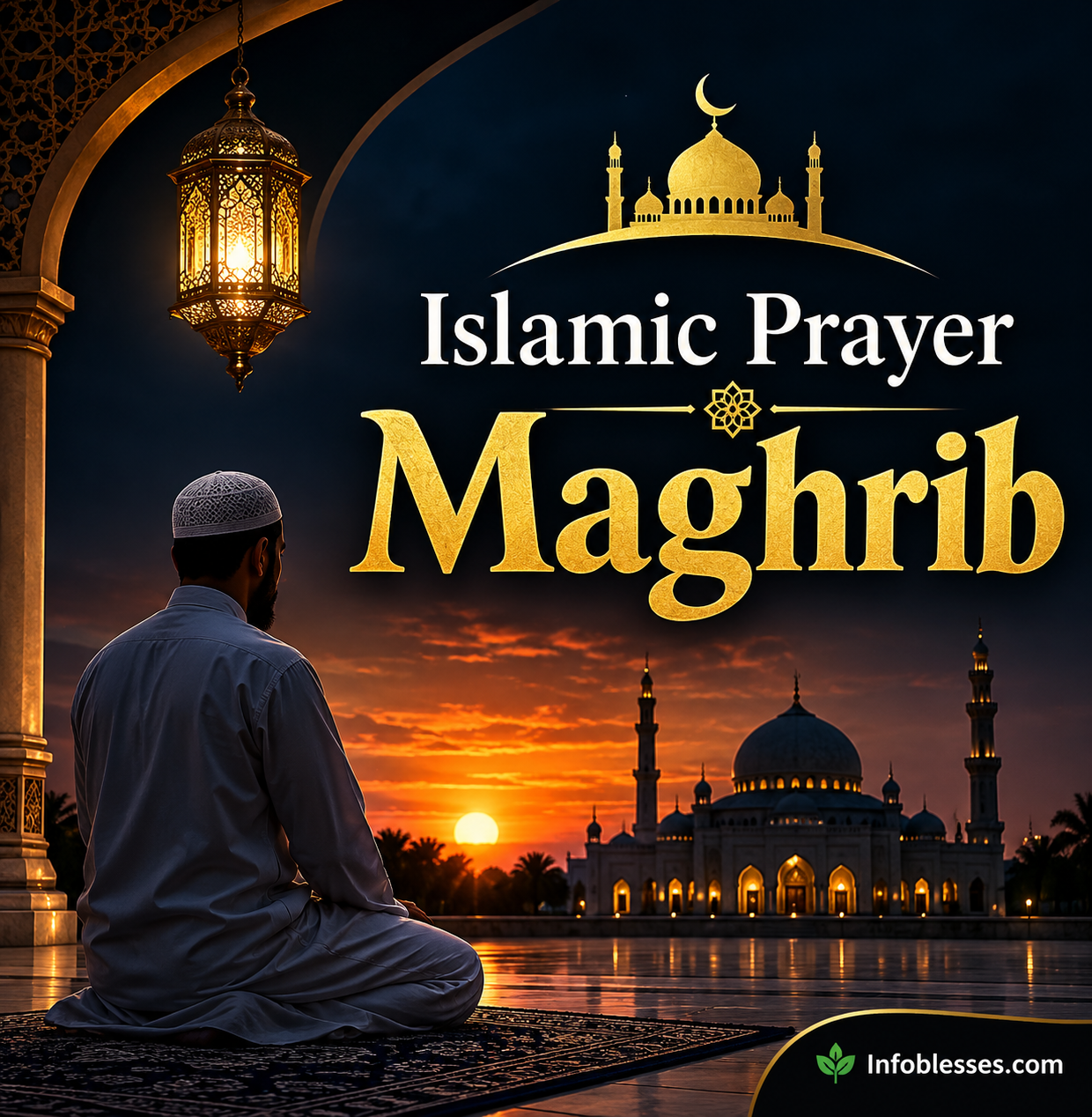
Islamic Prayer Maghrib is one of the five obligatory daily prayers performed by Muslims around the world. It takes place just after sunset, marking the transition from daytime to nighttime. For many Muslims, this prayer is an important opportunity to pause, reflect on the blessings of the day, and reconnect with Allah before beginning their evening activities.
Unlike some other daily prayers, Maghrib has three obligatory rakats, making it unique among the five Fard prayers. Learning its correct timing, structure, and recitations can help Muslims perform it with confidence and sincerity.
Whether you’re a new Muslim, a young learner, or someone looking to refresh your understanding, this guide explains everything you need to know. From Maghrib prayer time and the number of rakats to the complete method of praying, you’ll find clear and practical information below.
1. What Is Maghrib Prayer in Islam?
Maghrib is the fourth of the five daily obligatory prayers in Islam when counted from Fajr. It is also known as the sunset prayer because its time begins immediately after the sun sets below the horizon.
The word Maghrib refers to the west or the place and time of sunset. This prayer reminds Muslims that every day comes to an end and that life is a gift to be used with gratitude, faith, and kindness.
Muslims perform Maghrib prayer to worship Allah, follow the teachings of Prophet Muhammad (peace be upon him), and maintain a regular connection with their Creator.
Why is Maghrib important?
Maghrib prayer has several important spiritual purposes:
-
Remembering Allah: It gives you a moment to pause and remember Allah after a busy day.
-
Showing gratitude: It encourages thankfulness for food, health, family, work, and other blessings.
-
Building discipline: Praying at a fixed time helps establish a consistent daily routine.
-
Finding peace: Salah provides a quiet moment to reflect and release daily stress.
-
Strengthening faith: Regular prayer helps nurture spiritual awareness and closeness to Allah.
Maghrib isn’t simply a task to complete before dinner. It’s an opportunity to leave worldly distractions behind for a few minutes and focus on what matters most.
2. Maghrib Prayer Time: When Does It Start and End?
Maghrib prayer time starts immediately after the sun has completely set below the horizon. It doesn’t begin when the sky becomes dark or when the stars appear. Instead, the actual sunset determines its beginning.
The exact clock time changes every day depending on your geographical location and season. For instance, sunset in summer usually occurs later than in winter in many locations.
When does Maghrib begin?
Maghrib begins at local sunset. Once the sun has set, the time for the Maghrib prayer enters.
Muslims often use a reliable prayer timetable, mosque announcement, or prayer-time application to know the exact time. These tools calculate sunset according to location.
When does Maghrib end?
The ending time is traditionally linked to the disappearance of twilight, though the details of defining twilight and the preferred timing can differ between schools of Islamic jurisprudence.
Generally, Maghrib should be performed promptly after sunset rather than unnecessarily delayed. It’s wise to plan your evening activities around this prayer.
| Prayer timing | Explanation |
|---|---|
| Start | Immediately after sunset |
| Recommended practice | Pray soon after its time begins |
| End | Before the beginning of Isha, according to the relevant prayer-time calculation and jurisprudential view |
How can you check Maghrib prayer time?
You can find the correct Maghrib time by:
-
Checking your local mosque’s daily timetable.
-
Using a trusted Islamic prayer-time application.
-
Searching for sunset time in your city.
-
Following your local Islamic center’s announcements.
Remember: Maghrib time is different in every city. Always use a timetable based on your own location rather than copying a time from another city.
3. How Many Rakats Are in Maghrib Prayer?
A common question among Muslims is how many rakats are required for Maghrib. The obligatory Maghrib prayer consists of 3 Fard rakats. After completing these, Muslims commonly perform 2 Sunnah rakats.
The obligatory portion is essential, while the additional Sunnah prayer is a voluntary act of worship with spiritual reward.
Maghrib rakats breakdown
| Prayer | Rakats | Status |
|---|---|---|
| Maghrib Fard | 3 | Obligatory |
| Sunnah after Fard | 2 | Sunnah |
| Common total | 5 | 3 Fard + 2 Sunnah |
What are Fard rakats?
Fard means obligatory. The three Fard rakats of Maghrib are the required portion of the sunset prayer for a Muslim who is obligated to pray.
These three rakats are performed in sequence:
-
The first Rakat includes Surah Al-Fatihah and another Quranic passage.
-
The second Rakat includes Surah Al-Fatihah and another Quranic passage, followed by sitting for Tashahhud.
-
The third Rakat includes Surah Al-Fatihah, followed by bowing and prostration, then the final sitting.
What are Sunnah rakats?
Sunnah prayers are voluntary prayers associated with the practice of Prophet Muhammad (peace be upon him). Two Sunnah rakats are commonly prayed after the three obligatory Maghrib rakats.
These extra prayers are an opportunity to gain reward and strengthen your worship. If you’re learning, first focus on completing the obligatory three rakats correctly, then build consistency with the Sunnah prayers.
4. Preparations Before Performing Maghrib Prayer
Before beginning Maghrib, make sure you’re ready for Salah. Proper preparation helps you focus and perform your prayer peacefully without unnecessary interruptions.
Step 1: Perform Wudu
Wudu (ablution) is the ritual purification required before prayer when it is needed. Wash the required body parts in the prescribed manner.
The basic steps of Wudu include:
-
Make the intention for purification.
-
Say Bismillah.
-
Wash your hands.
-
Rinse your mouth and nose.
-
Wash your face.
-
Wash both arms up to and including the elbows.
-
Wipe your head and ears.
-
Wash both feet up to and including the ankles.
Follow the Wudu method taught according to your school of Islamic practice.
Step 2: Wear clean clothes
Wear clean clothing that covers the required parts of your body (awrah) according to Islamic rules. Make sure your prayer area is clean, too.
Step 3: Face the Qibla
Stand facing the Kaaba in Makkah. If you aren’t sure of the direction, use a Qibla compass, a trusted prayer application, or ask someone at your mosque.
Step 4: Make your intention (Niyyah)
The intention is made in your heart to perform the three obligatory rakats of Maghrib for Allah.
You don’t have to speak the intention aloud. Having the sincere intention to perform the prayer is what matters.
5. How to Pray Maghrib: Step-by-Step Guide
The following guide explains the three obligatory rakats of Maghrib in a commonly taught format. Minor details, such as hand placement and some recitations, may differ according to madhhab (school of Islamic jurisprudence). Follow a reliable teacher for the method you practice.
First Rakat
1. Begin with Takbeer
Stand upright facing the Qibla. Raise your hands as taught in your prayer tradition and say:
Allahu Akbar (Allah is the Greatest).
Place your hands in the position you follow for Salah.
2. Recite the opening supplication
If you follow a method that includes the opening supplication, recite Thana:
Subhanaka Allahumma wa bihamdika, wa tabarakasmuka, wa ta’ala jadduka, wa la ilaha ghayruk.
This praises Allah and glorifies Him.
3. Recite Surah Al-Fatihah
Recite Surah Al-Fatihah, the opening chapter of the Quran.
It includes praise of Allah, recognition of His mercy, acknowledgment of the Day of Judgment, and a request for guidance to the straight path.
4. Recite another Surah or Quranic verses
After Al-Fatihah, recite another short Surah or suitable verses from the Quran. Beginners often learn Surah Al-Ikhlas, Surah Al-Falaq, or Surah An-Nas.
5. Perform Ruku (bowing)
Say Allahu Akbar and bow, placing your hands on your knees and keeping your back appropriately straight.
Recite:
Subhana Rabbiyal Azeem (Glory be to my Lord, the Most Great).
This is commonly repeated three times.
6. Rise from Ruku
Return to a standing position while saying:
Sami’ Allahu liman hamidah.
Then say:
Rabbana lakal hamd.
Pause briefly in the upright position.
7. Perform the first Sajdah
Say Allahu Akbar and go down into prostration. Place your forehead and nose, palms, knees, and toes appropriately on the ground.
Recite:
Subhana Rabbiyal A’la (Glory be to my Lord, the Most High).
This is commonly repeated three times.
8. Sit between the two Sajdahs
Say Allahu Akbar as you rise from prostration. Sit briefly in the prescribed sitting position.
9. Perform the second Sajdah
Say Allahu Akbar and perform the second prostration. Recite Subhana Rabbiyal A’la again.
The first Rakat is now complete.
Second Rakat
10. Stand for the second Rakat
Rise while saying Allahu Akbar. Recite Surah Al-Fatihah followed by another Surah or Quranic verses.
Then perform Ruku, rise from Ruku, and perform the two Sajdahs in the same manner as the first Rakat.
11. Sit for Tashahhud
After the second Sajdah, sit and recite Tashahhud (At-Tahiyyat).
Common Tashahhud recitation (transliteration)
At-tahiyyatu lillahi was-salawatu wat-tayyibat.
As-salamu ‘alayka ayyuhan-nabiyyu wa rahmatullahi wa barakatuh.
As-salamu ‘alayna wa ‘ala ‘ibadillahis-salihin.
Ashhadu an la ilaha illallah,
wa ashhadu anna Muhammadan ‘abduhu wa rasuluh.
This sitting is the intermediate sitting. In the three-rakat Maghrib prayer, you recite Tashahhud here, then stand for the third Rakat.
Third Rakat
12. Stand for the third Rakat
Say Allahu Akbar and stand upright. Recite Surah Al-Fatihah.
In the commonly taught method for the obligatory Maghrib prayer, the third Rakat includes Al-Fatihah without an additional Surah. There are variations in certain details among schools.
13. Perform Ruku and Sajdah
After Al-Fatihah:
-
Say Allahu Akbar and bow for Ruku.
-
Recite Subhana Rabbiyal Azeem.
-
Rise from Ruku and say the appropriate praise.
-
Perform the first Sajdah.
-
Sit briefly.
-
Perform the second Sajdah.
14. Complete the final sitting
After the second Sajdah of the third Rakat, sit for the final Tashahhud.
Recite Tashahhud, then send blessings upon the Prophet Muhammad (peace be upon him), commonly known as Salawat or Durood Ibrahim.
Salawat (common transliteration)
Allahumma salli ‘ala Muhammadin wa ‘ala ali Muhammad,
kama sallayta ‘ala Ibrahima wa ‘ala ali Ibrahim,
innaka Hamidum Majid.
Allahumma barik ‘ala Muhammadin wa ‘ala ali Muhammad,
kama barakta ‘ala Ibrahima wa ‘ala ali Ibrahim,
innaka Hamidum Majid.
You may also recite a suitable supplication before ending the prayer, as taught in your tradition.
15. End with Salam
Turn your head to the right and say:
Assalamu alaikum wa rahmatullah.
Then turn your head to the left and repeat:
Assalamu alaikum wa rahmatullah.
The three obligatory rakats of Maghrib are now complete.
6. What Should You Recite During Maghrib Prayer?
Learning the recitations may feel challenging at first, but it gets easier with practice. You don’t have to memorize everything in one day. Start with the essentials and gradually improve.
Here are some commonly recited Quranic passages and phrases:
| Recitation | When it’s used |
|---|---|
| Allahu Akbar | Transitions between prayer positions |
| Surah Al-Fatihah | Every Rakat |
| Short Surah | Commonly first and second Rakat |
| Subhana Rabbiyal Azeem | During Ruku |
| Sami’ Allahu liman hamidah | Rising from Ruku |
| Rabbana lakal hamd | After rising |
| Subhana Rabbiyal A’la | During Sajdah |
| At-Tahiyyat | Sitting |
| Salawat/Durood Ibrahim | Final sitting |
Which short Surahs can beginners learn?
If you’re new to prayer, these short Surahs are often a good starting point:
-
Surah Al-Ikhlas: Teaches the oneness and uniqueness of Allah.
-
Surah Al-Falaq: A prayer seeking protection from harm.
-
Surah An-Nas: A prayer seeking refuge in Allah.
-
Surah Al-Kawthar: A short Surah that is easy to memorize.
Practice slowly, listen to correct recitation, and review the meaning. Understanding what you say can help make your Salah more meaningful.
7. Sunnah Prayers After Maghrib
After completing the three Fard rakats, Muslims commonly perform two Sunnah rakats.
These are prayed as a separate two-rakat prayer. You begin with Takbeer, recite Al-Fatihah and another Surah in each Rakat, perform Ruku and Sajdah, sit for Tashahhud at the end, recite Salawat, and finish with Salam.
Why pray the Sunnah after Maghrib?
The Sunnah prayer offers a chance to increase voluntary worship and follow the Prophet’s example. It’s also a useful way to spend a few extra minutes in remembrance instead of rushing into evening distractions.
You can also recite Dhikr after Salah, such as:
-
Astaghfirullah (seeking forgiveness).
-
Subhanallah (glory be to Allah).
-
Alhamdulillah (all praise belongs to Allah).
-
Allahu Akbar (Allah is the Greatest).
The commonly practiced post-prayer tasbeeh includes repeating Subhanallah, Alhamdulillah, and Allahu Akbar in prescribed counts. Practices and counts may vary, so follow the authentic guidance you have learned.
8. Common Mistakes to Avoid During Maghrib Prayer
Everyone makes mistakes while learning. The important thing is to improve your knowledge, practice carefully, and ask qualified people when you’re unsure about a ruling.
Here are some common mistakes to watch for when performing Maghrib prayer.
Delaying prayer unnecessarily
Maghrib has a relatively short prayer window compared with some other daily prayers. Try to perform it soon after sunset rather than putting it off until you’re busy with other activities.
Rushing through Ruku and Sajdah
Bowing and prostration shouldn’t be rushed. Take a moment to settle into each position. Salah is an act of worship, not a race.
Forgetting the sitting after the second Rakat
Maghrib is a three-rakat prayer. After completing the second Rakat, sit and recite Tashahhud before standing for the third Rakat.
Confusing the third Rakat with the first two
The third obligatory Rakat is commonly performed with Al-Fatihah alone, without an additional Surah. Learn the correct sequence and follow the method of your madhhab.
Losing focus
It’s normal for your mind to wander. When you notice this happening, gently bring your attention back to the words and movements of prayer.
Not learning the meaning of recitations
Memorizing Arabic recitations is important, but understanding their meaning can improve concentration. Learn the translation of Al-Fatihah and the short Surahs you recite.
Worrying too much about small mistakes
Don’t let fear of making mistakes prevent you from praying. Learn what is required, practice consistently, and ask an imam or qualified teacher if you need help determining whether a mistake affects the validity of your prayer.
9. Benefits of Performing Maghrib Prayer Regularly
Regular Salah can influence many parts of your daily life. Maghrib offers a natural point of transition between daytime responsibilities and evening rest.
Spiritual benefits
-
Closeness to Allah: Regular prayer strengthens your relationship with your Creator.
-
Gratitude: You get to reflect on the blessings you’ve received throughout the day.
-
Forgiveness: Prayer and remembrance encourage repentance and spiritual growth.
-
Faith and patience: Maintaining prayer helps build a stronger connection with your religion.
Personal benefits
Maghrib also offers a structured pause that may support healthier daily habits.
| Benefit | How it may help |
|---|---|
| Routine | Creates a regular evening habit |
| Reflection | Encourages thinking about the day’s actions |
| Mindfulness | Helps bring attention to the present moment |
| Discipline | Builds consistency with worship |
| Family connection | Can encourage prayer together at home |
| Peaceful transition | Separates work or study from evening activities |
Prayer isn’t a replacement for professional help when you’re dealing with stress or other difficulties. However, for many believers, worship, reflection, and community are meaningful sources of comfort.
10. Tips for Beginners Learning Maghrib Prayer
If you’re just learning Maghrib, don’t feel pressured to master everything immediately. Most people become more confident through repetition and guidance.
Learn the movements first
Understand the order of standing, bowing, rising, prostrating, sitting, and finishing the prayer. Knowing the sequence helps prevent confusion.
Memorize the essential recitations gradually
Start with Al-Fatihah. Then learn the phrases used in Ruku and Sajdah, followed by Tashahhud and Salawat. Add short Surahs as you progress.
Practice with a teacher
A local imam, knowledgeable family member, or qualified teacher can demonstrate the correct movements and help you correct mistakes.
Use reliable learning resources
Look for instructional materials that show the prayer from beginning to end. Prefer resources that clearly explain the method and identify the Islamic school of thought they follow.
Create a prayer routine
When sunset approaches, prepare for Maghrib. Complete your work where possible, make Wudu, and find a quiet prayer space. Establishing a routine makes it easier to pray consistently.
Focus on quality rather than speed
Take your time. Learn what you’re saying, understand the movements, and try to pray with humility and concentration.
11. Maghrib Prayer in Congregation
Maghrib can be performed individually or in congregation. Praying at the mosque provides an opportunity to join fellow Muslims, strengthen community ties, and learn from the imam.
When Maghrib is performed in congregation:
-
Stand in the rows behind the imam.
-
Follow the imam’s movements without moving ahead of him.
-
Listen to the Quranic recitation during the portions recited aloud.
-
Maintain a straight row and avoid unnecessary movement.
-
Follow the imam through the prayer until Salam.
Maghrib is commonly recited aloud by the imam in the first two obligatory rakats, while the third is recited quietly. Details for followers differ according to school of thought, so learn the congregational method from your local imam.
Praying with others is especially helpful if you’re new to Salah because you can observe the movements and improve your understanding.
12. Helpful Resources to Learn More
If you’d like to deepen your knowledge of Maghrib and other daily prayers, use reliable Islamic educational resources.
-
Islamic Relief UK – How to Pray Maghrib Salah – A scholar-reviewed guide with the prayer’s timing, rakats, and method.
-
Sunnah.com – Explore Hadith collections related to prayer, its timings, and its importance.
-
Your local mosque or Islamic center – A qualified teacher can demonstrate the prayer and answer questions about your madhhab.
Use trustworthy references, particularly when learning rulings about missed prayers, mistakes during Salah, or differences between schools.
13. Frequently Asked Questions (FAQs)
1. How many rakats are in Maghrib prayer?
Maghrib has 3 obligatory (Fard) rakats. Muslims commonly perform 2 Sunnah rakats afterward, making 5 rakats in total when including the Sunnah.
2. When does Maghrib prayer time start?
Maghrib starts immediately after sunset, when the sun has completely gone below the horizon. Exact clock times vary by location and date.
3. Can I pray Maghrib immediately after the Adhan?
Yes. Once the actual Maghrib time has entered, you may perform the prayer. It’s generally recommended not to delay it unnecessarily.
4. Is Maghrib prayer recited aloud or silently?
In the commonly taught method, the first two Fard rakats are recited aloud when praying individually in the relevant manner or leading a congregation, and the third Rakat is recited quietly. Details may differ based on the situation and school of thought.
5. What happens if I miss Maghrib prayer?
If you miss Maghrib within its prescribed time, you should pray it before its time ends. If its time has passed, you generally need to make it up (Qada). If you’ve missed it, don’t give up—make the prayer up and work on protecting your prayer times in the future. Ask a qualified scholar if you have questions about a specific situation.
6. Can I pray Maghrib at home?
Yes. Maghrib can be prayed at home as well as in the mosque, provided you meet the conditions of Salah. Praying in congregation at a mosque has special importance, but the prayer may be performed at home.
7. Do I have to pray the Sunnah rakats after Maghrib?
The two Sunnah rakats after Maghrib are not part of the obligatory three Fard rakats. They are voluntary Sunnah prayers and are commonly practiced after the obligatory prayer.
8. What should I recite in the third Rakat of Maghrib?
In the commonly taught method for the three obligatory rakats, you recite Surah Al-Fatihah in the third Rakat, then proceed to Ruku and Sajdah. The method of recitation may vary by madhhab.
9. Can a beginner pray Maghrib using a guide?
Beginners can use learning materials to help memorize recitations and understand the sequence. Work toward learning the required recitations and movements, and seek help from a knowledgeable teacher. If you need guidance about what is acceptable during prayer while learning, ask a qualified scholar.
10. What is the difference between Maghrib and Isha?
Maghrib begins just after sunset and consists of three obligatory rakats. Isha is the night prayer, which begins after the twilight period ends, and its obligatory prayer consists of four rakats for a resident. Their timing and prayer structure are different.
Conclusion:
Maghrib prayer is a beautiful daily act of worship that allows Muslims to reconnect with Allah as the day comes to an end. Knowing its correct time, rakats, recitations, and movements makes it easier to pray with confidence and sincerity.
Remember these essential points:
-
Maghrib begins immediately after sunset.
-
The obligatory prayer consists of 3 Fard rakats.
-
Two Sunnah rakats are commonly performed afterward.
-
Perform Wudu, face the Qibla, and make your intention.
-
Follow the proper sequence of standing, bowing, prostration, and sitting.
-
Pray calmly, avoid unnecessary delays, and continue learning.
If you’re still learning, take it one step at a time. Focus on improving your recitations, understanding the meaning of Salah, and maintaining consistency. Every sincere effort to worship Allah is meaningful.
May Allah accept your prayers, guide you toward goodness, and fill your evenings with peace, blessings, and faith. Ameen.

Welcome to Info Blesses I am Rana Ahtasham an AI Powered SEO and Content Writer With 3 year experience.I help websites rank highter, grow traffic, and look amazing. My goal is to make SEO and web design simple and effective for everyone.Lets achieve more togather!