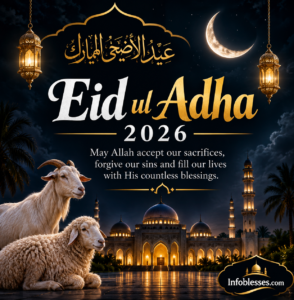
Eid ul Adha is one of the most important Islamic festivals celebrated by Muslims worldwide. Known as the Festival of Sacrifice or Bakra Eid, this special occasion represents faith, obedience, generosity, gratitude, and compassion.
Eid ul Adha 2026 was celebrated on Wednesday, May 27, 2026, in Pakistan, following the official sighting of the Dhul Hijjah moon by the Central Ruet-e-Hilal Committee. The first day of Dhul Hijjah was May 18, while the Day of Arafah fell on May 26.
The festival commemorates Prophet Ibrahim’s (Abraham’s) extraordinary willingness to obey Allah’s command. His devotion teaches Muslims that true faith requires sincerity, patience, and complete trust in Allah.
For millions of Muslims, Eid ul Adha is also a time for performing Qurbani, attending special Eid prayers, visiting relatives, sharing meals, and helping people experiencing financial difficulties.
However, the meaning of this festival goes much deeper than traditional celebrations. It reminds people to develop a generous heart, strengthen family relationships, and share their blessings with others.
In this comprehensive guide, we’ll explore the date of Eid ul Adha 2026, its historical background, religious importance, Qurbani guidelines, worldwide celebrations, and practical ways to make the occasion meaningful.
1. Eid ul Adha 2026 Date: When Was Bakra Eid Celebrated?
One of the most frequently searched questions is: When is Eid ul Adha 2026?
The date depends on the Islamic lunar calendar and the sighting of the crescent moon marking the beginning of Dhul Hijjah.
Confirmed Eid ul Adha 2026 Date in Pakistan
In Pakistan, the Central Ruet-e-Hilal Committee announced that the Dhul Hijjah moon had been sighted on May 17, 2026.
Consequently, the Islamic month of Dhul Hijjah began on Monday, May 18.
The confirmed dates were:
| Important Occasion | Date | Day |
|---|---|---|
| Beginning of Dhul Hijjah | May 18, 2026 | Monday |
| Day of Arafah | May 26, 2026 | Tuesday |
| Eid ul Adha | May 27, 2026 | Wednesday |
| Second Day of Eid | May 28, 2026 | Thursday |
| Third Day of Eid | May 29, 2026 | Friday |
The official announcement was reported by Radio Pakistan and confirmed through the Central Ruet-e-Hilal Committee.
Eid ul Adha 2026 in Other Countries
Although Muslims worldwide celebrate the same religious festival, the Gregorian date can differ between countries because of different moon-sighting decisions and calendar methods.
For example, Saudi Arabia also observed Eid ul Adha on Wednesday, May 27, 2026.
In some countries, Eid celebrations may take place on a different Gregorian date depending on local religious authorities.
Therefore, Muslims should follow the official moon-sighting announcements and religious guidance in their respective countries.
Why Does the Date Change Every Year?
The Islamic calendar follows the lunar cycle rather than the solar calendar.
A lunar year contains approximately 354 or 355 days, which is around 10 or 11 days shorter than the Gregorian year.
As a result, Islamic festivals move earlier each year on the Gregorian calendar.
For instance, Eid ul Adha may fall in May one year and gradually move into April or March in subsequent years.
This changing calendar is why Muslims check the expected Eid date every year.
2. History of Eid ul Adha: The Story of Prophet Ibrahim
The history of Eid ul Adha is connected with the remarkable faith and devotion of Prophet Ibrahim (AS).
His story is one of the most powerful lessons in Islamic teachings because it demonstrates the importance of trusting Allah even during the most difficult circumstances.
The Extraordinary Test of Faith
According to the Islamic tradition, Prophet Ibrahim (AS) received a command in a dream to sacrifice his beloved son.
Islamic scholars understand this dream as a divine command and a test of his obedience.
Although the situation was extremely difficult, Prophet Ibrahim (AS) remained committed to following Allah’s command.
He discussed the matter with his son, Prophet Ismail (AS), who responded with patience and willingness to obey Allah.
Their conversation demonstrates the remarkable faith shared by both father and son.
Allah’s Mercy and the Replacement Sacrifice
When Prophet Ibrahim (AS) demonstrated his complete willingness to obey Allah, Allah intervened and provided a great sacrifice in place of his son.
Therefore, Prophet Ismail (AS) was not sacrificed.
This event demonstrated that Allah does not require human sacrifice. Instead, the test revealed the sincerity and devotion of Prophet Ibrahim (AS).
Muslims commemorate this important event through Qurbani during Eid ul Adha.
Lessons from the Story of Prophet Ibrahim
The story offers several important lessons for everyday life.
1. Complete trust in Allah
Believers should maintain their faith during challenging circumstances.
2. Patience during difficulties
Life includes unexpected challenges. Patience helps people remain strong and hopeful.
3. Family cooperation
The relationship between Prophet Ibrahim and Prophet Ismail demonstrates the importance of communication, respect, and shared religious values.
4. Obedience and sincerity
Acts of worship should be performed with genuine intentions rather than for public recognition.
5. Generosity and compassion
The festival reminds Muslims to share their blessings with people who need support.
What Does Qurbani Symbolize?
Qurbani is not simply the act of slaughtering an animal.
Its deeper meaning is the willingness to give up personal desires and priorities for the sake of Allah.
The Qur’an explains this spiritual principle in Surah Al-Hajj, verse 37.
The verse teaches that neither the meat nor the blood of sacrificial animals reaches Allah. Rather, what matters is the believer’s devotion and righteousness.
This is one of the most important messages of Eid ul Adha.
3. Religious Significance of Eid ul Adha 2026
Eid ul Adha holds a special position in Islam because it combines worship, remembrance, sacrifice, and social responsibility.
It also marks an important period in the annual Hajj pilgrimage.
Strengthening Faith and Spiritual Connection
The festival encourages Muslims to strengthen their relationship with Allah.
The remembrance of Prophet Ibrahim (AS) inspires believers to develop sincerity, patience, and confidence in divine guidance.
Muslims are encouraged to reflect on their personal lives and consider whether their actions demonstrate genuine faith.
For example, someone may choose to donate money to a struggling family instead of spending unnecessarily on luxury items.
Another person may dedicate more time to prayer, helping parents, or supporting community activities.
These small actions reflect the wider message of sacrifice.
Connection with Hajj
Eid ul Adha takes place during the Islamic month of Dhul Hijjah, which is especially important because Muslims perform Hajj during this month.
Hajj is one of the five pillars of Islam and is an obligation for Muslims who meet the necessary physical and financial conditions.
Millions of pilgrims travel to Makkah to perform the pilgrimage.
The Day of Arafah is particularly significant because pilgrims gather on the plain of Arafat as part of the Hajj rituals.
The following day is Eid ul Adha.
Importance of the First Ten Days of Dhul Hijjah
The first ten days of Dhul Hijjah are considered highly blessed in Islamic teachings.
Muslims are encouraged to increase good deeds during this period.
These may include:
- Performing regular prayers.
- Reading and understanding the Quran.
- Giving charity.
- Making sincere supplications.
- Remembering Allah through Dhikr.
- Helping parents and relatives.
- Supporting people in need.
- Seeking forgiveness for past mistakes.
These actions allow believers to prepare spiritually for Eid.
The Importance of the Day of Arafah
The ninth day of Dhul Hijjah is known as the Day of Arafah.
It is one of the most important days of the Islamic calendar.
For pilgrims performing Hajj, standing at Arafat is a central part of the pilgrimage.
For Muslims who aren’t performing Hajj, fasting on this day is a highly recommended voluntary act.
According to an authentic hadith recorded in Sahih Muslim, fasting on the Day of Arafah is associated with the forgiveness of sins from the previous year and the coming year.
However, pilgrims performing Hajj generally do not fast on this day because they need strength for their pilgrimage activities.
Eid ul Adha as a Celebration of Gratitude
Another important aspect of Eid ul Adha is gratitude.
Muslims are encouraged to recognize their blessings and appreciate what Allah has provided.
This gratitude should appear in everyday behavior.
For example, families can:
- Prepare food for neighbors.
- Visit elderly relatives.
- Help unemployed people.
- Donate useful items.
- Support local charities.
- Include lonely individuals in family gatherings.
In this way, Eid becomes more than a religious event. It becomes an opportunity to build a kinder society.
4. Qurbani During Eid ul Adha: Rules and Guidelines
Qurbani is one of the most recognizable religious practices associated with Eid ul Adha.
It involves the sacrifice of eligible livestock during the prescribed days of Eid, following Islamic guidelines.
The rules and legal details can differ according to Islamic schools of thought. Therefore, Muslims should consult qualified scholars for guidance about individual circumstances.
Which Animals Are Suitable for Qurbani?
The commonly accepted sacrificial animals include:
| Animal | General Age Requirement |
|---|---|
| Goat | At least one year |
| Sheep | Generally one year; certain qualifying exceptions exist |
| Cow | At least two years |
| Buffalo | At least two years |
| Camel | At least five years |
Age requirements should be checked according to the relevant Islamic school of thought.
The animal must also meet the necessary health and physical conditions.
Conditions of a Suitable Sacrificial Animal
A Qurbani animal should be healthy and free from serious defects.
Examples of conditions that may make an animal unsuitable include:
- Obvious blindness.
- Severe illness.
- Serious lameness.
- Extreme weakness.
- Major physical defects.
Minor imperfections may be treated differently under Islamic jurisprudence.
Therefore, buyers should ask a knowledgeable religious authority before purchasing an animal if they have concerns.
How to Choose a Qurbani Animal
Choosing a suitable animal requires careful attention.
Follow these practical steps:
Step 1: Set your budget
Determine how much you can reasonably spend without creating unnecessary financial pressure.
Step 2: Check the animal’s health
Observe its movement, appearance, energy, and general physical condition.
Step 3: Verify its age
Ask the seller about the animal’s age and check available evidence where possible.
Step 4: Compare prices
Visit different livestock markets and compare animals before making a decision.
Step 5: Consider animal welfare
Choose a clean, safe, and comfortable animal-handling arrangement.
Step 6: Confirm religious requirements
Consult a qualified scholar if you’re unsure whether the animal meets the requirements.
How Many People Can Share Qurbani?
Islamic rules allow different arrangements depending on the type of animal.
- A goat or sheep is generally sacrificed on behalf of one person.
- A cow or buffalo can generally be shared by up to seven participants.
- A camel can also generally be shared by up to seven participants.
The participants should follow the relevant religious rules concerning intention and ownership.
When Should Qurbani Be Performed?
Qurbani must take place within the prescribed time.
Generally, it begins after the Eid prayer on the first day and continues through the applicable days of sacrifice.
The exact final deadline differs among Islamic schools of thought.
For this reason, people should follow the guidance of their local religious authorities.
5. Distribution of Qurbani Meat: The Importance of Sharing
One of the most beautiful aspects of Eid ul Adha is the distribution of sacrificial meat.
This tradition reflects the Islamic values of compassion, fairness, and community support.
The purpose is to ensure that people from different financial backgrounds can share in the blessings of Eid.
The Common Three-Part Distribution Practice
A widely followed traditional arrangement divides the meat into three portions.
| Portion | Intended Recipients |
|---|---|
| First portion | Family members |
| Second portion | Relatives, friends, and neighbors |
| Third portion | Poor and deserving people |
This is a common recommendation rather than a universal mandatory formula in every school of Islamic law.
The central principle is to share generously and ensure that disadvantaged people are not forgotten.
Why Is Meat Distribution Important?
Imagine a family that cannot afford meat throughout the year.
Eid ul Adha provides an opportunity for them to enjoy a special meal without financial pressure.
Similarly, widows, elderly people, orphans, and low-income households can benefit from thoughtful distribution.
The value of Qurbani becomes even greater when people remember those who are often overlooked.
Practical Tips for Fair Distribution
- Prepare a list of deserving households before Eid.
- Use clean food-grade packaging.
- Keep meat refrigerated or properly chilled.
- Deliver portions privately and respectfully.
- Avoid creating long queues or unnecessary public attention.
- Include families who may be too embarrassed to ask for help.
- Coordinate with trusted community organizations.
A thoughtful distribution system can make the festival more meaningful for everyone.
6. Eid Prayer: How Muslims Begin the Celebration
Eid prayer is one of the most important religious activities on the morning of Eid ul Adha.
Muslims gather in mosques, open prayer grounds, and designated Eidgahs to offer the special congregational prayer.
Preparing for Eid Prayer
Before attending Eid prayer, Muslims commonly follow several recommended practices.
These include:
- Taking a bath or performing Ghusl.
- Wearing clean and suitable clothes.
- Applying fragrance where appropriate.
- Eating after the Eid prayer, as following the practice of delaying food until after the sacrifice is traditionally associated with Eid ul Adha.
- Reciting Takbeer.
- Attending the congregational prayer.
Specific recommended practices may vary between Islamic traditions.
Eid Takbeer
During the days of Eid ul Adha, Muslims recite Takbeer to remember and glorify Allah.
A familiar expression is:
Allahu Akbar, Allahu Akbar, La ilaha illallah, Wallahu Akbar, Allahu Akbar, wa lillahil hamd.
Meaning:
Allah is the Greatest, Allah is the Greatest. There is no deity worthy of worship except Allah. Allah is the Greatest, Allah is the Greatest, and all praise belongs to Allah.
There are also different established forms of Takbeer.
How Is Eid Prayer Performed?
Eid prayer is a special congregational prayer consisting of two rak’ahs with additional Takbeers.
The exact number and placement of additional Takbeers vary according to the school of Islamic jurisprudence.
After the prayer, an imam commonly delivers a sermon.
The sermon may discuss the significance of Eid, sacrifice, family responsibilities, and helping the community.
Muslims should follow the prayer method taught by their local imam.
7. Eid ul Adha Celebrations Around the World
Eid ul Adha is celebrated across different continents and cultures.
Although religious practices remain connected through shared Islamic teachings, local customs make the celebrations unique.
Eid ul Adha in Pakistan
In Pakistan, Eid ul Adha is commonly known as Bakra Eid or Bari Eid.
Preparations often begin weeks before the festival.
People visit livestock markets to purchase goats, cows, buffaloes, and camels.
Popular markets in major cities attract large numbers of buyers and sellers.
Families also purchase new clothes, arrange meals, clean their homes, and prepare for visiting relatives.
After Eid prayer, Qurbani takes place according to religious guidelines.
Popular dishes include:
- Beef Karahi.
- Mutton Karahi.
- Beef Biryani.
- Seekh Kebabs.
- Chapli Kebabs.
- Nihari.
- Pulao.
- BBQ dishes.
Families enjoy these meals together while sharing food with friends and neighbors.
Eid ul Adha in Saudi Arabia
Saudi Arabia has a special connection with Eid ul Adha because the festival occurs during Hajj.
Pilgrims from around the world gather in Makkah and nearby holy sites.
The celebrations include Eid prayers, Qurbani, family gatherings, and charitable activities.
Eid ul Adha in Turkey
In Turkey, Eid ul Adha is commonly called Kurban Bayramı.
Families visit relatives, exchange greetings, and share meals.
Many people also arrange charitable donations and support disadvantaged members of their communities.
Eid ul Adha in the United Kingdom
Muslim communities across the United Kingdom celebrate Eid through congregational prayers, family gatherings, charity events, and community meals.
Mosques and Islamic organizations often arrange special activities for children and families.
Eid ul Adha in the United States
In the United States, Muslim communities organize Eid prayers, cultural events, food-sharing activities, and charity programs.
The festival provides an opportunity for Muslim families to strengthen their religious and cultural identity.
A Shared Message Across Cultures
Despite differences in food, clothing, languages, and traditions, the central message remains the same.
Eid ul Adha encourages Muslims to remember Allah, practice generosity, and strengthen their relationships with others.
8. How to Prepare for Eid ul Adha: A Practical Guide
Proper planning can make Eid celebrations more organized and enjoyable.
Instead of waiting until the last moment, families can prepare important arrangements in advance.
Create an Eid Budget
Start by identifying your expected expenses.
| Expense | Suggested Budget Category |
|---|---|
| Qurbani animal | Religious obligation |
| Eid clothing | Personal shopping |
| Food and groceries | Household preparation |
| Meat distribution | Packaging and delivery |
| Charity | Community support |
| Family visits | Transportation |
| Cleaning supplies | Hygiene and sanitation |
Set a realistic budget and avoid unnecessary borrowing or financial pressure.
Arrange Qurbani Early
If you intend to perform Qurbani, research livestock sellers and compare prices.
Check the animal’s condition before purchasing.
Also, arrange suitable transportation and identify a clean, authorized location for the sacrifice.
Prepare Your Home
Clean your house before Eid morning.
Organize the kitchen, arrange seating for guests, and prepare basic food supplies.
If you’re expecting relatives, plan sleeping arrangements and refreshments.
Plan Family Visits
Make a simple schedule for visiting parents, grandparents, relatives, and friends.
This helps avoid confusion and ensures that everyone receives attention.
Organize Meat Storage
Prepare clean containers, food-grade packaging, and sufficient refrigeration.
Avoid leaving raw meat at room temperature for extended periods.
Prepare Children for Eid
Children often look forward to Eid because of new clothes, family visits, gifts, and delicious food.
Parents can explain the story of Prophet Ibrahim and encourage children to participate in charitable activities.
This helps them understand the true purpose of the festival.
9. Eid ul Adha Family Activities and Traditions
Eid is an excellent opportunity to strengthen relationships and create happy memories.
Families can celebrate through simple activities that focus on love, gratitude, and togetherness.
Exchange Eid Greetings
People commonly greet one another by saying:
Eid Mubarak!
Other expressions include:
- May Allah accept your sacrifices.
- Wishing you a blessed Eid.
- May your home be filled with happiness.
- May Allah grant peace and prosperity to your family.
A simple greeting can make someone feel remembered and appreciated.
Give Eidi to Children
In many South Asian households, adults give children money or small gifts known as Eidi.
This tradition creates excitement and allows children to enjoy the festival.
Parents can also teach children to save a portion of their Eidi or donate a small amount to charity.
Visit Elderly Relatives
Eid is a wonderful time to visit grandparents and elderly family members.
Spending time with them demonstrates respect and strengthens family relationships.
For relatives who live far away, a phone call or video conversation can make a meaningful difference.
Arrange a Family Meal
Families often prepare special meals and enjoy them together.
Instead of focusing only on expensive dishes, consider preparing food that everyone enjoys.
Sharing a meal is a simple but powerful way to strengthen family bonds.
Take Family Photographs
Many families enjoy taking photographs in their Eid clothes.
These pictures can become valuable memories that families appreciate for years.
10. Charity, Kindness, and Helping Others During Eid
The spirit of Eid ul Adha extends beyond personal celebrations.
It encourages Muslims to care for people who may be struggling financially, emotionally, or socially.
Support Low-Income Families
Consider identifying families in your neighborhood who need assistance.
You can provide:
- Food packages.
- Clothing.
- Essential groceries.
- Educational supplies.
- Medical assistance through appropriate charities.
- Financial support.
Even small contributions can create meaningful improvements.
Help Orphans and Vulnerable Children
Children without adequate family support may experience loneliness during festivals.
Community organizations can arrange meals, gifts, educational activities, and safe celebrations.
Support Local Charities
Choose reputable organizations that follow transparent donation and distribution practices.
If you’re donating Qurbani meat through an organization, confirm how the sacrifice is performed and how the meat reaches intended recipients.
Practice Kindness Beyond Eid
The real value of Eid becomes visible when its lessons continue throughout the year.
Helping others should not be limited to one religious occasion.
Muslims can make kindness a regular part of their daily lives.
11. Traditional Eid ul Adha Food and Special Dishes
Food is an important part of Eid celebrations in many Muslim communities.
Families prepare traditional dishes using Qurbani meat and other ingredients.
Popular Pakistani Eid Dishes
1. Beef Biryani
A flavorful rice dish prepared with beef, spices, tomatoes, and herbs.
2. Mutton Karahi
A popular dish cooked with meat, tomatoes, ginger, garlic, and traditional spices.
3. Seekh Kebabs
Minced meat mixed with spices and shaped onto skewers before grilling.
4. Beef Pulao
A traditional rice dish cooked with meat stock and aromatic spices.
5. Nihari
A slow-cooked meat dish commonly enjoyed with naan.
6. BBQ Meat
Families often arrange outdoor grilling sessions using suitable cuts of beef or mutton.
Healthy Eating During Eid
Eid meals can be delicious without becoming excessive.
Consider these simple suggestions:
- Include vegetables in meals.
- Drink enough water.
- Avoid eating excessively large portions.
- Use appropriate cooking methods.
- Store meat safely.
- Maintain regular physical activity.
- Be mindful of food waste.
A balanced approach helps families enjoy traditional food while maintaining healthy habits.
12. Animal Welfare, Cleanliness, and Environmental Responsibility
Responsible Qurbani practices are important for protecting animals, people, and the surrounding environment.
Religious devotion should be accompanied by cleanliness, compassion, and responsible behavior.
Treat Animals Humanely
Animals should receive appropriate food, water, shelter, and care.
Avoid unnecessary stress, rough handling, and overcrowding.
The sacrifice should be performed by a trained and competent person using suitable equipment.
Maintain Clean Surroundings
After Qurbani, ensure that the area is cleaned properly.
Follow local municipal regulations for handling animal waste and disposing of by-products.
Avoid leaving blood, waste, or unwanted animal remains in public spaces.
Practice Food Safety
Raw meat should be handled with clean equipment and stored safely.
Important precautions include:
- Wash hands before and after handling raw meat.
- Keep raw meat separate from cooked food.
- Use clean cutting boards.
- Refrigerate perishable meat promptly.
- Freeze meat that won’t be used soon.
- Thaw frozen meat safely.
These steps help protect families from foodborne illnesses.
Reduce Food Waste
Buy and distribute reasonable quantities of food.
Use suitable packaging and coordinate with recipients to prevent unnecessary waste.
The festival’s message of gratitude should also encourage responsible consumption.
13. The Lasting Lessons of Eid ul Adha
Eid ul Adha provides lessons that remain relevant throughout everyday life.
Lesson 1: Faith Requires Sincerity
The story of Prophet Ibrahim reminds Muslims that genuine devotion comes from the heart.
Lesson 2: Sacrifice Builds Character
Sometimes people must sacrifice comfort, time, or personal preferences to support their families and communities.
Lesson 3: Generosity Strengthens Society
Sharing food and helping disadvantaged people can create stronger communities.
Lesson 4: Family Relationships Matter
Eid encourages people to reconnect with relatives and resolve misunderstandings.
Lesson 5: Gratitude Brings Contentment
Appreciating blessings helps people develop a more positive outlook on life.
Lesson 6: Worship Should Influence Everyday Behavior
Religious celebrations should inspire honesty, compassion, patience, and responsible actions throughout the year.
14. Frequently Asked Questions About Eid ul Adha 2026
1. When was Eid ul Adha 2026 in Pakistan?
Eid ul Adha 2026 was celebrated in Pakistan on Wednesday, May 27, following the official announcement of the Central Ruet-e-Hilal Committee on May 17, 2026.
2. What was the Islamic date of Eid ul Adha 2026?
Eid ul Adha fell on 10 Dhul Hijjah 1447 AH in Pakistan.
3. Why is Eid ul Adha called Bakra Eid?
In South Asian countries, Eid ul Adha is commonly called Bakra Eid because goats and other livestock are traditionally purchased and sacrificed during the festival.
The name is a cultural expression of the festival’s Qurbani tradition.
4. What is the main purpose of Eid ul Adha?
The main purpose is to remember Prophet Ibrahim’s devotion and willingness to obey Allah.
The festival also encourages gratitude, generosity, sacrifice, and helping people in need.
5. What is Qurbani in Islam?
Qurbani is the religious sacrifice of eligible livestock during the prescribed days of Eid ul Adha.
It commemorates the event involving Prophet Ibrahim and Prophet Ismail and represents devotion to Allah.
6. Which animals can be sacrificed on Eid ul Adha?
Commonly accepted animals include goats, sheep, cows, buffaloes, and camels, provided they meet the applicable age and health requirements.
7. Can seven people share one cow for Qurbani?
Yes. Under commonly followed Islamic rulings, up to seven people can share one cow or buffalo for Qurbani, subject to the relevant conditions.
8. How should Qurbani meat be distributed?
A widely followed practice is to divide the meat among family members, relatives and neighbors, and people experiencing financial hardship.
However, this three-part division is a recommendation rather than a universally mandatory formula.
9. Is fasting on the Day of Arafah recommended?
Yes. Fasting on the ninth day of Dhul Hijjah is highly recommended for Muslims who aren’t performing Hajj.
An authentic hadith in Sahih Muslim describes the great reward associated with this fast.
10. Why does Eid ul Adha have a different date every year?
The Islamic calendar is based on lunar months, which are shorter than Gregorian calendar months.
Therefore, Eid ul Adha moves approximately 10 or 11 days earlier each year on the Gregorian calendar.
11. How many days is Eid ul Adha celebrated?
The festival is associated with the 10th, 11th, and 12th days of Dhul Hijjah. The applicable Qurbani period can extend through the 13th according to Islamic jurisprudence.
Public holidays may differ between countries.
12. What is the difference between Eid ul Fitr and Eid ul Adha?
Eid ul Fitr marks the completion of Ramadan, the month of fasting.
Eid ul Adha commemorates the sacrifice and devotion of Prophet Ibrahim and takes place during Dhul Hijjah.
Both festivals include special prayers, family gatherings, and charitable activities.
13. Can Qurbani be performed on behalf of someone else?
Qurbani can be arranged on behalf of another person under applicable Islamic rules.
The exact conditions depend on the type of Qurbani and the relevant school of thought. It is advisable to consult a qualified scholar.
14. What should Muslims say when greeting each other on Eid?
The most common greeting is Eid Mubarak, which means Blessed Eid.
People also pray for Allah’s acceptance of worship and sacrifices.
15. What is the most important lesson of Eid ul Adha?
The most important lesson is sincere devotion to Allah.
The festival teaches Muslims to be patient, generous, grateful, compassionate, and willing to put their faith into practice.
15. Conclusion:
Eid ul Adha 2026 was celebrated on May 27 in Pakistan, bringing Muslims together for prayer, Qurbani, charity, and family celebrations.
However, the true meaning of this blessed occasion goes far beyond its date and traditional customs.
The story of Prophet Ibrahim (AS) reminds believers that sincere faith, obedience, and trust in Allah are essential parts of a meaningful Islamic life.
The practice of Qurbani teaches sacrifice, while the distribution of meat encourages generosity and compassion.
From attending Eid prayers and visiting relatives to supporting disadvantaged families, every meaningful activity provides an opportunity to strengthen relationships and improve the community.
As Muslims reflect on Eid ul Adha, they should remember that its most important lessons aren’t limited to three days of celebration.
Faith, gratitude, patience, kindness, and generosity should remain part of everyday life.
May Allah accept our prayers, good deeds, and sacrifices, and bless every family with peace, happiness, health, and prosperity. Ameen.

Welcome to Info Blesses I am Rana Ahtasham an AI Powered SEO and Content Writer With 3 year experience.I help websites rank highter, grow traffic, and look amazing. My goal is to make SEO and web design simple and effective for everyone.Lets achieve more togather!