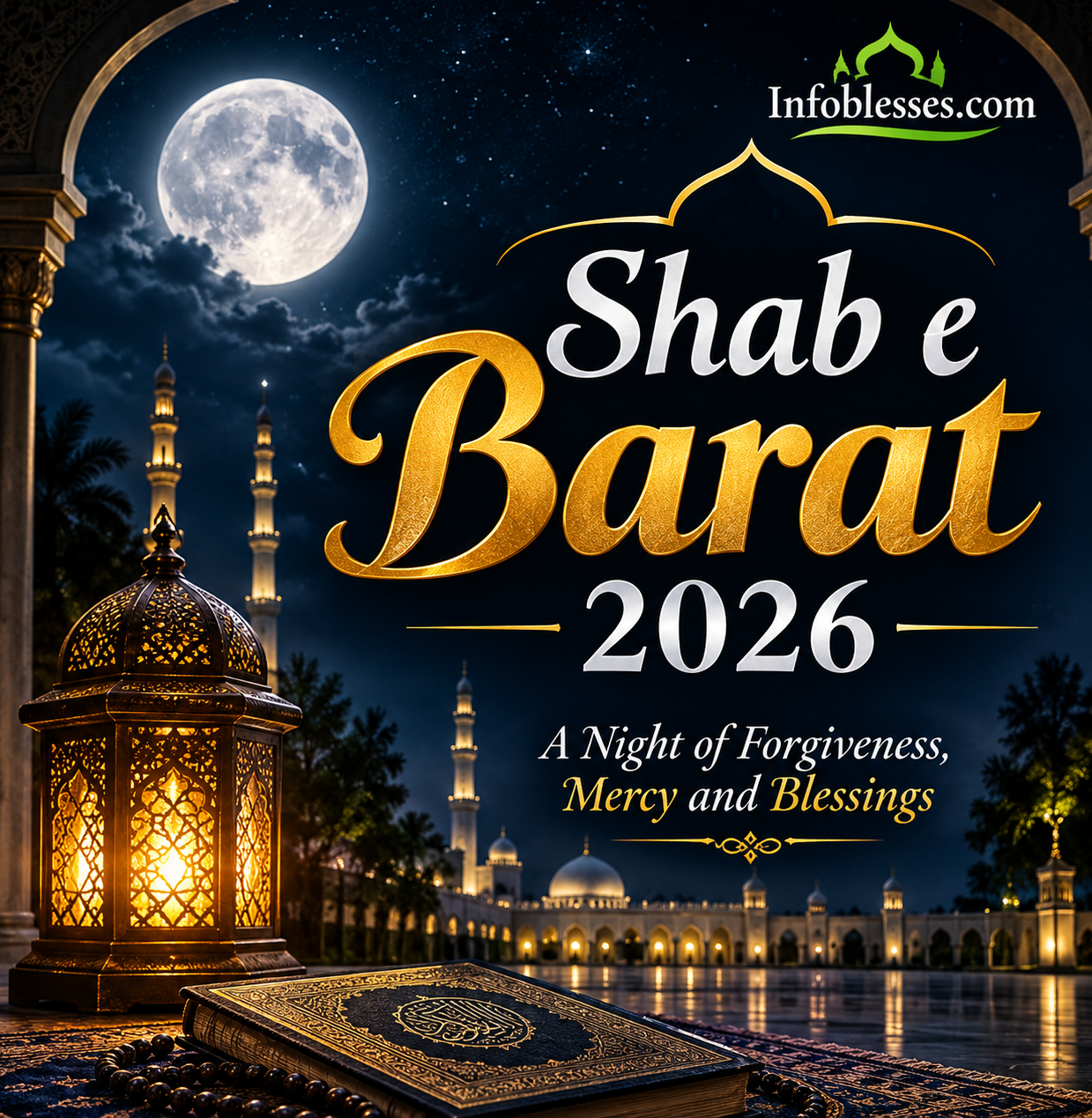
Shab e Barat 2026: Date, Significance and Importance
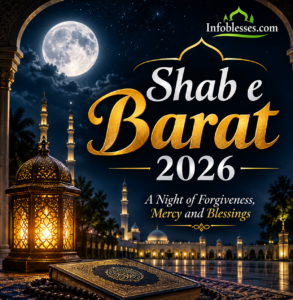
Shab e Barat 2026 is widely observed by Muslims in South Asia as a night of prayer, repentance, and seeking Allah’s forgiveness. It falls in the middle of Shaban, the eighth month of the Islamic lunar calendar.
For many Muslims, this occasion provides an opportunity to reflect on their actions, improve their relationship with Allah, remember the Hereafter, and prepare spiritually for the coming month of Ramadan.
The occasion is also known as the Night of Forgiveness, Laylat al-Bara’ah, and Mid-Shaban.
However, Muslims should understand the difference between established Islamic teachings and cultural customs. Although scholars have different opinions about the special status of the 15th night of Shaban, sincere repentance, voluntary worship, and remembering Allah are valuable acts throughout the year.
Let’s explore everything you need to know about this important Islamic occasion.
1. Shab e Barat 2026 Date in Pakistan and Around the World
Shab e Barat 2026 was observed in Pakistan on the night between Tuesday, February 3, and Wednesday, February 4, 2026, corresponding to the middle of Shaban 1447 AH.
The Islamic calendar follows the lunar cycle. Therefore, Islamic dates begin at sunset rather than midnight.
This means the night associated with the 15th of Shaban begins after Maghrib on the preceding Gregorian evening.
Shab e Barat 2026 Date Details
| Detail | Information |
|---|---|
| Islamic occasion | Shab e Barat |
| Hijri date | 15 Shaban 1447 AH |
| Gregorian night | February 3, 2026 |
| Daytime date | February 4, 2026 |
| Islamic month | Shaban |
| Day | Tuesday night to Wednesday |
| Also known as | Night of Forgiveness |
Pakistan’s official holiday information listed Shab-e-Barat as an optional holiday on February 4, subject to moon sighting.
The precise observance can differ between countries because Islamic months depend on local moon-sighting decisions.
Sources:
sindhhighcourt.gov.pk+2
Why Does the Date Change Every Year?
The Islamic calendar contains approximately 354 or 355 days, while the Gregorian calendar contains 365 or 366 days.
Consequently, Islamic occasions move approximately 10 or 11 days earlier each Gregorian year.
For example:
-
Shab e Barat 2025 occurred in February.
-
Shab e Barat 2026 occurred in early February.
-
Shab e Barat 2027 is expected in January, subject to moon sighting.
Muslims should check reliable local Islamic calendar announcements before making arrangements.
2. What Is Shab e Barat? Meaning and Definition
The expression Shab e Barat comes from Persian and Arabic linguistic traditions.
-
Shab: Night.
-
Barat: Associated with freedom, deliverance, or salvation.
The expression is commonly understood as the Night of Forgiveness or Night of Deliverance.
In Arabic, the middle night of Shaban is called Laylat al-Nisf min Shaban.
It is an occasion that many Muslim communities associate with seeking forgiveness, making dua, reading the Quran, and reflecting on personal responsibilities.
Other Names of Shab e Barat
| Name | Meaning |
|---|---|
| Shab e Barat | Night of Forgiveness |
| Laylat al-Bara’ah | Night of Deliverance |
| Mid-Shaban | Middle of Shaban |
| Laylat al-Nisf min Shaban | Night of the Middle of Shaban |
| Night of Forgiveness | Seeking Allah’s mercy |
The names may differ, but they generally refer to the same mid-Shaban observance.
It is important to remember that the Arabic and Persian names themselves do not establish a particular religious ritual. Specific acts of worship should be evaluated according to reliable Islamic evidence.
3. Significance of Shab e Barat in Islam
The significance of Shab e Barat is discussed by Muslim scholars through different interpretations of narrations concerning the middle of Shaban.
Some scholars consider certain narrations about Allah’s forgiveness on this night acceptable when considered collectively. Others question their strength or the religious basis for assigning special worship to this particular night.
One commonly discussed narration reports that Allah looks upon His creation during the middle night of Shaban and forgives many people, except those involved in certain forms of association with Allah and serious hostility.
Scholars differ regarding the authenticity and interpretation of the reports.
This difference makes it especially important to avoid presenting disputed religious claims as universally established facts.
A Night for Seeking Forgiveness
Regardless of differences concerning the night itself, asking Allah for forgiveness is an essential part of Islamic life.
Every Muslim makes mistakes. Sometimes people neglect their prayers, hurt others, engage in dishonest behaviour, or become distracted by worldly responsibilities.
Repentance offers an opportunity to return to Allah.
A sincere Muslim should:
-
Recognize personal mistakes.
-
Feel genuine regret.
-
Stop the wrongdoing.
-
Make a firm intention not to repeat it.
-
Restore the rights of anyone who has been harmed.
For example, someone who has spoken badly about a relative should not simply ask Allah for forgiveness. They should also try to correct the harm and seek reconciliation where appropriate.
Remembering the Hereafter
Shab e Barat also reminds Muslims of life’s temporary nature.
We often spend considerable time pursuing money, popularity, possessions, and social status. However, Islamic teachings encourage believers to remember that their actions have consequences beyond this world.
Use the occasion to consider important questions:
-
Am I fulfilling my religious responsibilities?
-
Am I treating my parents respectfully?
-
Do I owe anyone money?
-
Have I hurt someone through my words?
-
Am I making enough time for prayer?
-
What improvements should I make before Ramadan?
Such reflection can turn a religious occasion into a meaningful opportunity for personal growth.
4. Importance of the Month of Shaban
To understand Shab e Barat properly, Muslims should also understand the importance of the entire month of Shaban.
Shaban is the eighth month of the Islamic calendar and comes immediately before Ramadan. It provides an opportunity to strengthen religious habits before the arrival of the month of fasting.
The Prophet Muhammad (peace be upon him) regularly observed voluntary fasts during Shaban.
According to a narration from Aisha (RA), the Prophet (PBUH) fasted more during Shaban than in any other month apart from Ramadan.
This narration is recorded in Sahih al-Bukhari, Hadith 1969.
Sunnah+1
Why Is Shaban Important?
There are several reasons why Muslims should pay attention to this month:
-
It provides an opportunity to increase voluntary fasting.
-
It helps Muslims prepare for Ramadan.
-
It encourages regular Quran recitation.
-
It provides time to improve daily prayers.
-
It reminds believers to seek forgiveness.
-
It encourages charity and kindness.
How to Prepare for Ramadan During Shaban
You don’t need to wait until Ramadan begins to improve your religious routine.
Consider these practical steps:
-
Start reading a small portion of the Quran every day.
-
Establish regular prayer times.
-
Reduce unnecessary screen time.
-
Increase voluntary fasting if your health allows.
-
Give charity to people in need.
-
Make a list of personal and spiritual goals.
-
Resolve disagreements with family members.
For example, someone who struggles to wake up for Fajr can begin adjusting their sleeping schedule during Shaban. By the time Ramadan arrives, waking up early may feel much easier.
5. Islamic Teachings and Hadith About Shab e Barat
The religious status of the middle night of Shaban has been discussed by Islamic scholars for centuries.
Some narrations mention forgiveness on this night. However, scholars disagree about the strength of individual narrations and whether they establish a special form of worship.
One narration appears in Sunan Ibn Majah, Hadith 1390, describing forgiveness during the middle night of Shaban, with exceptions mentioned for a person who associates partners with Allah or maintains hostility.
The displayed grading on Sunnah.com identifies this particular narration as weak.
Sunnah
This distinction matters because Muslims should avoid claiming that every popular statement about Shab e Barat is an authentic hadith.
Differences Among Islamic Scholars
There are different scholarly approaches to this occasion.
| Scholarly approach | General position |
|---|---|
| Scholars accepting supporting narrations | Recognize virtue in the middle night of Shaban |
| Scholars questioning the narrations | Do not establish special worship for this night |
| Scholars emphasizing general worship | Encourage ordinary voluntary prayer, dua, and repentance without inventing rituals |
| Scholars discussing fasting | Distinguish the general Sunnah of Shaban fasting from fasting specifically because it is the 15th |
For a detailed discussion of the differing opinions, readers can consult:
-
Hanafi discussion of the virtue of 15 Shaban.
-
Discussion of scholarly objections to special mid-Shaban observances.
The important principle is to maintain respect when scholars differ and avoid turning a matter of disagreement into an excuse for hostility.
6. Best Prayers to Offer on Shab e Barat
Many Muslims wish to spend Shab e Barat in voluntary prayer.
There is no universally established special prayer with a fixed number of rakahs, compulsory surahs, or guaranteed results that all Muslims must perform on this night.
However, voluntary salah is an established form of worship at any time when prayer is permitted.
A Simple Voluntary Prayer Routine
You can follow this practical routine:
Step 1: Perform Wudu
Begin by performing ablution properly. Make sure you are physically clean and ready for prayer.
Step 2: Pray Your Obligatory Salah
Never allow voluntary worship to distract you from obligatory prayers.
Give special attention to Isha and Fajr.
Step 3: Offer Voluntary Salah
You may offer ordinary nafl prayers according to your ability and the guidance of your Islamic school.
Step 4: Recite the Quran
Read a portion of the Holy Quran with understanding.
Step 5: Make Dua
Ask Allah for forgiveness, guidance, health, protection, and goodness in this life and the Hereafter.
Step 6: Reflect on Your Actions
Think about your responsibilities and identify areas where you need improvement.
Which Surahs Can You Recite?
You can recite any surah of the Quran during voluntary prayer according to the normal rules of salah.
Some commonly recited surahs include:
-
Surah Al-Fatihah
-
Surah Al-Ikhlas
-
Surah Al-Falaq
-
Surah An-Nas
-
Surah Al-Kafirun
-
Surah Al-Mulk
However, don’t assume that a particular surah must be recited a fixed number of times specifically for Shab e Barat. Such claims require reliable religious evidence.
7. Powerful Duas for Shab e Barat 2026
Dua is one of the most meaningful ways to communicate with Allah.
You don’t need complicated Arabic words to make a sincere supplication. You can ask Allah in your own language, expressing your needs honestly and respectfully.
Here are several useful duas for forgiveness, guidance, mercy, and protection.
Dua 1: Seeking Forgiveness
أَسْتَغْفِرُ اللَّهَ وَأَتُوبُ إِلَيْهِ
Astaghfirullaha wa atubu ilayh.
Meaning: I seek forgiveness from Allah and repent to Him.
This short supplication is useful for regular remembrance and repentance.
Repeat it thoughtfully while considering the mistakes you want to leave behind.
Dua 2: The Best-Known Dua for Forgiveness
اللَّهُمَّ إِنَّكَ عَفُوٌّ تُحِبُّ الْعَفْوَ فَاعْفُ عَنِّي
Allahumma innaka ‘afuwwun tuhibbul-‘afwa fa’fu ‘anni.
Meaning: O Allah, You are Most Forgiving, and You love forgiveness, so forgive me.
This is a well-known authentic supplication taught by the Prophet (PBUH) to Aisha (RA) for Laylat al-Qadr. It is also a beautiful general dua to make at other times. It should not be presented as a prayer exclusively prescribed for Shab e Barat.
Dua 3: Dua for Guidance and Mercy
رَبَّنَا آتِنَا فِي الدُّنْيَا حَسَنَةً وَفِي الْآخِرَةِ حَسَنَةً وَقِنَا عَذَابَ النَّارِ
Rabbana atina fid-dunya hasanatan wa fil-akhirati hasanatan wa qina ‘adhaban-nar.
Meaning: Our Lord, grant us good in this world and good in the Hereafter, and protect us from the punishment of the Fire.
This Quranic supplication appears in Surah Al-Baqarah, verse 201.
Dua 4: Dua for Parents
رَبِّ ارْحَمْهُمَا كَمَا رَبَّيَانِي صَغِيرًا
Rabbir hamhuma kama rabbayani sagheera.
Meaning: My Lord, have mercy upon them as they brought me up when I was small.
This Quranic supplication appears in Surah Al-Isra, verse 24.
Remember your parents in your duas, whether they are alive or have passed away.
Dua 5: Dua for Protection and Forgiveness
رَبَّنَا ظَلَمْنَا أَنْفُسَنَا وَإِنْ لَمْ تَغْفِرْ لَنَا وَتَرْحَمْنَا لَنَكُونَنَّ مِنَ الْخَاسِرِينَ
Rabbana zalamna anfusana wa in lam taghfir lana wa tarhamna lanakunanna minal khasireen.
Meaning: Our Lord, we have wronged ourselves. If You don’t forgive us and have mercy upon us, we will surely be among the losers.
This is the supplication of Adam and Hawwa (peace be upon them), mentioned in Surah Al-A’raf, verse 23.
What Should You Ask Allah For?
During your personal duas, consider asking for:
-
Forgiveness for past mistakes.
-
Protection from harmful habits.
-
Good health and a peaceful life.
-
Guidance for your family.
-
Success in lawful work and business.
-
Relief for people facing hardship.
-
Mercy for deceased Muslims.
-
Strength to remain consistent in prayer.
-
Protection from arrogance, jealousy, and hatred.
-
The opportunity to reach Ramadan in good health.
Remember, sincere dua is more important than simply repeating words without understanding their meaning.
8. How to Spend Shab e Barat 2026: A Step-by-Step Guide
A meaningful night of worship doesn’t need to involve complicated arrangements or exhausting routines.
The best approach is to focus on sincerity, consistency, and actions supported by Islamic teachings.
Here is a simple schedule that Muslims can adapt according to their circumstances and scholarly guidance.
Evening: After Maghrib
Start the evening by completing your daily responsibilities and preparing for worship.
Recommended activities:
-
Perform Maghrib prayer on time.
-
Recite a portion of the Quran.
-
Make personal duas.
-
Seek forgiveness for past mistakes.
-
Avoid arguments and unnecessary distractions.
Take a few minutes to reflect on your relationship with Allah.
Night: After Isha
After performing Isha prayer, you can spend some time in voluntary worship.
Consider the following activities:
-
Offer voluntary salah.
-
Read the Quran with translation.
-
Recite authentic supplications.
-
Send blessings upon Prophet Muhammad (PBUH).
-
Make dua for your family and the Muslim community.
-
Spend time reflecting on your behaviour.
Don’t feel pressured to stay awake all night. Worship should be manageable and shouldn’t cause you to neglect your health or obligatory responsibilities.
Late Night: Before Fajr
If you’re able to wake up during the last part of the night, you can offer voluntary prayer and make sincere supplications.
The last third of the night is an established time for dua and seeking forgiveness throughout the year.
Morning: After Fajr
Make sure you perform Fajr prayer on time.
Continue your normal daily responsibilities while maintaining the positive intentions you developed during the night.
A practical worship checklist
0 of 9 completed
Reset checklist
9. Fasting on 15 Shaban: What Does Islam Say?
Fasting is an important form of worship in Islam. The month of Shaban has particular significance because the Prophet Muhammad (PBUH) regularly observed voluntary fasts during this month.
However, Muslims should distinguish between fasting during Shaban generally and believing that fasting specifically on the 15th has a uniquely established reward.
Is Fasting on 15 Shaban Compulsory?
No. Fasting on the 15th of Shaban is not obligatory.
The Prophet (PBUH) observed voluntary fasts during Shaban, as reported in Sahih al-Bukhari.
Muslims also have a general Sunnah of fasting on the 13th, 14th, and 15th days of lunar months. These are known as Ayyam al-Beed, or the White Days.
Therefore, someone fasting on the 15th as part of this monthly practice has a general basis for doing so.
Scholars differ regarding assigning a separate special virtue to fasting only on the 15th of Shaban.
Sunnah+2
Benefits of Voluntary Fasting
Voluntary fasting can help Muslims:
-
Develop self-control.
-
Increase gratitude.
-
Remember people experiencing hunger.
-
Strengthen spiritual discipline.
-
Prepare for Ramadan.
-
Develop healthier daily routines when fasting is suitable for their health.
People with medical conditions should seek appropriate medical advice before undertaking voluntary fasting.
10. Visiting Graves on Shab e Barat
Visiting graveyards is a practice that reminds Muslims of death and the Hereafter.
In Pakistan and other South Asian countries, many families visit graveyards around Shab e Barat to remember deceased relatives and make dua for them.
Is Visiting Graves Allowed?
Visiting graves is generally established in Islamic teachings as a reminder of the Hereafter.
However, Muslims should understand that visiting graves is not an obligatory part of Shab e Barat.
There is also disagreement about whether a particular graveyard visit should be specifically associated with this night.
Proper Etiquette When Visiting a Graveyard
If you visit a graveyard, remember these guidelines:
-
Maintain respectful behaviour.
-
Avoid shouting or unnecessary conversations.
-
Remember that everyone will eventually return to Allah.
-
Make dua for the deceased.
-
Avoid practices that involve asking the dead for supernatural assistance.
-
Do not disturb other visitors.
-
Keep the graveyard clean.
A visit should encourage humility and remembrance rather than becoming an occasion for competition, extravagance, or unnecessary celebrations.
11. Common Mistakes and Misconceptions About Shab e Barat
Although Shab e Barat is important in many Muslim communities, some popular beliefs and practices require careful examination.
Muslims should prioritize reliable Islamic knowledge rather than following every claim shared on social media.
Mistake 1: Believing in a Compulsory Special Prayer
Some people believe that Shab e Barat requires a particular prayer with a fixed number of rakahs and specific Quranic recitations.
There is no universally established authentic prescription requiring all Muslims to perform such a ritual.
Ordinary voluntary prayers are permissible, but inventing compulsory religious rituals is not appropriate.
Mistake 2: Assuming That Every Dua Is Guaranteed to Be Accepted
Muslims should make dua with hope and sincerity.
However, it is incorrect to promise that a particular formula guarantees the fulfillment of every worldly wish.
Allah responds to supplications according to His wisdom.
Mistake 3: Believing That the Night Replaces Laylat al-Qadr
Shab e Barat and Laylat al-Qadr are different occasions.
Laylat al-Qadr occurs during Ramadan and is described in the Quran as better than a thousand months.
The middle night of Shaban should not be confused with this special night of Ramadan.
Mistake 4: Spending Money on Fireworks
Fireworks, dangerous explosives, and unnecessary celebrations can cause injuries, disturb neighbours, and waste money.
A religious occasion should encourage peace, kindness, and responsible behaviour.
Mistake 5: Ignoring Obligatory Prayers
Some people spend hours in voluntary worship but neglect their obligatory prayers or daily responsibilities.
This reverses the proper priorities of Islamic worship.
Obligatory acts must remain central.
Mistake 6: Holding Grudges Against Others
A believer should try to remove hatred, jealousy, and unnecessary hostility from the heart.
If there is a disagreement with another person, seek a peaceful resolution.
Mistake 7: Sharing Unverified Religious Messages
Social media frequently circulates messages claiming that certain prayers guarantee wealth, marriage, long life, or forgiveness.
Before forwarding religious information, check its authenticity.
A useful principle is simple: don’t attribute a statement to the Prophet (PBUH) without reliable evidence.
12. How Is Shab e Barat Celebrated in Pakistan?
Shab e Barat has a strong cultural presence in Pakistan.
In cities such as Faisalabad, Lahore, Karachi, Islamabad, and Multan, many Muslim families observe the occasion through prayer, Quran recitation, charity, and family gatherings.
Local customs differ from one community to another.
Common Traditions in Pakistan
Some common activities include:
-
Visiting mosques for voluntary worship.
-
Reciting the Quran at home.
-
Making duas for deceased relatives.
-
Giving food and charity to needy families.
-
Preparing traditional sweets.
-
Visiting graveyards.
-
Listening to Islamic lectures.
Traditional Food and Sweets
In many Pakistani households, families prepare traditional foods and distribute them among neighbours, relatives, and people in need.
Some popular preparations include:
-
Halwa.
-
Zarda.
-
Rice-based desserts.
-
Traditional sweets.
-
Homemade food for neighbours.
These foods are cultural traditions rather than obligatory religious practices.
There is nothing wrong with sharing food as an act of kindness, provided people don’t consider a particular dish compulsory for religious acceptance.
Community and Family Activities
Parents can use the occasion to teach children about forgiveness, good manners, prayer, and respect for others.
For example, families can spend 15 minutes discussing the importance of honesty and helping people in need.
Such simple activities can create lasting positive habits.
13. Preparing Your Heart and Mind for Ramadan
One of the most practical ways to benefit from Shaban is to prepare for Ramadan.
Ramadan is a month of fasting, worship, patience, charity, and spiritual development.
Instead of waiting until the first day of Ramadan, Muslims can gradually improve their habits during Shaban.
Five Ways to Prepare for Ramadan
1. Improve Your Daily Prayers
Try to establish all five obligatory prayers at their proper times.
2. Build a Quran Reading Habit
Begin with a few pages every day. Gradually increase your reading according to your ability.
3. Practice Voluntary Fasting
If you’re healthy and able, observe voluntary fasts in Shaban according to established Islamic guidance.
4. Improve Your Character
Avoid gossip, dishonesty, anger, and unnecessary arguments.
5. Plan Your Charity
Identify people who need assistance and prepare to support them during Ramadan.
A Simple Ramadan Preparation Table
| Habit | Daily or Weekly Goal |
|---|---|
| Salah | Five obligatory prayers |
| Quran | 10–15 minutes daily |
| Dhikr | Regular remembrance |
| Charity | Give according to ability |
| Family | Spend quality time together |
| Character | Avoid harmful speech |
| Fasting | Voluntary fasting when appropriate |
These small improvements can make a significant difference over time.
14. Spiritual Benefits of Repentance and Self-Reflection
The most valuable outcome of a night of reflection is not simply feeling emotional for a few hours. It is making meaningful improvements that continue afterward.
Repentance is an important part of the relationship between a Muslim and Allah.
The Quran repeatedly encourages believers to turn toward Allah and seek His mercy.
Develop Better Relationships
Use this opportunity to improve relationships with parents, siblings, spouses, relatives, friends, and neighbours.
Sometimes a simple apology can repair a relationship that has remained damaged for years.
Become More Responsible
Think about your financial and personal responsibilities.
If you owe someone money, make a plan to repay it. If you’ve made a promise, try to fulfil it.
Islamic spirituality is not limited to prayer and fasting. It also includes honesty, justice, kindness, and fulfilling people’s rights.
Establish Long-Term Religious Habits
Instead of making unrealistic promises, choose manageable goals.
For example:
-
Read one page of the Quran daily.
-
Pray Fajr consistently.
-
Give charity regularly.
-
Avoid gossip.
-
Make dua every morning.
-
Forgive others where possible.
-
Spend time learning authentic Islamic teachings.
Small actions performed consistently can become powerful habits.
15. Frequently Asked Questions (FAQs) About Shab e Barat 2026
Here are answers to some of the most common questions about Shab e Barat, its date, prayers, fasting, and Islamic significance.
Q1. When Is Shab e Barat 2026 in Pakistan?
Shab e Barat 2026 was observed on the night of February 3, 2026, corresponding to 15 Shaban 1447 AH. The associated daytime date was February 4, 2026.
The Islamic night began after Maghrib on February 3.
Q2. What Is the Meaning of Shab e Barat?
Shab e Barat is commonly translated as the Night of Forgiveness or Night of Deliverance.
It is associated with the middle of Shaban, the eighth month of the Islamic calendar. Many Muslims use this occasion for repentance, dua, Quran recitation, and spiritual reflection.
Q3. Which Dua Should I Read on Shab e Barat?
You can recite the following beautiful supplication:
Allahumma innaka ‘afuwwun tuhibbul-‘afwa fa’fu ‘anni.
Meaning: O Allah, You are Most Forgiving, and You love forgiveness, so forgive me.
You can also make personal duas in your own language.
Q4. Is There a Special Namaz for Shab e Barat?
There is no universally established authentic special salah with a compulsory number of rakahs or fixed surah recitations for this night.
Muslims can perform ordinary voluntary prayers, read the Quran, and make dua. Follow reliable guidance from qualified scholars regarding disputed practices.
Q5. Is Fasting on 15 Shaban Sunnah?
The Prophet Muhammad (PBUH) regularly fasted during Shaban.
The 15th day also falls among the White Days (13th, 14th, and 15th) of the lunar month, for which voluntary fasting is generally recommended.
However, scholars differ about assigning an independent special virtue to fasting exclusively on the 15th of Shaban.
Q6. Can Women Pray on Shab e Barat During Menstruation?
Women experiencing menstruation do not perform salah or fast during this period.
However, they can still engage in many forms of worship, including dua, dhikr, seeking forgiveness, and sending blessings upon the Prophet (PBUH).
Regarding Quran recitation during menstruation, Islamic scholars have different opinions, so women should follow the guidance of their trusted scholars.
Q7. Is Visiting the Graveyard Compulsory on Shab e Barat?
No. Visiting graveyards is not compulsory on Shab e Barat.
Muslims may visit graves to remember death and make dua for deceased relatives, but this should not be treated as a required ritual for the occasion.
Q8. What Should Muslims Avoid on Shab e Barat?
Muslims should avoid:
-
Neglecting obligatory prayers.
-
Wasting money on unnecessary celebrations.
-
Dangerous fireworks.
-
Gossip and backbiting.
-
Fighting and holding grudges.
-
Spreading fabricated hadith.
-
Treating unsupported rituals as compulsory religious obligations.
The focus should remain on sincere worship, good character, and remembering Allah.
Q9. Is Shab e Barat the Same as Laylat al-Qadr?
No. They are two different occasions.
Shab e Barat is associated with the middle of Shaban, while Laylat al-Qadr occurs during the last ten nights of Ramadan.
Laylat al-Qadr has an explicitly established and exceptional status in the Quran.
Q10. Is Shab e Barat a Public Holiday in Pakistan?
Shab e Barat was listed as an optional holiday in Pakistan’s 2026 holiday schedule, with February 4 as the associated daytime date.
An optional holiday does not necessarily mean every office, school, or private business closes. Individual institutions may have different arrangements.
16. Reliable Islamic Sources and References
For readers who want to learn more about Shab e Barat and the month of Shaban, the following references are useful.
| Source | Subject | Reference |
|---|---|---|
| Sahih al-Bukhari | Fasting during Shaban | Hadith 1969 |
| Sunan Ibn Majah | Narration about the middle night of Shaban | Hadith 1390 |
| Quran | Dua for parents | Surah Al-Isra 17:24 |
| Quran | Dua for forgiveness | Surah Al-A’raf 7:23 |
| Pakistan Ministry of Religious Affairs | Shaban moon-sighting arrangements | Official ministry website |
| Time and Date | Pakistan holiday information | Shab e Barat holiday |
Important: Hadith authenticity and the specific religious status of mid-Shaban are matters of scholarly discussion. Readers should consult qualified Islamic scholars and distinguish between authentic narrations, weak reports, and cultural traditions.
17. Conclusion:
Shab e Barat 2026 was observed on the night of February 3–4 in Pakistan, corresponding to 15 Shaban 1447 AH.
For many Muslims, the occasion provides an opportunity to seek forgiveness, make dua, remember deceased relatives, and prepare for Ramadan.
However, the greatest value of spiritual reflection lies in making positive changes that continue throughout the year.
Rather than focusing only on special arrangements, Muslims should prioritize obligatory prayers, sincere repentance, good character, charity, and fulfilling the rights of other people.
Remember that Allah’s mercy is not limited to one particular night. Muslims can turn to Him every day, ask for forgiveness, and work toward becoming better believers.
May Allah forgive our sins, accept our sincere duas, guide our families, bless our parents, grant mercy to our deceased loved ones, and allow us to reach Ramadan with strong faith and good health. Ameen.
Welcome to Info Blesses I am Rana Ahtasham an AI Powered SEO and Content Writer With 3 year experience.I help websites rank highter, grow traffic, and look amazing. My goal is to make SEO and web design simple and effective for everyone.Lets achieve more togather!