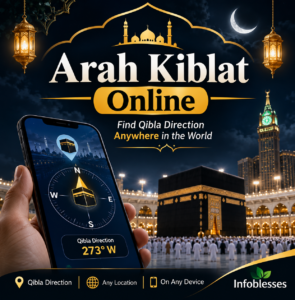

Finding the correct direction for daily prayers is an important part of Muslim worship. Muslims around the world face the Holy Kaaba in Makkah, Saudi Arabia, when performing Salah. However, identifying the correct direction isn’t always easy, especially when visiting unfamiliar places, traveling abroad, or praying somewhere without a nearby mosque.
Fortunately, modern technology has made this task much simpler. With Kiblat Online, Muslims can quickly discover the direction of the Kaaba using an internet-connected smartphone, tablet, or computer.
An online Qibla finder uses location information, geographical coordinates, and direction calculations to determine which way a person should face during prayer. Some tools also include a digital compass that responds to the movement of a smartphone.
Whether you’re at home, in a hotel, at work, or traveling internationally, these digital tools can make finding the Qibla more convenient.
In this comprehensive guide, we’ll explore how online Qibla services work, how to use them correctly, and which precautions can help improve their accuracy. We’ll also explain the difference between digital and traditional compasses and answer common questions about finding the Qibla.
1. What Is Kiblat Online and Why Is It Important?
Kiblat Online refers to digital tools and websites that help Muslims identify the direction of the Qibla through internet-based geographical calculations and, in some cases, smartphone compass technology.
The Qibla is the direction toward the Kaaba, located inside Masjid al-Haram in Makkah. Muslims face this direction during their obligatory daily prayers and other acts of worship that require facing the Qibla.
For people living close to Makkah, identifying the direction may be relatively straightforward. However, Muslims living thousands of kilometres away need a reliable method to determine the correct orientation.
This is where an online Qibla locator becomes useful.
Understanding the Importance of the Qibla
The Qibla represents a shared direction for Muslims worldwide. Regardless of nationality, language, or geographical location, Muslims turn toward the same sacred destination when performing Salah.
There are several reasons why identifying the Qibla matters:
- Religious significance: Facing the Qibla is an established requirement of Salah under Islamic teachings.
- Consistency: It helps Muslims maintain the correct prayer orientation wherever they are.
- Convenience: Digital tools make direction finding easier in unfamiliar surroundings.
- Accessibility: Many Qibla services are available without installing additional applications.
- Travel assistance: Visitors can identify the prayer direction in hotels, airports, offices, and other locations.
How Does an Online Qibla Finder Work?
Most online Qibla finders rely on two important types of information: your geographical location and the coordinates of the Kaaba.
The geographical location of the Kaaba is approximately:
| Location detail | Coordinates |
|---|---|
| Latitude | 21.4225° North |
| Longitude | 39.8262° East |
| City | Makkah |
| Country | Saudi Arabia |
An online service compares your location with these coordinates and calculates the initial direction toward the Kaaba.
This calculation generally uses spherical trigonometry and the great-circle method. A great circle represents the shortest route between two points on a spherical Earth.
Google explains its Qibla calculation method through its official Qibla Finder support page.
The Role of GPS Technology
GPS stands for Global Positioning System. It helps smartphones determine their geographical position using signals from satellites.
When you open a location-based Qibla service, your device may request permission to access your location.
Once permission is granted, the service can use your coordinates to calculate the direction of the Kaaba.
The process generally follows these steps:
- Your device identifies your current geographical location.
- The online service obtains your latitude and longitude.
- The system compares your coordinates with the Kaaba’s coordinates.
- A mathematical calculation determines the Qibla bearing.
- The result appears as a directional indicator or compass reading.
Some tools provide only a numerical bearing, while others display an interactive compass.
It’s worth remembering that GPS and compass technology perform different functions. GPS helps determine where you are, while a magnetometer helps determine the orientation of your device.
Understanding this difference can help you use digital Qibla services more effectively.
2. How to Find the Qibla Direction Online Easily
Finding the correct prayer direction doesn’t have to be complicated. Most online Qibla tools are designed with simple interfaces that people of different ages and technical backgrounds can use.
You don’t need advanced geographical knowledge or professional navigation equipment.
Here is a practical guide to using an online Qibla compass.
Step 1: Open a Reliable Qibla Finder
Start by choosing a trustworthy online Qibla service.
You can use Google’s Qibla Finder, which helps identify the direction of the Kaaba using your location.
Alternatively, choose a reputable Islamic website that provides geographical Qibla calculations.
Before using any service, check that it clearly explains its location permissions and calculation method.
Step 2: Allow Location Access
After opening the website, you may see a request asking permission to access your device’s location.
Allow location access if you’re comfortable sharing your current position with that service.
The website can then use your coordinates to calculate the direction toward Makkah.
If you don’t want to share your live location, look for an option to enter your city or geographical coordinates manually.
Keep in mind that manually selecting a city may provide a general direction rather than a precise reading for your exact location.
Step 3: Activate the Digital Compass
Some Qibla tools include a built-in digital compass.
If your smartphone supports the necessary orientation sensors, the compass can respond as you rotate your device.
Hold your phone flat and move it slowly until the directional indicator aligns with the displayed Qibla direction.
If the compass appears unstable, move away from nearby metal objects and electronic equipment.
Step 4: Check the Direction Carefully
Don’t immediately rely on the first reading.
Instead, take a moment to check whether the compass is behaving consistently.
You can improve your results by:
- Holding your smartphone horizontally.
- Moving away from large metal objects.
- Keeping your phone away from magnetic accessories.
- Calibrating the compass when necessary.
- Comparing the reading with another reliable source.
These simple precautions can reduce common direction errors.
Step 5: Mark the Prayer Direction
Once you’ve identified the Qibla, you can use a fixed reference point to remember the direction.
For example, you might identify a particular wall, corner, or carpet position in your prayer room.
If you regularly pray in the same location, marking the direction can save time.
However, remember that the direction may differ when you move to another building or location.
A Simple Example of Using an Online Qibla Compass
Imagine that you’re staying in a hotel during a business trip.
You enter your hotel room and want to perform Salah, but you don’t know which direction to face.
Instead of guessing, you can:
- Open a Qibla finder on your smartphone.
- Enable location access.
- Wait for your geographical position to load.
- Activate the compass if available.
- Hold your phone flat.
- Rotate until the directional indicator identifies the Qibla.
- Double-check the reading before beginning your prayer.
This process takes only a short time and can make praying in unfamiliar places much easier.
What If Your Smartphone Doesn’t Have a Compass?
Not every device includes a magnetometer or supports live compass readings.
That’s not necessarily a problem.
You can still use a Qibla calculator that displays the bearing in degrees from true north.
For example, a reading of 90 degrees indicates east, while 180 degrees indicates south.
You can use a separate compass or another reliable directional reference to identify the required bearing.
3. Benefits of Using an Online Qibla Compass
Digital technology has changed how people access religious information and everyday Islamic resources.
Online Qibla services are a good example of how simple technological solutions can support daily religious practices.
Here are some important benefits.
1. Easy Access From Almost Anywhere
One of the biggest advantages of Kiblat Online is accessibility.
You can open a Qibla finder through a web browser without necessarily installing an application.
This is particularly helpful for people who don’t want to use additional storage space on their smartphones.
Whether you’re at home, visiting relatives, or staying in a hotel, an internet-enabled device can help you identify the prayer direction.
2. Convenient for International Travelers
Traveling to another country can create practical challenges for Muslims.
You may not know the layout of a hotel room, the direction of nearby streets, or the location of the closest mosque.
An online Qibla compass can help you identify the prayer direction without depending entirely on local landmarks.
It’s especially useful when:
- Traveling for business.
- Visiting another country.
- Staying at airports.
- Exploring unfamiliar cities.
- Camping or spending time outdoors.
- Visiting places without nearby mosques.
3. Fast Direction Calculations
Traditional methods of finding the Qibla may require geographical knowledge, compass equipment, or assistance from someone familiar with the area.
An online Qibla calculator performs the geographical calculation automatically.
After obtaining your location, it can provide a direction in degrees or display an interactive indicator.
This makes the process easier for beginners.
4. Useful for Muslims of Different Ages
A good Qibla website should have a simple and understandable interface.
Older adults, students, and people unfamiliar with modern navigation technology can benefit from clear directional displays.
Many online services use arrows, compass symbols, and straightforward instructions.
These visual elements help users understand the results without needing technical expertise.
5. No Need for Specialized Equipment
A smartphone is often enough to access a digital Qibla finder.
You don’t necessarily need a separate navigation device, professional compass, or printed geographical map.
However, your device must have the appropriate sensors if you want a live compass experience.
6. Helpful for Establishing a Prayer Space
People who move into new homes or offices may need to identify a suitable prayer area.
An online Qibla tool can help determine the orientation of that space.
After checking the direction, you can arrange your prayer mat and other religious items accordingly.
For permanent installations, such as a mosque or dedicated prayer room, it is sensible to obtain additional verification from knowledgeable local authorities or qualified survey professionals.
7. Supports Independent Prayer Preparation
An online Qibla finder gives users a convenient way to check the direction themselves.
You don’t always need to wait for another person to help you.
This can be particularly useful for students, solo travelers, and people living in places where Islamic facilities are limited.
Comparing Popular Qibla-Finding Methods
Different methods have different advantages.
| Method | Main advantage | Possible limitation |
|---|---|---|
| Online Qibla finder | Convenient and accessible | Requires internet for many services |
| Smartphone compass | Portable and quick | Can be affected by magnetic interference |
| Traditional compass | Works without internet | Requires correct magnetic adjustment |
| Mosque prayer rows | Established local reference | Not always available nearby |
| Astronomical calculations | Based on geographical and astronomical principles | Requires accurate information and calculation |
No single method is perfect in every situation.
A combination of geographical calculations, compass checks, and trusted local references can provide greater confidence.
Is an Online Qibla Finder Always Accurate?
An online Qibla service can calculate a reliable geographical bearing, but the displayed direction may still be affected by your device.
For example, inaccurate GPS positioning can influence the result, while nearby metal objects can interfere with the smartphone’s compass.
Another important factor is the difference between magnetic north and true north.
True north refers to the geographical North Pole. Magnetic north is the direction indicated by a magnetic compass.
These directions aren’t identical.
A good Qibla service should account for this difference when displaying a live compass direction.
For best results, check your location, calibrate your phone, and compare the reading with another trusted source when necessary.
4. Common Mistakes to Avoid When Finding the Qibla
Even though digital Qibla tools are convenient, users can make mistakes that affect their results.
Understanding these issues can help you use an online Qibla finder more confidently.
Mistake 1: Ignoring Compass Calibration
An uncalibrated smartphone compass may display unstable or incorrect readings.
If the compass needle moves unpredictably, follow the calibration instructions provided by your device or application.
Many smartphones support a figure-eight movement to help recalibrate the magnetic sensor.
Mistake 2: Using a Compass Near Metal Objects
Metal structures, magnetic phone cases, speakers, and electronic equipment can interfere with compass readings.
Try moving to an open area before checking the direction.
This is especially important inside buildings with substantial steel structures.
Mistake 3: Confusing East With the Qibla
Some people assume that the Qibla always points east.
However, the direction of Makkah depends on the observer’s geographical location.
For example, people in some parts of Asia may face west or west-northwest, while people in North America may face northeast.
Therefore, never assume that the Qibla is the same direction everywhere.
Mistake 4: Trusting an Unverified Website
Not every website offers accurate geographical calculations.
Some tools may use outdated information, inaccurate location settings, or poorly designed compass displays.
Choose services that explain their methods and provide clear information about location accuracy.
Mistake 5: Forgetting Magnetic Declination
A magnetic compass points toward magnetic north, while many Qibla bearings are calculated from true north.
The difference between these directions is known as magnetic declination.
Depending on your location, this difference can be significant.
Use a compass that accounts for local magnetic declination or make the necessary correction before relying on a numerical bearing.
Mistake 6: Assuming a City-Level Reading Is Exact
If you manually select a city, the tool may calculate the Qibla direction using a central geographical point.
That may be sufficient for general guidance, but it isn’t necessarily the exact bearing for your current position.
Using accurate coordinates can improve the calculation.
5. Frequently Asked Questions About Kiblat Online
FAQ 1: What Is Kiblat Online?
Kiblat Online is a digital service that helps Muslims find the direction of the Holy Kaaba in Makkah. It generally uses geographical coordinates and mathematical calculations to identify the Qibla direction. Some services also provide a live smartphone compass.
FAQ 2: Can I Find the Qibla Direction Without Downloading an Application?
Yes. Many websites provide online Qibla calculators that work directly through a browser. You can open a compatible website on your smartphone, tablet, or computer. Some services require location permissions, while others allow you to enter your city or coordinates manually.
FAQ 3: Does an Online Qibla Finder Require GPS?
Not always. GPS or another location service can help determine your exact position automatically. However, you can also enter your geographical coordinates manually or select a city. The accuracy of the result depends partly on how accurately your location is identified.
FAQ 4: Can I Use a Qibla Compass Without Internet?
Some online services require an internet connection to load their calculations and maps. However, offline applications and traditional compasses can provide alternatives. If you already know your location’s Qibla bearing, you may also use a physical compass with the appropriate magnetic correction.
FAQ 5: Why Does My Smartphone Compass Show Different Directions?
Smartphone compass readings can be affected by magnetic interference, calibration problems, nearby electronics, and incorrect orientation. Additionally, magnetic north and true north are different. Move away from metal objects, calibrate your phone, and check whether the application accounts for magnetic declination.
FAQ 6: Is the Online Qibla Direction Suitable for Daily Salah?
A reliable online Qibla finder can be a useful way to identify the direction for daily prayers. However, users should check their location and device readings rather than blindly trusting an unstable compass. If you’re uncertain, consult a local mosque or knowledgeable Islamic authority.
FAQ 7: Can I Find the Qibla Direction While Traveling?
Absolutely. Online Qibla services are particularly helpful when traveling because they can calculate the direction from your current geographical location. They can be useful in hotels, airports, offices, and unfamiliar cities. You should still check compass accuracy and location permissions.
FAQ 8: Is the Qibla Direction the Same Everywhere?
No. The direction changes depending on your geographical position. Every Muslim faces the Kaaba, but the compass bearing differs from one location to another. This is why location-based calculations are important.
Conclusion:
Finding the correct prayer direction has become easier with modern digital technology. Kiblat Online provides a convenient way for Muslims to identify the direction of the Holy Kaaba using geographical coordinates, GPS technology, and smartphone compass features.
Whether you’re praying at home, working in an office, staying in a hotel, or traveling internationally, an online Qibla finder can make prayer preparation more convenient.
For the best results, choose a reliable service, provide accurate location information, calibrate your smartphone compass, and remember the difference between magnetic north and true north.
Most importantly, use technology as a helpful tool rather than relying blindly on every digital reading.
With the right precautions, an online Qibla compass can become a valuable resource for maintaining confidence and consistency in your daily prayers.

Welcome to Info Blesses I am Rana Ahtasham an AI Powered SEO and Content Writer With 3 year experience.I help websites rank highter, grow traffic, and look amazing. My goal is to make SEO and web design simple and effective for everyone.Lets achieve more togather!