1. Introduction to Surah Feel
Surah Feel, also known as Surah Al-Fil, is the 105th chapter of the Holy Quran. It consists of five short verses and is part of Juz 30. Despite its short length, it carries a remarkable message about Allah’s power, protection, and control over the entire universe.
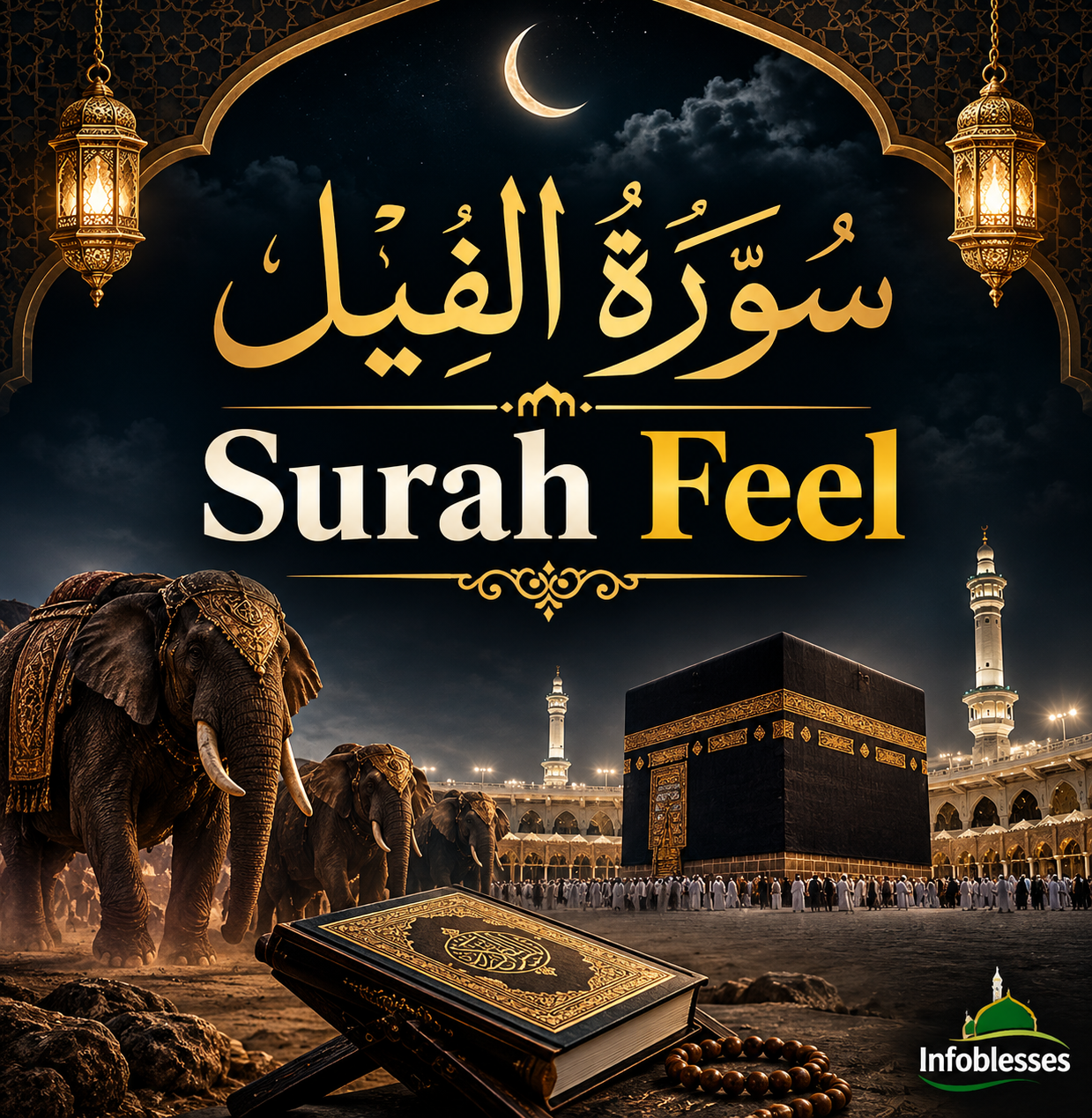
The word Feel means elephant in Arabic. The Surah takes its name from the army of elephants that came towards Makkah with the intention of destroying the Holy Kaaba.
This historical event is commonly known as the Event of the Elephant (Waqiat al-Fil). Islamic tradition connects it with the year of the birth of Prophet Muhammad ﷺ.
The chapter reminds Muslims that human strength, military power, wealth, and political influence are all limited. Allah can protect His sacred places and defeat powerful enemies through means that people may never expect.
Why Is Surah Feel Important?
There are several reasons why Muslims should understand this chapter:
-
It teaches the greatness and unlimited power of Allah.
-
It reminds believers that arrogance leads to destruction.
-
It explains an important event in Islamic history.
-
It encourages gratitude for Allah’s protection and blessings.
-
It develops trust in Allah during difficult situations.
-
It shows that worldly power cannot challenge divine authority.
Surah Feel is therefore more than a historical account. It is a lesson about faith that remains relevant in every generation.
2. Basic Facts About Surah Al-Fil
Before exploring its deeper meaning, it’s helpful to understand some basic facts about this Quranic chapter.
| Information | Details |
|---|---|
| Arabic name | سورة الفيل |
| English name | The Elephant |
| Surah number | 105 |
| Number of verses | 5 |
| Number of Rukus | 1 |
| Juz | 30 |
| Place of revelation | Makkah |
| Main subject | The army of the Elephant |
| Central message | Allah’s power and protection |
2.1 Meaning of the Name Surah Feel
The Arabic word Al-Fil translates into English as “The Elephant.”
The name refers to the elephant associated with the invading army led by Abraha. Elephants were powerful animals and could create fear among people who weren’t familiar with them in warfare.
The Quran mentions the companions of the elephant in its opening verse:
“Have you not considered, [O Muhammad], how your Lord dealt with the companions of the elephant?”
This opening question encourages people to remember an extraordinary event and reflect on Allah’s power.
2.2 Place of Revelation
Surah Al-Fil is classified as a Meccan Surah. It was revealed in Makkah before the migration of Prophet Muhammad ﷺ to Madinah.
Its message is closely connected with the history of Makkah and the protection of the Kaaba.
It also reminds the Quraysh of a major event that was familiar in their historical memory.
3. Historical Background: The Story of the Army of the Elephant
The historical background of Surah Feel is one of the most interesting stories connected with the early history of Makkah.
According to Islamic historical accounts, an army led by Abraha advanced towards Makkah with the intention of destroying the Kaaba.
The Kaaba was already an important religious centre for Arab tribes. People travelled from different regions to visit it.
Abraha wanted to change this situation.
3.1 Who Was Abraha?
Abraha was a ruler or governor in Yemen during the sixth century. Historical Islamic accounts describe him as a Christian ruler who wanted to establish a major pilgrimage centre in Yemen.
He built a large church in Sana’a, hoping that Arab tribes would visit it instead of travelling to Makkah.
However, the Kaaba continued to hold a special position among the Arabs.
Traditional accounts describe Abraha as becoming increasingly determined to destroy the Kaaba after his efforts failed to attract the expected attention.
3.2 Why Did Abraha Want to Destroy the Kaaba?
The Kaaba had religious, cultural, and social importance among Arab communities.
Pilgrims travelled to Makkah, and the Quraysh benefited from the city’s position as an important gathering place.
Abraha wanted to redirect this attention towards his newly constructed religious building.
His ambition eventually led him to prepare a military expedition against Makkah.
The army reportedly included elephants, which explains why the event became known as the Year of the Elephant.
3.3 What Happened to the Army?
When Abraha’s army approached Makkah, the people faced a powerful military force.
The Quran doesn’t provide every historical detail of the expedition. Instead, it focuses on Allah’s response.
According to Surah Feel, Allah sent birds in flocks against the army. These birds struck the soldiers with stones of baked clay.
The invading force was ultimately destroyed and its plans failed.
The Quran describes the army’s condition using the image of eaten-up crop remains.
This dramatic description shows how completely their strength and confidence were overturned.
The most important point isn’t the size of the army or the number of elephants. It’s the fact that Allah’s power is greater than every human force.
4. Surah Feel Arabic, Transliteration, and English Translation
Here are the five verses of Surah Al-Fil, along with their transliteration and a simple English translation.
سورة الفيل
Surah Al-Fil – The Elephant
VERSE 1
أَلَمْ تَرَ كَيْفَ فَعَلَ رَبُّكَ بِأَصْحَابِ الْفِيلِ
Alam tara kayfa fa’ala rabbuka bi ashaabil feel
Have you not seen how your Lord dealt with the companions of the elephant?
VERSE 2
أَلَمْ يَجْعَلْ كَيْدَهُمْ فِي تَضْلِيلٍ
Alam yaj’al kaydahum fee tadleel
Did He not frustrate their plan?
VERSE 3
وَأَرْسَلَ عَلَيْهِمْ طَيْرًا أَبَابِيلَ
Wa arsala ‘alayhim tayran abaabeel
And He sent against them birds in flocks.
VERSE 4
تَرْمِيهِمْ بِحِجَارَةٍ مِنْ سِجِّيلٍ
Tarmeehim bihijaaratim min sijjeel
Striking them with stones of baked clay.
VERSE 5
فَجَعَلَهُمْ كَعَصْفٍ مَأْكُولٍ
Faja’alahum ka’asfim ma’kool
Then He made them like eaten-up straw.
English renderings are simplified for learning. Translation wording can differ between Quran editions.
You can also read the Arabic text and explore translations and commentary at Quran.com – Surah Al-Fil.
5. Explanation of Each Verse of Surah Feel
Understanding each verse helps readers appreciate the chapter’s message more deeply.
Verse 1: Allah’s Power Over the Army of the Elephant
The first verse asks whether people have considered how Allah dealt with the companions of the elephant.
It directs attention towards a remarkable historical event.
The verse teaches that Allah is fully aware of human actions and that no army can escape His authority.
It also encourages believers to reflect on the blessings and protection Allah provides.
Verse 2: The Failure of Their Plan
The second verse explains that Allah made the enemy’s plan unsuccessful.
Abraha had an army, resources, and confidence. Yet none of these things could guarantee victory.
This verse reminds us that human plans are limited. Success ultimately depends on Allah’s will.
It also teaches an important lesson about arrogance. People shouldn’t believe that their wealth or position makes them invincible.
Verse 3: Birds Sent in Flocks
The third verse describes Allah sending birds in groups against the invading army.
The Arabic word Ababil refers to flocks or successive groups.
The Quran doesn’t provide a detailed scientific description of these birds. Its focus is on the divine intervention that defeated the army.
The verse reminds believers that Allah can use even seemingly small creatures to accomplish extraordinary things.
Verse 4: Stones of Baked Clay
The fourth verse explains that the birds struck the soldiers with stones of Sijjil.
The expression is commonly understood as stones of baked clay.
The important message is that Allah used a means that the powerful army couldn’t overcome.
This demonstrates that divine power doesn’t depend on conventional military strength.
Verse 5: The Army Became Like Eaten Straw
The final verse describes the army as becoming like eaten-up straw.
This image represents complete defeat and destruction.
The army that once appeared powerful became helpless.
The verse closes the Surah with a strong reminder: worldly strength is temporary, while Allah’s authority is absolute.
6. Surah Feel Meaning and Its Central Message
The central message of Surah Feel is that Allah has complete control over everything in creation. No matter how powerful a person, army, government, or nation becomes, its strength remains limited.
This Surah teaches Muslims to look beyond visible power and recognize the authority of the Creator.
There are several important themes within its five verses.
6.1 Allah Is the Most Powerful
The story of the Elephant demonstrates that Allah’s power cannot be compared with human strength.
Abraha’s army had weapons, soldiers, and elephants. Nevertheless, it couldn’t accomplish its objective.
This teaches Muslims that Allah doesn’t need human resources to protect His creation.
A believer should remember this lesson when facing difficult circumstances. Even when a problem appears impossible, Allah’s power remains unlimited.
6.2 Arrogance Can Lead to Destruction
Abraha’s expedition illustrates the danger of excessive pride and ambition.
He believed that his military power could achieve something that would change the religious importance of Makkah.
However, his confidence couldn’t protect him from defeat.
Surah Feel reminds us that success should never make us arrogant. Wealth, intelligence, physical strength, and authority are blessings that should encourage gratitude rather than pride.
6.3 Allah Protects What He Wills
One of the most powerful messages of this chapter is Allah’s protection.
The Kaaba was threatened by an army that appeared much stronger than the people of Makkah.
Yet Allah protected His sacred House.
This doesn’t mean that believers will never face hardship. Rather, it teaches that Allah’s wisdom and authority are greater than human understanding.
6.4 Worldly Power Is Temporary
Human beings often judge success by wealth, social position, physical strength, or political influence.
Surah Feel challenges this way of thinking.
Abraha possessed significant worldly power, but it didn’t give him control over the outcome of his expedition.
A person’s true success should therefore be measured through faith, good character, righteous actions, and obedience to Allah.
6.5 History Contains Lessons for Future Generations
The story of the Elephant is not included in the Quran simply to provide historical information.
It invites people to think about their responsibilities and relationship with Allah.
Muslims can learn from past events by examining the choices, attitudes, and consequences described in the Quran.
This approach makes Quranic stories meaningful in everyday life.
7. Benefits of Reciting Surah Feel
Reciting the Quran is an important act of worship in Islam. Surah Feel is a short chapter that Muslims can memorize, recite, and reflect upon regularly.
Its benefits should be understood through the general teachings of the Quran rather than unsupported claims about special rewards.
There isn’t an established authentic narration specifying a particular worldly reward, guaranteed protection, or fixed number of recitations exclusively for Surah Al-Fil.
However, reading and understanding this Surah offers several meaningful spiritual and educational benefits.
7.1 Strengthening Faith in Allah
The story of the Elephant encourages believers to strengthen their faith in Allah.
It demonstrates that divine power is greater than every human creation.
When Muslims recite this Surah with understanding, they are reminded that Allah is the ultimate authority.
This can help develop stronger belief, especially during difficult periods.
For example, someone facing financial problems, family difficulties, or professional challenges can reflect on the Surah’s central message: human circumstances aren’t beyond Allah’s knowledge or power.
7.2 Developing Trust in Allah (Tawakkul)
Tawakkul means placing one’s trust in Allah while making responsible efforts.
Surah Feel teaches that visible strength doesn’t guarantee success.
A Muslim should work hard, make sensible decisions, and seek beneficial opportunities while trusting Allah with the outcome.
For instance:
-
A student should study seriously and trust Allah for success.
-
A business owner should work honestly and seek Allah’s help.
-
A family should make responsible decisions and pray for guidance.
-
Someone experiencing hardship should remain hopeful and avoid despair.
The Surah reminds believers that they aren’t required to control every outcome.
7.3 Learning Gratitude
Allah protected the Kaaba from the invading army.
This event reminds Muslims to appreciate the blessings they receive.
Gratitude (Shukr) is an important part of Islamic character.
People sometimes focus so much on their difficulties that they overlook the blessings already present in their lives.
These blessings include:
-
Good health and physical abilities.
-
Family relationships and friendship.
-
Food, water, and shelter.
-
Opportunities to learn and work.
-
The ability to worship Allah.
-
Safety and peace.
Reciting Surah Feel and reflecting on its message can encourage a more grateful attitude.
7.4 Increasing Quranic Understanding
Surah Feel is short, making it suitable for people who are beginning to study the Quran.
By learning its Arabic words, translation, and explanation, readers can improve their understanding of Quranic language.
Parents can also use this Surah to introduce children to Islamic history.
Teachers may explain the story through simple examples, helping students understand the relationship between faith, humility, and responsibility.
7.5 Encouraging Hope During Difficulties
Life includes challenges that sometimes appear too large to overcome.
Surah Feel reminds believers that circumstances can change in unexpected ways.
The army of the Elephant seemed powerful, but its plans failed.
This story encourages Muslims to remain hopeful, continue making lawful efforts, and avoid losing faith during difficult moments.
Hope doesn’t mean ignoring problems. It means facing them with patience, wisdom, and trust in Allah.
7.6 Teaching Humility
The story demonstrates that human beings should recognize their limitations.
No matter how successful someone becomes, they remain dependent on Allah.
A humble person acknowledges their blessings, treats others respectfully, and avoids using power to harm people.
7.7 Supporting Regular Quran Recitation
Because Surah Feel has only five verses, it’s relatively easy to include in a regular Quran-reading routine.
Muslims can recite it during their voluntary Quran study and learn its meaning gradually.
The purpose should be sincere worship and understanding, rather than believing in an unverified formula for obtaining a particular result.
An important reminder: The spiritual benefits of Quran recitation come through sincere worship, reflection, and acting upon its guidance. Muslims should avoid spreading claims about special Surah Feel rituals or guaranteed outcomes without reliable Islamic evidence.
8. Eleven Powerful Lessons from Surah Feel
Surah Feel contains important lessons that can guide Muslims in their personal, family, and social lives.
Here are eleven teachings worth remembering.
Lesson 1: Never Underestimate Allah’s Power
The first lesson is that Allah’s power is beyond human imagination.
Abraha’s army appeared strong, but it couldn’t overcome Allah’s will.
We should never assume that a situation is impossible simply because we cannot see a solution.
Lesson 2: Avoid Arrogance
Arrogance makes people believe they’re superior to others.
Surah Feel reminds us that worldly authority doesn’t make anyone independent of Allah.
Muslims should remain humble regardless of their success.
Lesson 3: Put Your Trust in Allah
Trust in Allah should remain part of every believer’s life.
When difficulties arise, Muslims should pray, make responsible efforts, and maintain hope.
Lesson 4: Respect Sacred Places
The Kaaba holds a special position in Islam.
The story teaches Muslims to respect the sacred symbols and places that Allah has honored.
Lesson 5: Small Things Can Have Great Impact
The birds mentioned in Surah Feel were the means through which Allah defeated a powerful army.
This demonstrates that something seemingly small shouldn’t automatically be considered insignificant.
In everyday life, small acts of kindness, honesty, and charity can also create meaningful change.
Lesson 6: Wealth Doesn’t Guarantee Success
Abraha’s resources couldn’t guarantee victory.
Muslims should therefore avoid measuring their worth through money or possessions.
True success includes faith, good character, and beneficial actions.
Lesson 7: Learn from History
The Quran encourages reflection on past events.
Instead of treating history as entertainment, Muslims should ask what lessons they can apply to their own lives.
Lesson 8: Be Thankful for Allah’s Blessings
The protection of the Kaaba reminds believers to appreciate the blessings Allah provides.
Gratitude should be expressed through words, worship, and good actions.
Lesson 9: Don’t Lose Hope During Hardship
A difficult situation isn’t necessarily permanent.
Surah Feel encourages believers to remember Allah’s power and remain hopeful.
Lesson 10: Human Plans Are Limited
People can make plans, prepare resources, and work towards their goals. However, they cannot control every outcome.
This lesson encourages humility and responsible decision-making.
Lesson 11: Worship Allah Alone
The chapter ultimately directs attention towards Allah as the true source of power and protection.
Its message encourages sincere worship and dependence on Him rather than arrogance or misplaced confidence in worldly power.
9. How to Incorporate Surah Feel into Daily Life
Understanding the Surah is important, but applying its teachings is equally valuable.
Here are practical ways to benefit from its message.
9.1 Read with Understanding
Don’t limit your Quranic reading to pronunciation alone.
Learn the translation of each verse and reflect on its meaning.
Even a few minutes of thoughtful Quran study can help strengthen your connection with the Book of Allah.
9.2 Teach Children the Story
Parents can introduce Surah Feel to children through simple explanations.
Explain who Abraha was, why he marched towards Makkah, and how Allah protected the Kaaba.
This can help children develop an early understanding of Islamic history.
9.3 Practice Humility
Avoid looking down on others because of wealth, education, or social position.
Remember that every blessing is ultimately from Allah.
9.4 Maintain Hope
When facing personal or professional difficulties, remember the lesson of Surah Feel.
Make practical efforts, seek advice, pray, and trust Allah.
9.5 Make Gratitude a Daily Habit
Take time to appreciate your blessings.
Thank Allah for health, family, food, safety, and opportunities.
Show gratitude through kindness and responsible actions.
9.6 Memorize the Five Verses
If you haven’t memorized Surah Feel, learn one verse at a time.
Listen to a reliable Quran recitation, practice the pronunciation, and review regularly.
For proper pronunciation, learning from a qualified Quran teacher is especially helpful.
10. Frequently Asked Questions (FAQs) About Surah Feel
Here are answers to common questions about Surah Feel, its meaning, history, and benefits.
Q1. What is the meaning of Surah Feel?
Surah Feel means “The Elephant.” It is the 105th chapter of the Holy Quran and describes how Allah defeated the army of the Elephant that intended to destroy the Kaaba.
Q2. How many verses are in Surah Feel?
Surah Feel contains five verses. It is a short Meccan Surah included in the 30th Juz of the Quran.
Q3. Why was Surah Feel revealed?
Surah Feel reminds people of how Allah protected the Kaaba from Abraha’s invading army. It teaches that Allah’s power is greater than every human force.
Q4. Who was Abraha in the story of Surah Feel?
Abraha was a ruler of Yemen who wanted to redirect Arab pilgrims towards a church he had built in Sana’a. According to Islamic historical accounts, he later led an army towards Makkah to destroy the Kaaba.
Q5. What does Ababil mean in Surah Feel?
Ababil refers to birds arriving in flocks or successive groups. The third verse describes Allah sending these birds against Abraha’s army.
Q6. What is the main benefit of reciting Surah Feel?
Reciting Surah Feel is an act of Quranic worship. Reflecting on its message can strengthen faith, encourage gratitude, and remind Muslims to trust Allah. However, no specific guaranteed worldly reward or special protection formula has been established through an authentic narration exclusively for this Surah.
Q7. Is Surah Feel a Meccan or Madinan Surah?
Surah Feel is a Meccan Surah. It was revealed in Makkah and contains five verses.
Q8. Can children memorize Surah Feel easily?
Yes. Its five short verses make it suitable for children who are learning Quranic recitation. Parents and teachers can help children memorize it gradually while explaining its meaning.
Q9. What is the central lesson of Surah Feel?
The central lesson is that Allah has unlimited power and authority. No matter how strong human beings become, they cannot overcome His will.
Q10. What is the Year of the Elephant?
The Year of the Elephant refers to the year associated with Abraha’s expedition against Makkah. Islamic tradition places this event around the time of Prophet Muhammad’s ﷺ birth.
11. Conclusion:
Surah Feel is a beautiful reminder of Allah’s unlimited power, wisdom, and authority. Although it contains only five verses, its historical and spiritual messages offer valuable guidance for Muslims.
The story of Abraha and his army demonstrates that worldly strength doesn’t guarantee success. Allah can defeat the most powerful forces through means that people may never expect.
The Surah also teaches humility, gratitude, patience, and trust in Allah.
Muslims should not only memorize and recite Surah Feel but also understand its meaning and apply its lessons in everyday life.
Whether you’re a student learning Quranic chapters, a parent teaching children Islamic history, or someone seeking a deeper connection with the Holy Quran, Surah Feel offers meaningful guidance.
Its message remains clear:
Never become arrogant because of worldly power, never lose hope during hardship, and always remember that Allah is the ultimate protector and source of strength.
May Allah help us understand the Holy Quran, follow its teachings, and strengthen our faith. Ameen.

Welcome to Info Blesses I am Rana Ahtasham an AI Powered SEO and Content Writer With 3 year experience.I help websites rank highter, grow traffic, and look amazing. My goal is to make SEO and web design simple and effective for everyone.Lets achieve more togather!