Allah is the central figure of Islamic faith and the foundation of everything Muslims believe, worship, and practice. In Islam, Allah is the one and only Creator, Sustainer, and Lord of the universe. He is eternal, all-powerful, merciful, and unlike anything in creation.
Understanding Allah is essential for understanding Islam. Every major Islamic teaching, from prayer and charity to fasting and pilgrimage, is connected to belief in His existence and oneness.
The word Allah carries deep spiritual meaning. It represents the belief that there is only one God worthy of worship, that He has no partners, and that all creation depends on Him.
Muslims also learn about Allah through His beautiful names, commonly known as Asma-ul-Husna. These names describe His mercy, knowledge, power, forgiveness, wisdom, and other perfect attributes.
This article explores the meaning of Allah, His important names, and His significance in Islam. Whether you’re a Muslim seeking to strengthen your faith or a curious reader interested in Islamic beliefs, this guide will help you understand the subject clearly.
1. What Does Allah Mean in Islam?
Allah is the Arabic name used in Islam for the one supreme God. It refers to the Creator of everything in existence, including the heavens, the earth, human beings, animals, and the entire universe.
Unlike ordinary titles, the name Allah identifies the unique God who has no equal, partner, or rival. Muslims believe that He existed before creation and will remain forever.
In Islamic theology, Allah isn’t limited by time, space, physical appearance, or human weaknesses. He doesn’t need food, sleep, rest, or assistance. Instead, everything in creation depends entirely on Him.
The Islamic understanding of Allah is based mainly on the Holy Quran and the teachings of Prophet Muhammad (peace be upon him).
The Arabic Meaning of Allah
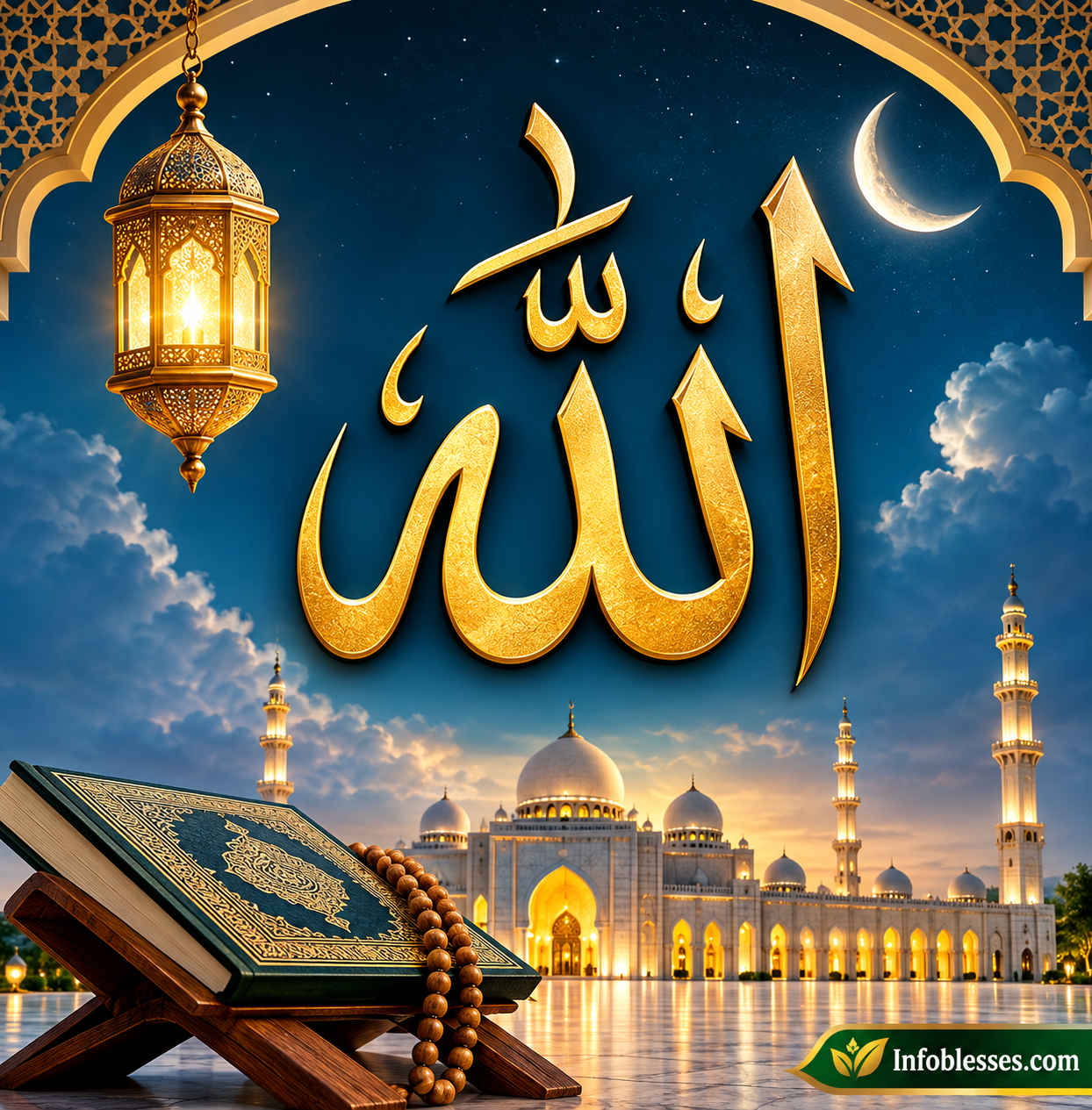
The word Allah is written in Arabic as الله. It is the central name for God in Islamic belief.
In English, Allah is commonly translated as God. However, many Muslims prefer using the Arabic word because it directly reflects the name used throughout the Quran.
The word represents the one supreme Creator rather than a separate deity or a limited supernatural being.
Several important ideas are connected with the meaning of Allah:
- Uniqueness: Allah has no equal or competitor.
- Eternity: He has no beginning and no end.
- Omnipotence: He has complete power over everything.
- Knowledge: Nothing is hidden from Him.
- Mercy: He is compassionate and forgiving.
- Sovereignty: Everything belongs to Him.
The meaning of Allah is therefore much deeper than simply identifying a powerful being. It establishes the Islamic understanding of a perfect Creator who controls and sustains the entire universe.
Tawhid: The Oneness of Allah
One of the most important concepts in Islam is Tawhid, which means believing in the absolute oneness of Allah.
Tawhid is the foundation of Islamic faith. A Muslim believes that Allah alone deserves worship and that no person, object, angel, prophet, or other created being shares His divinity.
The concept is commonly explained through three connected areas:
1. Oneness of Lordship
Muslims believe that Allah alone creates, owns, controls, and sustains the universe. Everything that exists depends on His power and permission.
2. Oneness of Worship
All acts of worship must be directed toward Allah alone. This includes prayer, supplication, seeking divine forgiveness, and acts of devotion.
3. Oneness of His Names and Attributes
Muslims believe that Allah possesses perfect names and attributes. Nothing in creation is equal to Him, and His qualities cannot be compared with human limitations.
Tawhid influences every part of Muslim life. It encourages believers to depend on Allah, remain humble, avoid arrogance, and recognize that worldly achievements are ultimately blessings from Him.
It also creates a direct spiritual relationship between the believer and the Creator.
Allah in Surah Al-Ikhlas
One of the clearest explanations of Allah’s uniqueness appears in Surah Al-Ikhlas, the 112th chapter of the Quran.
This short chapter contains four verses and communicates a central Islamic belief: Allah is absolutely one and incomparable.
Its main teachings include:
- Allah is One.
- Allah is independent, while all creation depends on Him.
- He neither gives birth nor was He born.
- Nothing is comparable to Him.
The chapter is particularly important because it removes misunderstandings about the nature of God.
It explains that Allah isn’t part of creation and doesn’t share the limitations of created beings.
For Muslims, Surah Al-Ikhlas is an essential chapter for understanding Islamic monotheism.
You can read its complete translation here: https://quran.com/al-ikhlas
Allah’s Uniqueness and Greatness
Islam teaches that Allah is beyond human imagination and understanding. People can learn about His names and attributes through revelation, but they cannot fully comprehend His greatness.
For example, human beings require sleep, food, and rest. Allah requires none of these things.
Human knowledge is limited, but His knowledge encompasses everything. People may forget events, misunderstand situations, or make mistakes, whereas Allah’s knowledge is complete and perfect.
Ayat-ul-Kursi, found in Surah Al-Baqarah (2:255), provides a powerful description of these attributes.
It identifies Allah as Al-Hayy, the Ever-Living, and Al-Qayyum, the Sustainer of all existence. It also explains that neither sleep nor tiredness overtakes Him.
These teachings help Muslims understand that the universe doesn’t exist independently. Every moment of existence depends on the power and will of its Creator.
Belief in Allah’s greatness also encourages humility. A person who recognizes the greatness of the Creator becomes less attached to pride, wealth, social status, and temporary worldly achievements.
Ultimately, understanding Allah means recognizing that He is the source of life, guidance, mercy, and ultimate accountability.
2. The Beautiful Names of Allah
One of the most meaningful ways Muslims understand Allah is through His beautiful names, known in Arabic as Asma-ul-Husna.
These names describe His perfect qualities and help believers develop a deeper relationship with their Creator.
The Quran emphasizes the importance of these names in Surah Al-A’raf, verse 180, which teaches that the most beautiful names belong to Allah and encourages believers to call upon Him through them.
The names aren’t simply words to memorize. Each one carries a spiritual meaning that can influence a Muslim’s thoughts, actions, prayers, and behavior.
For example, understanding that Allah is Ar-Rahman reminds believers of His vast mercy. Knowing that He is Al-Alim encourages honesty because nothing is hidden from His knowledge.
What Are the 99 Names of Allah?
The 99 names of Allah are widely known as Asma-ul-Husna, meaning the Most Beautiful Names.
These names describe different aspects of Allah’s perfection, including His mercy, power, forgiveness, wisdom, justice, and knowledge.
A well-known Hadith narrated by Abu Hurairah and recorded in Sahih al-Bukhari and Sahih Muslim mentions that Allah has 99 names and promises Paradise to the person who properly comprehends them.
The word used in the Hadith is commonly understood as involving more than simply memorizing a list. It also carries the idea of understanding and living according to their meanings.
It’s worth noting that scholars have discussed whether the number 99 represents a special group of names or a limit on all Divine Names. Many scholars explain that it shouldn’t be understood as restricting Allah to only 99 names.
Different traditional lists may also vary in their arrangement and selection.
The following are some widely recognized names and their meanings.
Important Names of Allah and Their Meanings
| Arabic Name | English Meaning | Spiritual Significance |
|---|---|---|
| Ar-Rahman | The Most Compassionate | His vast mercy |
| Ar-Rahim | The Most Merciful | His continuous mercy |
| Al-Malik | The King | His absolute sovereignty |
| Al-Quddus | The Most Holy | His perfect purity |
| As-Salam | The Source of Peace | His perfection and peace |
| Al-Aziz | The Almighty | His unmatched power |
| Al-Khaliq | The Creator | His power to create |
| Al-Ghaffar | The Ever-Forgiving | His repeated forgiveness |
| Al-Alim | The All-Knowing | His complete knowledge |
| As-Sami | The All-Hearing | He hears everything |
| Al-Basir | The All-Seeing | He sees everything |
| Ar-Razzaq | The Provider | He provides for creation |
| Al-Hakim | The All-Wise | His perfect wisdom |
| Al-Hayy | The Ever-Living | His eternal life |
| Al-Qayyum | The Self-Sustaining | He sustains all existence |
| Al-Wadud | The Most Loving | His perfect love |
| Al-Ahad | The One | His absolute oneness |
| As-Samad | The Eternal Refuge | All creation depends on Him |
These names provide a foundation for understanding the Islamic concept of divine perfection.
Allah’s Mercy, Forgiveness, and Wisdom
Among the most frequently mentioned attributes of Allah are mercy and forgiveness.
The names Ar-Rahman and Ar-Rahim appear together in the opening chapter of the Quran, Surah Al-Fatihah.
This chapter begins by praising Allah as the Most Compassionate and Most Merciful. It reminds believers that mercy is central to their understanding of their Creator.
Allah’s mercy encourages Muslims never to lose hope, even when they make mistakes.
Islam teaches that sincere repentance is always important. A believer should recognize wrongdoing, feel genuine regret, seek forgiveness, and make a sincere effort to improve.
Another important name is Al-Hakim, meaning the All-Wise.
This name reminds Muslims that divine wisdom exceeds human understanding. People may sometimes experience situations that seem confusing, unfair, or difficult. However, Islamic belief encourages them to recognize the limits of their own knowledge.
Allah is also Al-Ghaffar, the Ever-Forgiving. This name teaches that believers should continue turning toward Him rather than allowing guilt or despair to control their lives.
At the same time, mercy doesn’t mean that actions have no consequences. Islam balances forgiveness with justice and personal responsibility.
How the Names of Allah Influence Daily Life
Learning the beautiful names of Allah can influence how Muslims behave in everyday situations.
These names offer lessons that extend beyond religious ceremonies and formal worship.
Consider the following examples:
When learning about Ar-Rahman: A believer is reminded to show compassion toward family members, neighbors, children, and people experiencing difficulties.
When learning about Al-Adl and divine justice: A person is encouraged to act fairly, avoid cheating, and respect the rights of others.
When learning about Al-Alim: A Muslim remembers that Allah knows both public and private actions. This encourages honesty even when nobody else is watching.
When learning about Al-Ghaffar: Believers are encouraged to seek forgiveness and avoid losing hope after making mistakes.
When learning about Ar-Razzaq: Muslims recognize that provision comes from Allah and are encouraged to work honestly, remain grateful, and avoid excessive jealousy.
These examples demonstrate how the names of Allah can become practical guides for personal development.
They also encourage believers to develop positive qualities without claiming that human beings can possess divine perfection.
How to Learn and Remember the Names
Learning the 99 names of Allah can become a meaningful spiritual practice.
However, memorizing names without understanding their meanings may limit the benefits of this exercise.
A more effective approach involves learning gradually and reflecting on each name.
Here are some practical methods:
- Learn two or three names each day.
- Understand the Arabic pronunciation and English meaning.
- Read the Quranic passages connected with those names.
- Use appropriate names when making dua.
- Reflect on how their meanings influence your behavior.
- Revise previously learned names regularly.
- Share your knowledge with family members and children.
For example, when asking Allah for forgiveness, a believer may call upon Him as Al-Ghaffar. When seeking mercy, the names Ar-Rahman and Ar-Rahim are especially meaningful.
This approach transforms learning into an ongoing spiritual experience.
The ultimate purpose of understanding Asma-ul-Husna isn’t simply to complete a memorization exercise. It’s to increase awareness of Allah, strengthen faith, and encourage a better way of living.
3. The Significance of Allah in Islam
Allah holds the central position in every aspect of Islamic belief and practice.
Islam isn’t simply a collection of religious ceremonies or cultural traditions. It is a complete way of life built around recognizing the Creator, worshipping Him, following His guidance, and accepting responsibility for one’s actions.
Belief in Allah gives Muslims a clear understanding of why they exist and what their responsibilities are.
It also provides spiritual direction during happiness, hardship, uncertainty, and major life decisions.
Allah’s Position in the Holy Quran
The Holy Quran is the primary source of Islamic guidance. It repeatedly teaches about Allah’s existence, oneness, mercy, knowledge, power, and relationship with creation.
Its chapters discuss different aspects of divine guidance and encourage people to reflect on the world around them.
Surah Al-Fatihah, the opening chapter, provides an excellent example.
It describes Allah as the Lord of all worlds, the Most Compassionate, and the Most Merciful. It also teaches believers to worship Him alone and ask Him for guidance.
Another important passage is Ayat-ul-Kursi in Surah Al-Baqarah.
This verse explains Allah’s sovereignty over the heavens and the earth, His complete knowledge, and His ability to sustain creation without difficulty.
These passages demonstrate that the Quran doesn’t present Allah as a distant or irrelevant concept. Instead, it encourages believers to recognize His presence through His knowledge, mercy, and control over all existence.
The Quran also invites people to observe nature.
The movement of the sun and moon, the changing seasons, the growth of plants, and the complexity of human life are all opportunities for reflection.
For Muslims, these signs strengthen awareness of the Creator and encourage gratitude for His blessings.
Worshipping Allah Alone
Worship is one of the most important expressions of belief in Allah.
Muslims believe that worship belongs exclusively to Him. Their religious practices are designed to strengthen their relationship with their Creator and remind them of their responsibilities.
The five pillars of Islam demonstrate this connection.
1. Shahadah (Declaration of Faith)
The declaration of faith confirms that there is no deity worthy of worship except Allah and that Muhammad is His Messenger.
It establishes the foundation of Muslim identity.
2. Salah (Daily Prayer)
Muslims perform five obligatory prayers every day. These prayers create regular opportunities to remember Allah, seek guidance, and express gratitude.
3. Zakat (Obligatory Charity)
Zakat teaches that wealth is a responsibility and that people should support those who are eligible to receive assistance.
4. Sawm (Fasting During Ramadan)
Fasting develops self-control, patience, gratitude, and awareness of Allah.
5. Hajj (Pilgrimage to Makkah)
Hajj brings Muslims from different countries and backgrounds together in worship of one Creator.
Apart from these five pillars, Muslims can remember Allah through voluntary prayers, supplications, Quran recitation, charity, and good deeds.
This demonstrates that worship isn’t restricted to a mosque or a specific time of day. Sincere actions performed with the right intention can also become acts of worship.
The Relationship Between Allah and Humanity
Islam teaches that human beings are created by Allah and are responsible for how they use the abilities, opportunities, and resources they receive.
People have the ability to make choices, develop relationships, pursue knowledge, and contribute to society.
However, these abilities come with responsibilities.
Muslims believe that Allah provides guidance through His revelations and messengers. The Quran explains principles that help people distinguish right from wrong and develop a meaningful life.
This relationship involves several important elements.
Gratitude: Recognizing blessings and expressing appreciation for them.
Obedience: Following divine guidance and avoiding actions prohibited by Islamic teachings.
Repentance: Turning toward Allah after making mistakes.
Patience: Remaining steadfast during difficult situations.
Responsibility: Understanding that actions have consequences.
Belief in Allah also encourages people to recognize the value of other human beings.
A person’s wealth, nationality, language, or social position doesn’t make them equal to the Creator. All people remain His creation.
This belief can encourage humility, fairness, and respect within families and communities.
Trusting Allah During Difficult Times
Life includes happiness, success, disappointment, illness, financial pressure, and unexpected challenges.
Islam teaches believers to place their trust in Allah during all these circumstances.
This concept is commonly known as Tawakkul.
Tawakkul means relying on Allah while also taking appropriate practical steps.
For example, someone looking for employment should work hard, improve their skills, and apply for suitable opportunities while asking Allah for guidance and assistance.
A student preparing for an examination should study responsibly rather than expecting success without effort.
Similarly, a person facing financial difficulties should seek lawful ways to improve their circumstances while remaining hopeful and patient.
Trusting Allah doesn’t mean ignoring problems or refusing to take action.
Instead, it means recognizing that human beings have limited control over outcomes.
This belief can provide emotional strength because Muslims understand that their efforts matter, even when results don’t match their expectations.
Prayer and remembrance can also help believers remain calm during difficult periods.
The belief in Allah’s mercy reminds them that hardship isn’t necessarily a sign of rejection or abandonment.
Rather than giving up, they are encouraged to continue making sincere efforts, seeking help, and maintaining hope.
Allah’s Role in Building a Moral Society
Belief in Allah has an important influence on Islamic ethics and social responsibility.
Muslims are encouraged to develop good character and treat other people with kindness, honesty, and fairness.
These values aren’t separate from religion. They are closely connected to the understanding that Allah knows every action and that people are accountable for their behavior.
For example:
- Honesty encourages trust in personal and professional relationships.
- Charity supports people experiencing poverty.
- Justice protects individuals from unfair treatment.
- Forgiveness can help repair damaged relationships.
- Respect for parents strengthens family responsibilities.
- Compassion encourages care for vulnerable people.
- Humility reduces arrogance and unnecessary conflict.
Islam also emphasizes that religious belief should be reflected in conduct.
A person cannot fully appreciate the importance of mercy while consistently treating others cruelly.
Likewise, understanding divine justice should encourage fairness rather than exploitation.
Belief in Allah can therefore contribute to a society where people recognize their responsibilities toward one another.
It provides a moral framework that connects personal faith with social behavior.
Ultimately, the significance of Allah in Islam extends beyond theological discussions. It influences worship, relationships, decisions, personal discipline, and the way Muslims understand their purpose in life.
Frequently Asked Questions (FAQs)
1. Who Is Allah in Islam?
Allah is the one and only God in Islam. Muslims believe He created the universe, sustains all existence, and has complete knowledge and power. He has no partners, equals, parents, or children. Worship is directed toward Him alone.
2. What Does Allah Mean in English?
Allah is commonly translated into English as God. It is the Arabic name used by Muslims for the one supreme Creator. The word represents the Islamic belief in one unique and eternal God.
3. Does Allah Have 99 Names?
Islamic tradition recognizes 99 beautiful names of Allah, known as Asma-ul-Husna. A Hadith in Sahih al-Bukhari and Sahih Muslim describes the virtue of comprehending these names. Scholars have also explained that the number doesn’t necessarily restrict all Divine Names to only 99.
4. Are Allah and God the Same?
In Islamic belief, Allah is the one God, the Creator of the universe. Allah is the Arabic name for God. Arabic-speaking people from different religious backgrounds may also use the word Allah when referring to God, although different religions have different theological understandings of Him.
5. Why Do Muslims Worship Allah?
Muslims worship Allah because they believe He alone created and sustains everything and is the only one worthy of worship. Worship expresses gratitude, obedience, love, humility, and recognition of His greatness.
6. How Can Muslims Become Closer to Allah?
Muslims can strengthen their relationship with Allah through regular prayer, Quran recitation, sincere repentance, remembrance, charity, good character, and learning His beautiful names. Maintaining patience and gratitude also helps believers develop stronger faith.
7. What Is the Difference Between Allah’s Names and Attributes?
Allah’s names are the specific names through which Muslims learn about His perfection, such as Ar-Rahman and Al-Alim. His attributes describe the qualities and meanings associated with those names, including mercy and knowledge. Both help believers understand Allah through the guidance of revelation.
Conclusion:
Allah is the foundation of Islamic faith and the center of Muslim worship. Understanding His meaning, beautiful names, and divine attributes helps believers develop a stronger connection with their Creator.
The concept of Tawhid teaches that Allah is one, unique, eternal, and without partners. His beautiful names reveal His mercy, wisdom, forgiveness, knowledge, and power.
The significance of Allah extends into every part of Muslim life, including prayer, family relationships, personal decisions, social responsibilities, and spiritual development.
Learning about Allah shouldn’t be limited to memorizing religious information. It should inspire gratitude, patience, humility, honesty, and compassion.
For Muslims, the journey of understanding Allah is a lifelong process. Through Quranic study, sincere worship, reflection, and good actions, believers can continue strengthening their faith and improving their relationship with their Creator.

Welcome to Info Blesses I am Rana Ahtasham an AI Powered SEO and Content Writer With 3 year experience.I help websites rank highter, grow traffic, and look amazing. My goal is to make SEO and web design simple and effective for everyone.Lets achieve more togather!