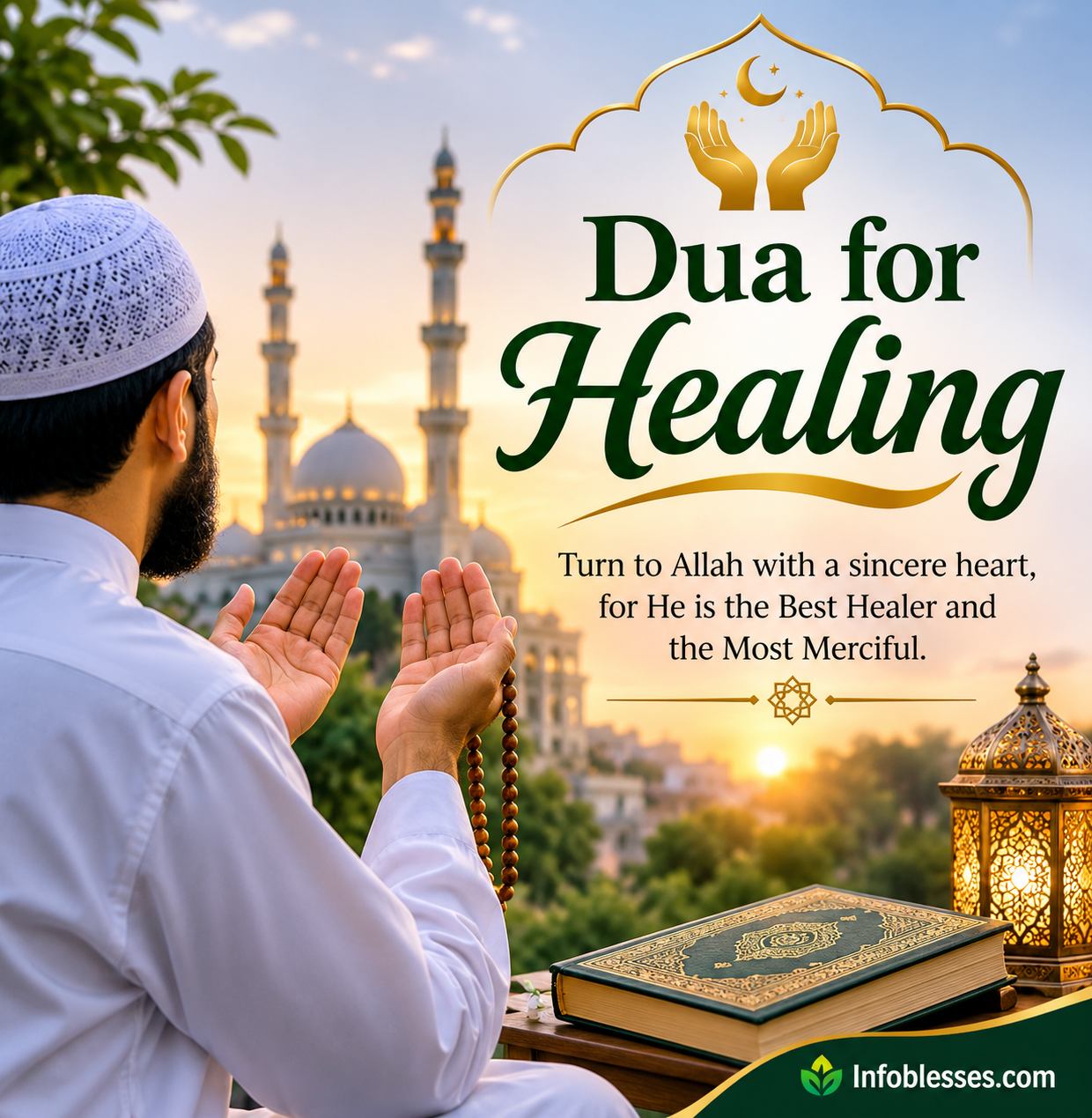
Introduction: Understanding the Power of Dua for Healing
Illness can affect every part of life. It can make ordinary activities difficult, create emotional stress, and leave a person feeling helpless. During these challenging moments, Muslims turn to Allah for comfort, strength, and recovery.
A dua for healing is a beautiful way to ask Allah for Shifa (healing). Islam teaches that Allah is the ultimate source of healing and that believers should place their trust in Him during times of illness.
The Quran reminds us:
“And when I am ill, it is He who cures me.”
— Surah Ash-Shu’ara (26:80)
This verse highlights an important Islamic belief: medical treatment may be a means of recovery, but ultimate healing comes from Allah.
Whether you’re experiencing physical pain, emotional difficulties, or a serious health challenge, sincere supplication can strengthen your connection with your Creator.
In this article, we’ll explore powerful duas for healing from the Quran and authentic Sunnah, their meanings, and practical ways to include them in daily life.
1. Understanding Shifa in Islam
The Arabic word Shifa means healing, cure, or recovery. In Islam, healing isn’t limited to physical health. It also includes emotional peace, spiritual strength, and protection from difficulties.
Allah has created different means through which people experience healing. These include medicine, medical professionals, healthy habits, rest, and sincere prayer.
Physical Healing
Physical healing refers to recovery from illness, injury, pain, or other medical conditions.
Muslims are encouraged to seek medical treatment while making dua for recovery. The Prophet Muhammad (peace be upon him) taught that Allah has provided remedies for illnesses.
This teaches believers that seeking treatment doesn’t conflict with trusting Allah.
Emotional and Mental Healing
Life’s challenges can cause anxiety, sadness, fear, and emotional exhaustion.
Dua provides an opportunity to express these feelings directly to Allah. A believer can ask for:
-
Relief from anxiety and sadness.
-
Strength during difficult circumstances.
-
Patience during illness.
-
Peace of heart and mind.
-
Hope when facing uncertainty.
Spiritual Healing
Spiritual healing involves strengthening one’s relationship with Allah.
Reciting the Quran, performing Salah, making Istighfar, and remembering Allah can help believers develop inner peace and strengthen their faith.
2. 15 Powerful Duas for Healing and Recovery
The following supplications include duas from authentic Islamic sources and general permissible prayers asking Allah for healing.
1. The Most Powerful Dua for Healing
One of the well-known Prophetic supplications for healing is:
Arabic:
اللَّهُمَّ رَبَّ النَّاسِ، أَذْهِبِ الْبَأْسَ، اشْفِ أَنْتَ الشَّافِي، لَا شِفَاءَ إِلَّا شِفَاؤُكَ، شِفَاءً لَا يُغَادِرُ سَقَمًا
Transliteration:
Allahumma Rabban-naas, adhhib il-ba’s, ishfi Antash-Shaafi, laa shifaa’a illaa shifaa’uka, shifaa’an laa yughaadiru saqamaa.
English Meaning:
“O Allah, Lord of mankind, remove the suffering and grant healing. You are the Healer. There is no healing except Your healing, a healing that leaves no illness behind.”
Reference: Sahih al-Bukhari 5743; Sahih Muslim 2191.
This dua is especially meaningful when someone is suffering from illness. It acknowledges Allah as the ultimate source of recovery.
2. Dua for Complete Shifa
Arabic:
اللَّهُمَّ اشْفِنِي شِفَاءً كَامِلًا
Transliteration:
Allahumma ishfini shifaa’an kaamilan.
Meaning:
“O Allah, grant me complete healing.”
This is a simple general supplication. It can be used when asking Allah for recovery from any illness.
3. Dua for Healing from Pain
The Prophet Muhammad (peace be upon him) taught a supplication for pain.
Arabic:
بِسْمِ اللَّهِ
Then say seven times:
أَعُوذُ بِاللَّهِ وَقُدْرَتِهِ مِنْ شَرِّ مَا أَجِدُ وَأُحَاذِرُ
Transliteration:
A’udhu billahi wa qudratihi min sharri maa ajidu wa uhaadhir.
Meaning:
“I seek refuge in Allah and His power from the evil of what I feel and what I fear.”
How to recite it:
-
Place your hand over the area where you feel pain.
-
Say Bismillah three times.
-
Recite the supplication seven times.
Reference: Sahih Muslim 2202.
4. Dua for Someone Who Is Sick
When visiting an ill person, the Prophet Muhammad (peace be upon him) taught the following supplication:
Arabic:
لَا بَأْسَ طَهُورٌ إِنْ شَاءَ اللَّهُ
Transliteration:
Laa ba’sa, tahoorun in shaa Allah.
Meaning:
“Do not worry; it is a purification, if Allah wills.”
Reference: Sahih al-Bukhari 5656.
This dua offers reassurance and reminds the sick person to remain hopeful.
5. Dua for Seven Times Healing
The Prophet Muhammad (peace be upon him) taught a supplication for a sick person:
Arabic:
أَسْأَلُ اللَّهَ الْعَظِيمَ رَبَّ الْعَرْشِ الْعَظِيمِ أَنْ يَشْفِيَكَ
Transliteration:
As’alullahal-‘Azeem Rabbal-‘Arshil-‘Azeem an yashfiyak.
Meaning:
“I ask Allah, the Magnificent, Lord of the Magnificent Throne, to heal you.”
Recite it seven times when visiting a sick Muslim.
Reference: Sunan Abi Dawud 3106; Jami’ at-Tirmidhi 2083.
6. Dua for Recovery from Serious Illness
Arabic:
رَبِّ إِنِّي مَسَّنِيَ الضُّرُّ وَأَنْتَ أَرْحَمُ الرَّاحِمِينَ
Transliteration:
Rabbi inni massaniyad-durru wa Anta arhamur-raahimeen.
Meaning:
“My Lord, indeed adversity has touched me, and You are the Most Merciful of the merciful.”
Reference: Surah Al-Anbiya (21:83).
This is the supplication of Prophet Ayyub (peace be upon him), who remained patient through prolonged suffering.
7. Dua for Protection and Well-Being
Arabic:
اللَّهُمَّ إِنِّي أَسْأَلُكَ الْعَفْوَ وَالْعَافِيَةَ
Transliteration:
Allahumma inni as’alukal-‘afwa wal-‘aafiyah.
Meaning:
“O Allah, I ask You for forgiveness and well-being.”
This is part of an authentic Prophetic supplication.
Reference: Sunan Abi Dawud 5074.
8. Dua for Healing from Anxiety and Sadness
Arabic:
اللَّهُمَّ إِنِّي أَعُوذُ بِكَ مِنَ الْهَمِّ وَالْحَزَنِ
Transliteration:
Allahumma inni a’udhu bika minal-hammi wal-hazan.
Meaning:
“O Allah, I seek refuge in You from anxiety and sadness.”
Reference: Sahih al-Bukhari 6369.
This supplication is particularly helpful when facing emotional pressure and difficult circumstances.
9. Dua for Healing Through the Quran
Arabic:
وَشِفَاءٌ لِمَا فِي الصُّدُورِ
Transliteration:
Wa shifaa’un limaa fis-sudoor.
Meaning:
“And a healing for what is in the hearts.”
Reference: Surah Yunus (10:57).
This verse reminds believers that the Quran provides spiritual guidance and healing.
10. Dua for Mercy and Recovery
Arabic:
رَبَّنَا آتِنَا مِنْ لَدُنْكَ رَحْمَةً
Transliteration:
Rabbanaa aatinaa min ladunka rahmah.
Meaning:
“Our Lord, grant us mercy from Yourself.”
Reference: Part of Surah Al-Kahf (18:10).
You can recite this verse while asking Allah for mercy, strength, and relief.
11. Dua for Healing a Family Member
Arabic:
اللَّهُمَّ اشْفِ مَرِيضَنَا وَارْحَمْهُ
Transliteration:
Allahumma ishfi mareedanaa warhamhu.
Meaning:
“O Allah, heal our sick person and have mercy upon them.”
This is a permissible general supplication rather than a specifically established Prophetic wording.
12. Dua for a Child’s Recovery
Arabic:
اللَّهُمَّ اشْفِ طِفْلِي وَاحْفَظْهُ مِنْ كُلِّ سُوءٍ
Transliteration:
Allahumma ishfi tifli wahfazhu min kulli soo’.
Meaning:
“O Allah, heal my child and protect them from every harm.”
Parents can make this heartfelt supplication whenever their children are unwell.
13. Dua for Strength During Illness
Arabic:
رَبِّ اشْرَحْ لِي صَدْرِي وَيَسِّرْ لِي أَمْرِي
Transliteration:
Rabbi ishrah li sadri wa yassir li amri.
Meaning:
“My Lord, expand my chest and make my task easy for me.”
Reference: Surah Taha (20:25–26).
14. Dua for Patience and Relief
Arabic:
رَبَّنَا أَفْرِغْ عَلَيْنَا صَبْرًا
Transliteration:
Rabbanaa afrigh ‘alaynaa sabraa.
Meaning:
“Our Lord, pour upon us patience.”
Reference: Part of Surah Al-Baqarah (2:250).
15. Dua for Allah’s Protection
Arabic:
بِسْمِ اللَّهِ الَّذِي لَا يَضُرُّ مَعَ اسْمِهِ شَيْءٌ فِي الْأَرْضِ وَلَا فِي السَّمَاءِ وَهُوَ السَّمِيعُ الْعَلِيمُ
Transliteration:
Bismillahilladhi laa yadurru ma’asmihi shay’un fil-ardi wa laa fis-samaa’i wa Huwas-Samee’ul-‘Aleem.
Meaning:
“In the name of Allah, with whose name nothing in the earth or heaven can cause harm, and He is the All-Hearing, the All-Knowing.”
Reference: Sunan Abi Dawud 5088; Jami’ at-Tirmidhi 3388.
3. Dua for Healing from the Quran
The Quran is a source of guidance, mercy, and spiritual healing.
Allah says:
“And We send down of the Quran that which is healing and mercy for the believers.”
— Surah Al-Isra (17:82)
Muslims often recite particular Quranic passages when seeking Shifa.
Surah Al-Fatihah
Its verses remind believers of Allah’s mercy, power, and guidance.
Ayat-ul-Kursi
Ayat-ul-Kursi is verse 255 of Surah Al-Baqarah.
It describes Allah’s greatness, knowledge, and authority over everything.
Muslims commonly recite it for protection and remembrance of Allah.
Surah Al-Ikhlas, Al-Falaq, and An-Nas
These three chapters are often recited for protection.
The Prophet Muhammad (peace be upon him) would recite the three Quls, blow lightly into his hands, and wipe them over his body before sleeping.
Reference: Sahih al-Bukhari 5017.
4. Dua for Healing from the Sunnah
The Sunnah provides practical examples of how the Prophet Muhammad (peace be upon him) made dua during illness.
His supplications teach Muslims to seek Allah’s mercy while remaining patient and hopeful.
Some important practices include:
-
Making dua for sick family members.
-
Visiting ill people and offering comforting words.
-
Reciting authentic healing supplications.
-
Practicing permissible ruqyah.
-
Seeking medical treatment.
The Prophet also encouraged Muslims to support one another during illness.
These practices show that Islam values both spiritual support and practical care.
5. How to Make Dua for Shifa Properly
Here are some helpful steps.
Step 1: Begin by Praising Allah
Start your supplication by praising Allah and acknowledging His greatness.
You may say:
Alhamdulillahi Rabbil-‘Aalameen.
Step 2: Send Blessings Upon the Prophet
Recite Salawat:
Allahumma salli ‘ala Muhammad wa ‘ala aali Muhammad.
Step 3: Ask for Healing Sincerely
Use authentic duas from the Quran and Sunnah.
You can also speak to Allah in your own language and explain your difficulties.
Step 4: Ask with Hope and Humility
Ask Allah with a sincere heart.
Avoid believing that your dua must be answered according to your preferred timing or exact expectations.
Step 5: Continue Making Dua
Don’t stop praying if recovery takes time.
Continue asking Allah for healing, patience, and strength.
6. Benefits of Reciting Dua for Healing
A sincere dua for healing can have several spiritual and emotional benefits.
Strengthens Your Connection with Allah
Making dua reminds Muslims that Allah is always aware of their struggles.
It creates an opportunity to turn toward Him during difficult moments.
Provides Spiritual Comfort
Prayer can offer reassurance during uncertainty.
It allows believers to express their fears and hopes without hesitation.
Encourages Patience
Illness can test a person’s patience.
Remembering Allah can help believers face difficult days with greater faith.
Builds Hope
A dua for healing encourages believers not to lose hope in Allah’s mercy.
Even when recovery is slow, Muslims can continue seeking His help.
Important: Spiritual comfort is valuable, but dua shouldn’t be treated as a guaranteed medical cure or a replacement for professional treatment.
7. Best Times to Make Dua for Healing
Muslims can make dua at any time. However, Islamic teachings identify certain times when supplication is especially encouraged.
| Time | Why It Is Special |
|---|---|
| Last third of the night | A highly recommended time for supplication |
| During Sujood | A position of closeness to Allah |
| Between Adhan and Iqamah | A recommended time for dua |
| While fasting | Supplication from a fasting person is encouraged |
| On Friday | There is an hour when dua is answered |
| During rainfall | A time associated with answered supplication |
Don’t feel that you must wait for a particular time to ask Allah for healing. You can make dua whenever you need comfort or assistance.
8. Supporting Healing Through Islamic Practices
Islam encourages believers to combine supplication with responsible action.
Here are several ways to support your healing journey.
Perform the Five Daily Prayers
Salah provides a regular opportunity to remember Allah.
It also creates a peaceful routine during difficult periods.
Read the Quran Regularly
Even a few verses each day can help strengthen your connection with the Quran.
Read slowly and reflect on the meanings.
Practice Sadaqah
Giving charity is a beautiful Islamic act.
It encourages compassion and helps people facing hardship.
However, charity shouldn’t be considered a guaranteed cure for a specific illness.
Seek Medical Treatment
The Prophet Muhammad (peace be upon him) encouraged seeking treatment.
Muslims should consult qualified doctors, follow medical advice, and use appropriate medication when needed.
Maintain Patience and Gratitude
Recovery may take time.
Try to remain patient while appreciating the blessings that remain in your life.
9. Common Mistakes to Avoid When Making Dua for Healing
When making a dua for Shifa, it’s important to understand Islamic teachings correctly.
Avoid these common mistakes:
-
Expecting instant recovery: Dua doesn’t mean that every illness will disappear immediately.
-
Abandoning medical treatment: Prayer and medical care can work together.
-
Believing in unsupported rituals: Avoid inventing religious practices and presenting them as authentic Sunnah.
-
Ignoring the meaning: Learning what you’re reciting can make your supplication more meaningful.
-
Losing hope: Continue asking Allah for mercy even when recovery takes longer than expected.
-
Blaming the sick person: Illness isn’t proof that someone has weak faith or has done something wrong.
The purpose of dua is to turn sincerely toward Allah, not to follow superstitions or guarantee a particular outcome.
10. Frequently Asked Questions About Dua for Healing
1. What is the most powerful dua for healing?
One of the most powerful authentic Prophetic supplications is:
Allahumma Rabban-naas, adhhib il-ba’s, ishfi Antash-Shaafi, laa shifaa’a illaa shifaa’uka, shifaa’an laa yughaadiru saqamaa.
It asks Allah to remove illness and grant complete healing.
2. Which Surah should I read for Shifa?
Surah Al-Fatihah is an important chapter associated with ruqyah. Muslims also recite Ayat-ul-Kursi and Surah Al-Ikhlas, Al-Falaq, and An-Nas for remembrance and protection.
3. Can I make dua for someone who is sick?
Yes. Muslims are encouraged to pray for sick family members, friends, and other believers.
You can recite:
As’alullahal-‘Azeem Rabbal-‘Arshil-‘Azeem an yashfiyak.
Ask Allah to grant the sick person recovery and well-being.
4. How many times should I recite a dua for healing?
There isn’t one fixed number for every healing supplication.
However, specific authentic supplications have recommended repetitions. For example, the pain supplication in Sahih Muslim 2202 is recited seven times after saying Bismillah three times.
Follow the established wording and repetition when one is specified.
5. Can I make dua for healing in English?
Yes. You can ask Allah for healing in English or any language you understand.
You don’t need to know Arabic to make a sincere personal supplication.
6. Can I make dua for quick recovery?
Absolutely. You can ask Allah to grant quick and complete recovery.
However, remember that healing happens according to Allah’s wisdom. Continue making dua while following appropriate medical advice.
7. Can I recite healing duas during menstruation?
A woman can make personal dua, perform Dhikr, and send blessings upon the Prophet during menstruation.
There are differences among Islamic scholars regarding some forms of Quran recitation during menstruation. Consult a trusted scholar for guidance according to your school of Islamic jurisprudence.
8. Can I make dua for mental health problems?
Yes. You can ask Allah for peace, strength, relief from sadness, and protection from anxiety.
You should also seek help from qualified mental health professionals when needed.
9. Is it necessary to perform Wudu before making dua?
No. Wudu isn’t a requirement for ordinary personal dua, although being in a state of purity is recommended when possible.
10. Does Allah answer every dua for healing?
Muslims believe Allah hears every sincere supplication. However, the answer may come in different ways and according to His wisdom.
A believer should continue making dua without losing hope.
11. Conclusion:
Illness can be one of life’s most difficult experiences. However, Islam teaches believers never to lose hope in Allah’s mercy.
A sincere dua for healing allows you to turn toward Allah, ask for Shifa, and seek comfort during difficult moments.
Remember the beautiful words of Prophet Ayyub (peace be upon him):
“Indeed, adversity has touched me, and You are the Most Merciful of the merciful.”
— Surah Al-Anbiya (21:83)
Make dua regularly, recite the Quran, perform your prayers, and support your recovery through appropriate medical treatment.
If someone you love is sick, remember them in your supplications.
May Allah grant healing to everyone suffering from illness, remove their pain, strengthen their hearts, and bless them with complete Shifa.
Ameen.

Welcome to Info Blesses I am Rana Ahtasham an AI Powered SEO and Content Writer With 3 year experience.I help websites rank highter, grow traffic, and look amazing. My goal is to make SEO and web design simple and effective for everyone.Lets achieve more togather!