Why Do Muslims Not Eat Pork?
Why do Muslims not eat pork? The short answer is simple: Islam explicitly prohibits the consumption of pork and swine meat. This prohibition is found in the Qur’an and is treated as a clear dietary rule in Islamic law. For Muslims, avoiding pork isn’t merely a matter of culture, personal preference, or modern health advice. It is an act of obedience to Allah.
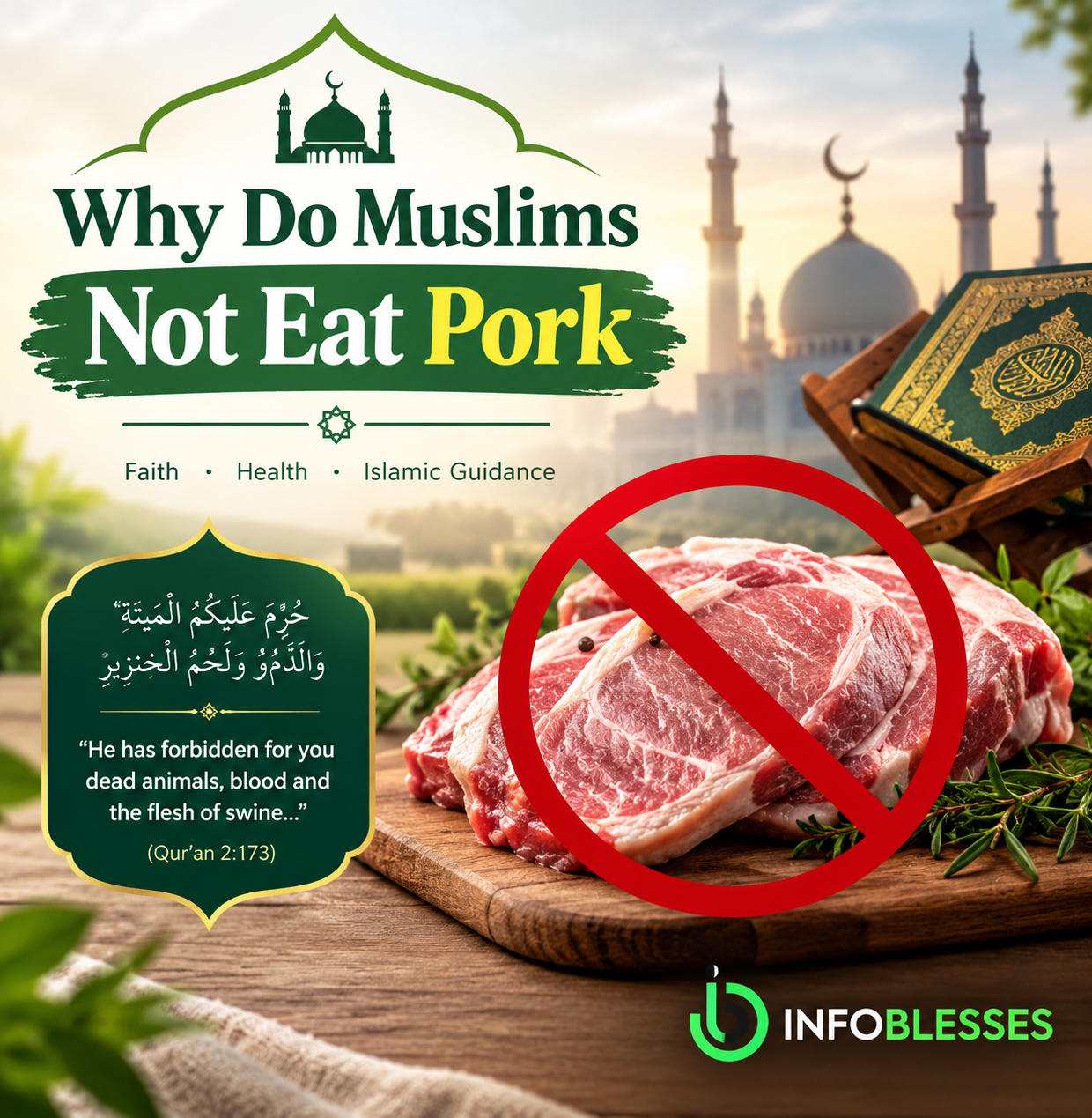
The Qur’an mentions swine among foods that Muslims are forbidden to consume. In Surah Al-Baqarah 2:173, the prohibition is stated alongside carrion, blood, and animals dedicated to something other than Allah. The same basic prohibition appears elsewhere in the Qur’an, including Surah Al-Ma’idah 5:3.
That said, there is more to the subject than simply saying, “Muslims don’t eat pork.” Islamic dietary rules are part of a larger concept called halal, meaning permissible or lawful. Its opposite, haram, refers to what is prohibited.
Understanding the Islamic reason for avoiding pork therefore requires looking at revelation, religious obedience, halal principles, and the limited circumstances in which an otherwise prohibited food may become temporarily permissible.
1. What Does the Qur’an Say About Pork?
The clearest answer to the question “Why do Muslims not eat pork?” begins with the Qur’an itself.
Several Qur’anic passages identify swine as prohibited food. One of the most direct is Surah Al-Baqarah 2:173, which states that Allah has forbidden believers from eating carrion, blood, swine, and animals slaughtered in the name of anyone other than Allah. The verse also gives an important exception for genuine necessity.
Another major reference is Surah Al-Ma’idah 5:3, where swine is again listed among prohibited foods. The verse also discusses other forms of unlawful animal consumption and reiterates the principle that extreme necessity can create an exception.
This makes the basic Islamic position quite straightforward:
- Pork is haram, meaning prohibited.
- The prohibition comes from Islamic revelation.
- Muslims are expected to avoid deliberately consuming pork.
- The rule applies regardless of whether an individual personally dislikes pork.
- Genuine necessity can change the ruling within strict limits.
The important point is that the Qur’an doesn’t present the pork prohibition as a temporary dietary trend. It presents it as part of a broader system of lawful and unlawful food.
For Muslims, this distinction matters. A person may choose not to eat a certain food because of taste, allergies, diet, cost, or health. Avoiding pork for religious reasons is different. It is connected to worship and obedience.
2. Why Is Pork Haram in Islam?
The most accurate answer is that pork is haram because Allah has prohibited it.
This may sound circular to someone unfamiliar with Islamic theology, but it reflects a fundamental principle of Islam: Muslims believe that Allah has the authority to determine what is lawful and unlawful.
In other words, the primary reason isn’t that Muslims first conducted a scientific investigation into pigs and then decided that pork should be banned. The religious command comes first.
Muslim scholars have discussed additional wisdoms behind the prohibition, including questions of purity, health, social practice, and obedience. However, these possible explanations shouldn’t replace the central reason found in revelation.
This distinction is particularly important because scientific explanations can change as knowledge develops. The Islamic ruling does not depend on proving that pork is always more dangerous than every other type of meat.
The central principle of obedience
Islam places considerable emphasis on following Allah’s commands even when a person doesn’t know every underlying wisdom.
This principle appears in many areas of religious life. Muslims pray at prescribed times, fast during Ramadan, give zakat under specified conditions, and follow particular rules concerning food.
Therefore, the Islamic answer can be summarized as:
Muslims don’t eat pork because Allah has prohibited its consumption.
That is the foundation of the rule.
3. The Difference Between Haram, Halal, and Makruh
To understand Islamic dietary rules properly, it’s useful to know a few basic terms.
Halal means lawful or permissible.
Haram means prohibited or unlawful.
Makruh generally refers to something disliked or discouraged, although classifications can vary depending on the school of Islamic jurisprudence and the particular issue.
Pork falls into the haram category.
This means a Muslim isn’t simply being encouraged to avoid it. Deliberately consuming pork is considered a violation of Islamic dietary law.
| Islamic term | General meaning | Pork’s status |
|---|---|---|
| Halal | Permissible/lawful | No |
| Haram | Prohibited/unlawful | Yes |
| Makruh | Disliked/discouraged | No; pork is more serious than this |
| Tayyib | Good, wholesome, pure | Associated with permissible food principles |
The word halal is often used in everyday conversation to describe food prepared according to Islamic requirements. However, halal is broader than a simple “no pork” rule.
For example, meat from an otherwise permissible animal can raise additional questions concerning how the animal was slaughtered, whether prohibited ingredients were added, and how the food was processed.
So, saying “halal means no pork” is an oversimplification.
4. Why Obedience Matters So Much in Islam
One of the most important aspects of the pork prohibition is the relationship between food and worship.
Food may seem like an ordinary part of daily life. Yet Islam gives ordinary actions religious meaning. Eating can become an act of worship when a Muslim chooses lawful food and follows Allah’s guidance.
This means the pork prohibition isn’t designed merely to create a list of foods Muslims cannot enjoy.
Instead, it can cultivate:
- obedience,
- self-discipline,
- mindfulness,
- gratitude,
- religious identity,
- and awareness of Allah.
Consider a simple example. Suppose a Muslim is offered a dish containing pork at a social gathering. The person may enjoy the smell or appearance of the meal, but still refuse it because of religious conviction.
That moment demonstrates the practical meaning of obedience.
The believer is effectively saying: My religious commitment is more important than my immediate appetite.
This is one reason dietary laws have such a powerful role in religious traditions. They turn everyday choices into reminders of faith.
5. What Does Halal Mean for Muslims?
The Islamic dietary system is commonly described using the concept of halal.
Halal food generally refers to food that Muslims are permitted to consume according to Islamic law. Pork is excluded from this category.
However, halal certification can involve many considerations beyond pork.
For processed foods, Muslims may check:
- gelatin,
- animal-derived enzymes,
- meat ingredients,
- flavorings,
- emulsifiers,
- processing aids,
- alcohol-containing ingredients,
- and the source of certain additives.
This can be especially important because pork isn’t always obvious from a food’s name.
For example, a package might not say “pork” in large letters. Instead, an ingredient could be derived from pork or another prohibited animal.
Why halal labels matter
In countries where Muslims are a minority, halal certification can make food shopping easier. A trusted halal symbol may indicate that the product or establishment has been assessed according to particular halal standards.
However, certification systems differ between organizations and countries. Therefore, Muslims who follow strict dietary practices may rely on certification bodies they trust.
6. Is Pork Forbidden Only Because It Is Unhealthy?
No. This is an important distinction.
You will sometimes hear people claim that Islam prohibited pork because pigs carry parasites or because pork is unhealthy.
Some historical or popular explanations emphasize health concerns. Certain pork products can indeed present health risks when contaminated, undercooked, or improperly handled. However, health concerns aren’t the fundamental basis of the Islamic prohibition.
The Qur’an doesn’t say, “Pork is forbidden because modern medicine has discovered these particular diseases.”
Instead, it directly identifies swine as prohibited food.
This means a Muslim’s obligation doesn’t disappear if a particular pork product is prepared under highly controlled modern conditions.
Even if a laboratory demonstrated that a particular pork product had very low health risks, the religious prohibition would remain.
Why this distinction matters
It prevents an overly narrow explanation of Islamic law.
If someone says, “Muslims don’t eat pork because pork is unhealthy,” a natural follow-up question is: “What if pork becomes perfectly safe?”
The Islamic answer is that the ruling isn’t dependent on that hypothetical. The prohibition is rooted in revelation.
Health considerations may be discussed as possible wisdoms, but they shouldn’t be presented as the sole reason.
7. What About Parasites and Other Health Risks?
Pork has historically been associated with certain parasites and infectious diseases, particularly when meat was inadequately cooked or food safety practices were poor.
Modern food safety has reduced many risks through refrigeration, inspection, hygiene, and proper cooking.
Still, these facts don’t establish the theological reason for the Islamic prohibition.
It’s more accurate to say that health-related explanations may offer possible wisdom, but revelation provides the legal basis.
This distinction is also useful when discussing other prohibited foods.
Islamic dietary laws aren’t simply a nineteenth- or twenty-first-century nutrition plan. They belong to a religious framework that includes worship, morality, purity, and obedience.
Therefore, Muslims aren’t required to constantly reevaluate the pork prohibition according to changing scientific studies.
Science can help explain possible consequences. It doesn’t determine the religious command.
8. Does Islam Consider Pigs Evil or Demonic?
No.
This is another common misunderstanding.
Islam prohibits Muslims from eating pork, but that doesn’t mean Muslims are required to believe that pigs are supernatural evil creatures.
Pigs are animals created by Allah. Muslims can recognize their existence as part of creation while still following the dietary prohibition.
The distinction is simple:
Not permissible to eat does not mean supernatural evil.
Islam has many rules concerning what humans can and cannot consume. A prohibition doesn’t necessarily imply hatred toward the thing itself.
For example, Islamic dietary law also prohibits consuming blood and carrion. These rules are about what humans should eat, not about labeling every prohibited substance as an evil spiritual being.
This is an important point because popular culture sometimes exaggerates religious attitudes toward pigs.
The Islamic position is more precise: swine is prohibited as food.
9. Does the Pork Ban Include More Than Pork Chops?
Yes.
The issue isn’t limited to an obvious piece of pork such as bacon, ham, or a pork chop.
Muslims may also need to consider ingredients or products derived from pigs.
Examples can include:
- pork fat or lard,
- pork gelatin,
- certain meat-based flavorings,
- some processed foods,
- some pharmaceutical or cosmetic ingredients,
- and products whose animal-derived ingredients aren’t clearly identified.
The exact ruling on particular derivatives can depend on the substance, its source, its processing, and the interpretation followed by a Muslim or Islamic legal authority.
That is why a blanket statement such as “I checked the meat, so everything is fine” may not always be enough.
Why ingredient awareness matters
Modern food manufacturing is complicated. A single product may contain ingredients sourced from several countries and manufacturers.
As a result, Muslims living in non-Muslim-majority countries often become careful label readers.
This isn’t necessarily because they are suspicious of every food. Rather, they are trying to fulfill a religious obligation in an environment where pork-derived ingredients may be less obvious.
10. What If a Muslim Accidentally Eats Pork?
Accidentally consuming pork is different from knowingly and deliberately eating it.
Suppose someone eats a packaged snack without realizing that it contains a pork-derived ingredient. Later, they discover the ingredient.
They haven’t intentionally chosen to violate the prohibition.
Islamic law recognizes the importance of intention and circumstances. The Qur’an itself provides an exception for those compelled by necessity and emphasizes Allah’s forgiveness and mercy.
A Muslim who discovers an accidental mistake would generally avoid continuing to consume the prohibited food once they become aware of it.
This illustrates an important feature of Islamic religious practice: mistakes and deliberate choices aren’t automatically treated as identical.
Muslims may also consult a qualified scholar when a particular ingredient or situation is complicated.
11. What If Someone Has No Other Food Available?
The Qur’an explicitly recognizes situations of genuine necessity.
Surah Al-Baqarah 2:173 states that someone compelled by necessity, without desire for the prohibited food and without exceeding the immediate need, is not sinful.
A similar principle appears in Surah Al-Ma’idah 5:3, which discusses extreme hunger and necessity.
This is significant because it demonstrates that Islamic law isn’t designed to ignore human survival.
The general principle is:
A prohibited food remains prohibited, but genuine necessity can create a limited exception.
The exception isn’t a loophole for convenience. It applies to real circumstances in which a person’s basic survival or serious welfare is at stake and no lawful alternative is reasonably available.
For example, someone who has abundant halal food choices wouldn’t normally be considered “forced” to eat pork simply because they prefer it.
The Qur’anic language emphasizes necessity rather than appetite.
12. How Is the Pork Prohibition Different From Other Islamic Food Rules?
Pork is one part of a larger dietary framework.
The Qur’an also prohibits or regulates other categories of food, including carrion, blood, and animals dedicated to something other than Allah.
This shows that Islamic dietary law isn’t centered exclusively on pigs.
The broader framework involves questions such as:
- What animal is being consumed?
- Was it slaughtered according to Islamic requirements?
- Was it dedicated to Allah or another object of worship?
- Does the food contain prohibited ingredients?
- Is the person consuming it under ordinary circumstances or genuine necessity?
This wider context makes the Islamic dietary system easier to understand.
It’s not simply a cultural dislike of pork. It’s part of a coherent religious approach to food.
13. Common Misconceptions About Why Muslims Don’t Eat Pork
Let’s clear up several misconceptions.
Misconception 1: Muslims avoid pork only because pigs are dirty
This isn’t the primary Islamic reason. The central reason is that Allah prohibited swine as food.
Misconception 2: Modern science created the pork prohibition
No. The prohibition comes from Islamic revelation and predates modern food science by many centuries.
Misconception 3: Muslims hate pigs
Not necessarily. Muslims can recognize pigs as animals while avoiding their consumption.
Misconception 4: Only pork meat is relevant
Pork-derived ingredients and products may also require attention.
Misconception 5: A Muslim can eat pork if it is cooked properly
Cooking can address certain food-safety concerns, but it doesn’t change the Islamic legal status of pork.
Misconception 6: Pork is the only forbidden food
No. Islamic dietary law contains several prohibited categories.
Misconception 7: The rule has no exceptions whatsoever
There is an important exception for genuine necessity, as explicitly stated in the Qur’an.
14. How Muslims Avoid Pork in Everyday Life
For Muslims living in countries where pork is uncommon, avoiding it may be relatively easy.
In other parts of the world, however, pork can appear in restaurants, supermarkets, school cafeterias, hotels, airlines, and processed foods.
Muslims may therefore take several practical steps.
Reading food labels
Ingredient lists can help identify obvious pork ingredients and animal-derived substances.
Choosing halal-certified products
Halal certification can make purchasing decisions simpler.
Asking restaurants
When eating outside, Muslims may ask whether a dish contains pork, pork fat, pork-based stock, or other prohibited ingredients.
Checking meat sources
Chicken, beef, lamb, and other meats aren’t automatically halal simply because they’re not pork. Muslims may also consider slaughtering requirements and contamination.
Avoiding cross-contamination
Some observant Muslims may avoid food prepared on equipment that has been used for pork, depending on their understanding of Islamic law and the circumstances.
These habits make the religious rule practical rather than merely theoretical.
15. Is There a Deeper Wisdom Behind the Pork Prohibition?
Muslim scholars and thinkers have discussed the wisdom behind Islamic dietary restrictions for centuries.
Some explanations focus on physical well-being. Others emphasize spiritual discipline, purity, obedience, distinction from other religious communities, or the broader concept of living according to divine guidance.
However, it’s important not to claim certainty where Islamic scripture doesn’t provide a specific explanation.
A useful distinction is:
The reason for the ruling is Allah’s command; the wisdom behind the ruling may have several dimensions.
This approach is both theologically cautious and intellectually honest.
It also explains why the Islamic prohibition remains meaningful regardless of changing scientific conditions.
If a particular health concern associated with pork becomes less significant because of improved technology, the religious ruling doesn’t automatically change.
The command and the possible wisdom behind it are related but not identical.
16. Pork and Muslim Identity
Food can play a major role in religious identity.
For many Muslims, refusing pork is a visible expression of faith. It can remind them that Islam affects not only worship inside a mosque but also everyday decisions at home, at work, while traveling, and when socializing.
A Muslim may decline bacon at breakfast, ask about ingredients at a restaurant, or choose a halal meal while traveling.
These actions can look small from the outside. Religiously, however, they can represent a commitment to live according to Islamic principles.
Food therefore becomes part of a Muslim’s daily relationship with faith.
This is one reason the question “Why do Muslims not eat pork?” deserves an answer that goes beyond health myths.
The real answer is fundamentally religious.
17. Frequently Asked Questions About Muslims and Pork
1. Why do Muslims not eat pork?
Muslims don’t eat pork because Islamic scripture explicitly prohibits consuming swine. The Qur’an identifies swine among foods that are forbidden, making the prohibition a matter of Islamic dietary law.
2. Is pork haram in Islam?
Yes. Pork and swine meat are considered haram, meaning prohibited, in Islam.
3. Does the Qur’an explicitly forbid pork?
Yes. Several Qur’anic passages mention swine among prohibited foods. Surah Al-Baqarah 2:173 and Surah Al-Ma’idah 5:3 are two of the clearest references.
4. Is pork forbidden because pigs are unhealthy?
Health concerns can be discussed as possible wisdoms, but they aren’t the fundamental legal reason. The primary reason is that Allah explicitly prohibited swine as food.
5. Can Muslims eat pork during an emergency?
The Qur’an provides an exception when someone is genuinely compelled by necessity and does not exceed what is needed.
6. Do Muslims hate pigs?
No. Islam’s dietary prohibition doesn’t require Muslims to regard pigs as supernatural or inherently evil. The rule concerns consuming swine as food.
7. Is bacon haram for Muslims?
Traditional bacon made from pork is haram. Products made from permissible meats, such as some forms of beef or turkey bacon, can be halal if they meet the relevant Islamic requirements.
8. Can Muslims eat food cooked with pork?
Generally, Muslims who follow Islamic dietary law avoid pork and foods containing pork-derived ingredients. Questions involving cooking equipment, oils, sauces, or cross-contamination can vary depending on the circumstances and legal interpretation.
9. What does halal mean?
Halal means lawful or permissible according to Islamic principles. In food, it refers to foods Muslims are permitted to consume under Islamic dietary rules.
10. What happens if a Muslim accidentally eats pork?
An accidental mistake is different from knowingly choosing prohibited food. Once the person realizes the food contains pork, they can stop consuming it. For complicated cases, they may ask a qualified Islamic scholar for guidance.
Conclusion:
So, why do Muslims not eat pork?
The clearest and most accurate answer is that Islam prohibits the consumption of pork because Allah has explicitly forbidden swine as food. The Qur’an states this prohibition in multiple passages, including Surah Al-Baqarah 2:173 and Surah Al-Ma’idah 5:3.
Health concerns may be discussed as possible wisdoms, but they shouldn’t be confused with the foundation of the religious ruling. Likewise, Muslims don’t avoid pork simply because pigs are considered “dirty” or because of cultural tradition.
The prohibition is part of the Islamic concept of halal and haram and reflects a broader commitment to obeying divine guidance.
At the same time, Islamic law recognizes human necessity. The Qur’an makes clear that someone facing genuine compulsion or extreme hunger isn’t treated in the same way as someone who deliberately chooses prohibited food.
Ultimately, avoiding pork is an everyday expression of Muslim faith. For believers, it isn’t merely about what’s on the dinner plate. It’s about living according to a religious framework that connects ordinary choices with worship, discipline, and obedience to Allah.

Welcome to Info Blesses I am Rana Ahtasham an AI Powered SEO and Content Writer With 3 year experience.I help websites rank highter, grow traffic, and look amazing. My goal is to make SEO and web design simple and effective for everyone.Lets achieve more togather!