
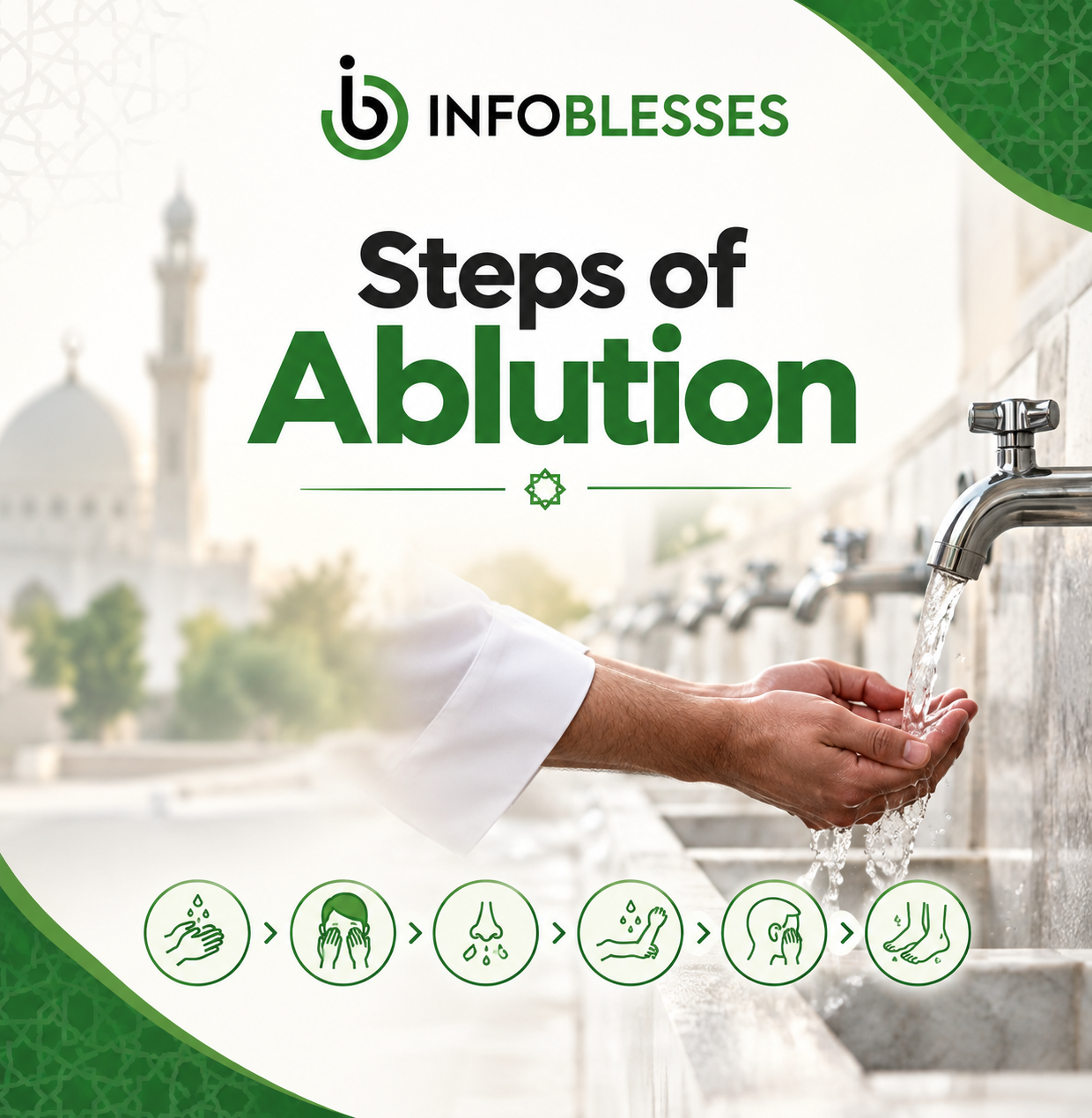
Understanding Wudu and Its Importance
Wudu, commonly called ablution, is the Islamic method of ritual purification performed before prayer and certain other acts of worship. Learning the correct steps of ablution helps a Muslim prepare both physically and spiritually for salah.
The word wudu refers to a specific form of purification using clean water. It isn’t simply ordinary washing. Rather, it is an act of worship performed with intention and according to an established method.
For someone learning Islam, the process can seem detailed at first. However, once the sequence becomes familiar, the steps of ablution are straightforward. In fact, many Muslims can complete wudu in only a few minutes.
The basic command for wudu appears in the Quran in Surah Al-Ma’idah 5:6. The verse describes washing the face and arms, wiping the head, and washing the feet to the ankles before prayer. It also explains circumstances in which another form of purification, known as tayammum, may be used when water cannot be used or found.
What Is Wudu?
Wudu is a ritual purification involving particular parts of the body.
Unlike taking a normal shower, wudu follows a defined sequence. The worshipper uses water to wash or wipe specific areas, beginning with the hands and continuing through the face, arms, head, ears, and feet.
The purpose isn’t merely physical cleanliness. Wudu is also a preparation for standing before Allah in prayer.
A useful way to remember the process is:
Hands → Mouth → Nose → Face → Arms → Head → Ears → Feet
The exact details can vary somewhat according to Islamic legal schools, but this sequence reflects a widely taught method based on Quranic instructions and Prophetic practice.
Why Muslims Perform Wudu
Prayer occupies a central position in Muslim life, and purification is an important preparation for salah.
Wudu provides a regular opportunity to pause, wash away everyday dirt, and turn one’s attention toward worship. The repeated routine can also encourage mindfulness. Instead of rushing directly from an ordinary activity into prayer, the worshipper takes a few moments to prepare.
The spiritual meaning of purification is also emphasized in Islamic teachings. Wudu is connected with cleanliness, worship, discipline, and readiness for prayer.
It is therefore helpful to approach the steps of ablution with care rather than treating them as a mechanical checklist.
Wudu in the Quran
The clearest Quranic description of wudu is found in Al-Ma’idah 5:6. The verse instructs believers to wash the face and arms to the elbows, wipe the head, and wash the feet to the ankles before prayer.
The same verse also discusses situations involving illness, travel, and lack of water, and introduces tayammum as an alternative form of purification in appropriate circumstances.
This is significant because it shows that Islamic purification is not intended to create unnecessary hardship. The verse explicitly presents purification alongside ease and gratitude.
Wudu in the Sunnah
Prophetic narrations provide additional details about how wudu was performed.
One of the well-known descriptions comes from Uthman ibn Affan, who demonstrated the ablution of the Prophet Muhammad ﷺ. The narration describes washing the hands, rinsing the mouth and nose, washing the face and arms, wiping the head, and washing the feet.
This Prophetic example is particularly useful because the Quran establishes the essential areas while the Sunnah provides practical details about performing them.
For this reason, learning the steps of ablution from both Quranic guidance and authentic Prophetic reports gives a fuller understanding of the practice.
The 12 Steps of Ablution
The following method presents a practical sequence commonly taught for wudu. Some details are classified differently as obligatory, recommended, or Sunnah depending on the Islamic legal school a person follows.
Step 1: Make the Intention
Begin by making the intention (niyyah) to perform wudu for purification.
The intention is an act of the heart. You don’t necessarily need to pronounce a special sentence aloud. What matters is knowing internally that you’re performing wudu for worship and purification.
For example, you may simply intend:
“I am performing wudu to purify myself for prayer.”
Then begin calmly.
Step 2: Say Bismillah
It is customary to begin by saying:
Bismillah
“In the name of Allah.”
Starting with the name of Allah reminds the worshipper that wudu is an act of devotion rather than just routine washing.
This simple beginning also helps establish the right mindset before continuing with the remaining steps of ablution.
Step 3: Wash the Hands
Wash both hands thoroughly, generally up to the wrists.
Make sure water reaches the entire surface, including between the fingers. If something is physically preventing water from reaching the skin, such as thick paint or another waterproof substance, it should be removed when reasonably possible.
Washing the hands first is practical because the hands will be used throughout the rest of the process.
A common Sunnah practice is to wash them three times.
Step 4: Rinse the Mouth
Take water into the mouth and rinse it.
This is known as madmadah. The purpose is to clean the mouth and follow the Prophetic method of purification.
You don’t need to use excessive amounts of water. A small amount is sufficient when used effectively.
If you’re performing wudu in a public place, be considerate of others and avoid splashing water unnecessarily.
Step 5: Clean the Nose
Next, bring water into the nostrils and then expel it gently.
This practice is called istinshaq and istinthar in discussions of Islamic purification.
Again, moderation is important. The goal is effective purification, not discomfort or waste.
People with medical conditions affecting the nose should follow appropriate medical considerations and ask a qualified scholar if they need guidance about a particular situation.
Step 6: Wash the Face
Wash the entire face.
This generally includes the area from the normal hairline to the chin and from one ear to the other.
Pay attention to areas that can easily be missed, such as the sides of the face and the area around the nose.
If you have a thick beard, the detailed rulings concerning washing beneath the beard can vary depending on its thickness and the school of Islamic law being followed.
A good rule is to make sure the water reaches all of the facial area that is normally exposed.
Step 7: Wash the Arms
Wash the right arm first and then the left.
The washing extends from the fingertips to and including the elbows.
This is an important detail. Simply washing the hands isn’t enough. Water should cover the entire required area.
Pay particular attention to:
- Between the fingers
- Around the wrists
- The elbows
- The underside of the forearms
- Any areas that may remain dry
The Prophetic descriptions of wudu commonly mention washing the arms three times.
Step 8: Wipe the Head
Next comes masah, or wiping the head with wet hands.
Unlike washing the face or arms, this is performed by wiping rather than pouring water over the head.
The exact extent of the head that should be wiped differs among legal schools. Some schools require wiping the entire head, while others recognize a smaller required area with additional recommended practice.
For everyday learning, it is useful to follow the established method taught by a trusted scholar or mosque in your community.
Step 9: Wipe the Ears
The ears are commonly wiped as part of the Sunnah method of wudu.
A person may use the remaining moisture on the hands after wiping the head.
The details of ear wiping and whether it is considered obligatory or Sunnah vary among schools. Therefore, don’t become anxious if you’ve learned a slightly different method from another Muslim.
The essential point is to follow a reliable method consistently.
Step 10: Wash the Feet
Wash the right foot and then the left foot.
The washing extends to and includes the ankles.
Make sure water reaches:
- Between the toes
- Around the heels
- The sides of the feet
- Behind the ankles
- The soles and other areas of the foot
The heels are particularly important because they can easily remain dry when someone rushes through wudu.
The Prophetic descriptions of ablution emphasize washing the feet thoroughly.
Step 11: Maintain the Proper Order
The order of the steps of ablution is important in schools that consider sequence an obligation or emphasized requirement.
The familiar order is:
- Hands
- Mouth
- Nose
- Face
- Arms
- Head
- Ears
- Feet
Try not to jump randomly between body parts.
Once you’ve practiced the sequence several times, it becomes second nature.
Step 12: Complete Wudu With Supplication
After finishing wudu, many Muslims recite the testimony of faith and a supplication associated with purification.
A commonly recited wording begins:
Ashhadu an la ilaha illallahu wahdahu la sharika lah, wa ashhadu anna Muhammadan abduhu wa rasuluh.
The meaning is that one testifies that there is no deity worthy of worship except Allah alone, without partner, and that Muhammad ﷺ is His servant and Messenger.
The post-wudu supplication is a beautiful way to finish the process by turning attention from physical purification toward faith.
Sunnah Practices and Common Mistakes
Understanding the steps of ablution is only part of learning wudu. It’s equally useful to know which practices are recommended and which mistakes should be avoided.
How Many Times Should Each Part Be Washed?
Three washes are widely associated with the complete Prophetic method, but this doesn’t mean every part must always be washed three times.
Islamic narrations also describe washing certain parts once or twice.
The important distinction is between washing adequately and wasting water.
If one thorough wash fulfills the required washing of an area according to the applicable legal school, repeatedly washing it without reason isn’t necessary.
Water Conservation During Wudu
Wudu doesn’t require a large amount of water.
In fact, wastefulness should be avoided. Keep the tap at a moderate flow and turn it down or off while you’re not actively using water.
A practical routine is:
- Use a small amount of water for each action.
- Don’t leave the tap running continuously.
- Make sure water reaches the required areas.
- Don’t confuse excessive water with better purification.
Good wudu is about completeness, not extravagance.
Common Wudu Mistakes
Some mistakes are especially common among beginners.
1. Missing the elbows:
People sometimes wash only the forearms and stop before properly including the elbows.
2. Missing the ankles:
The feet should be washed to and including the ankles.
3. Leaving dry areas:
Rings, tight jewelry, or other objects may prevent water from reaching the skin. They should be moved when necessary.
4. Forgetting between the toes:
This area can easily remain dry.
5. Using excessive water:
More water doesn’t automatically mean better wudu.
6. Rushing:
Hurrying can result in incomplete washing.
7. Becoming overly doubtful:
Islamic purification shouldn’t become a source of constant anxiety. Once you’re reasonably certain that you’ve completed wudu correctly, don’t repeatedly restart it because of baseless doubts.
Differences Between Islamic Schools
Muslims may perform some parts of wudu differently while still following established Islamic scholarship.
For example, there are differences concerning the extent of the head that must be wiped, the status of certain introductory actions, and some details surrounding sequence and intention.
The four major Sunni schools—Hanafi, Maliki, Shafi’i, and Hanbali—share the fundamental framework of wudu while differing on certain legal details.
There are also differences among other Islamic traditions.
These variations don’t mean that Muslims should argue about every minor detail. If you’re learning wudu, the best approach is to follow a reliable scholar, teacher, or recognized school consistently rather than combining isolated rulings from different sources.
What Breaks Wudu?
Knowing the steps of ablution is useful, but Muslims also need to understand when wudu ends and must be renewed.
The exact rulings can differ in certain cases, but several matters are broadly recognized.
Natural Bodily Functions
Passing urine or stool breaks wudu.
Passing wind also breaks wudu.
Other bodily discharges may have their own rulings depending on what they are and the circumstances involved.
After using the bathroom, normal cleanliness should be observed before performing fresh wudu.
Loss of Consciousness
Complete loss of consciousness, such as fainting, generally requires a new wudu.
Deep sleep can also affect wudu, with detailed rulings depending on the circumstances and legal school.
The key idea is that a state in which a person cannot reliably control or perceive bodily functions can affect ritual purity.
Other Matters With Scholarly Differences
Some issues have recognized differences of opinion.
For example, scholars have discussed whether touching a member of the opposite sex breaks wudu, depending on the circumstances and legal school. Certain types of bleeding and other bodily conditions have also been treated differently by different jurists.
This is one reason a person should avoid assuming that every ruling found in a random online article applies universally.
When a matter is important or personally relevant, consult a qualified scholar familiar with your legal tradition.
When Should You Perform Wudu?
Wudu is most closely associated with salah, but purification also has broader importance in Islamic practice.
Before the Five Daily Prayers
Muslims perform wudu before prayer when they are not already in a state of wudu.
The five daily prayers are:
- Fajr
- Dhuhr
- Asr
- Maghrib
- Isha
A person doesn’t necessarily need to repeat wudu before every prayer if the previous wudu remains valid.
This makes the practice both simple and flexible.
Before Other Acts of Worship
Wudu may also be recommended or required for certain other acts of worship, depending on the specific act and school of jurisprudence.
For example, ritual purity has important rulings connected with handling or reciting the Quran, circumambulation, and other religious practices.
Because the details differ, it is wise to learn the ruling relevant to the particular act rather than applying one general rule to everything.
Maintaining Wudu
Maintaining wudu can become a useful daily habit.
Some Muslims choose to remain in a state of wudu whenever practical, especially when they expect to pray soon.
However, maintaining wudu should not become a source of stress. Islam provides practical rules for ordinary life, and purification is meant to facilitate worship rather than make everyday activities unnecessarily difficult.
Frequently Asked Questions
Is Wudu Required for Every Prayer?
Wudu is required for salah when a person’s previous ritual purification has been invalidated. If you already have valid wudu, you don’t have to perform a completely new wudu simply because another prayer time has arrived.
For example, if you perform wudu before Dhuhr and nothing occurs that invalidates it, you may use that same wudu for Asr.
Can You Perform Wudu Once for Several Prayers?
Yes. A person may pray multiple prayers with one valid wudu.
A Prophetic narration in Sahih Muslim records an occasion when the Prophet ﷺ prayed multiple prayers with one ablution. This demonstrates that renewing wudu isn’t automatically required for every individual prayer when purification remains valid.
Do You Have to Wash Each Part Three Times?
Not necessarily.
Three repetitions are a well-known Sunnah practice, but Islamic narrations also describe other numbers of washes.
The essential requirement is to properly wash the areas that must be washed according to the legal school being followed.
Avoid turning the number three into a reason for wasting water.
Can You Perform Wudu With Very Little Water?
Yes.
Wudu requires sufficient water to properly wash the required areas, not a large quantity of water.
Using a small amount carefully is perfectly reasonable. In fact, avoiding unnecessary water waste is consistent with the broader Islamic emphasis on moderation.
What If You Forget One Step?
If you realize during wudu that you’ve missed a required part, complete it according to the ruling of the school you’re following.
If you only remember much later, the ruling can depend on which part was missed and which legal school you follow.
For beginners, the best approach is to learn the essential steps carefully and practice them until the sequence becomes natural.
Does Sleeping Break Wudu?
Sleep can affect wudu, but the ruling depends on the type and depth of sleep.
Deep sleep in which a person loses awareness generally requires renewing wudu. Brief sleep while remaining aware may be treated differently.
Because the details vary, follow the established ruling of your school or qualified teacher.
What If Water Is Unavailable?
Islam provides an alternative called tayammum in circumstances where water is unavailable or cannot appropriately be used.
Quran 5:6 mentions tayammum using clean earth or suitable natural material in specified circumstances.
This demonstrates an important principle: Islamic purification has rules, but those rules also recognize genuine hardship.
What If I Have a Medical Problem?
If using water would cause harm, worsen an illness, or interfere with medical treatment, special rulings may apply.
The exact answer depends on the medical situation and the relevant Islamic legal ruling.
A qualified Islamic scholar can explain the purification requirement, while a healthcare professional can advise on the medical side.
Can I Wear a Waterproof Substance During Wudu?
If a substance forms a barrier that prevents water from reaching skin that must be washed, it generally needs to be removed before wudu.
Examples may include certain types of waterproof cosmetics, thick paint, or adhesives.
However, not every cosmetic or skincare product creates an actual water barrier. If you’re unsure, check the product and ask a qualified scholar.
Is Wudu Only About Physical Cleanliness?
No.
Physical cleanliness is an important part of wudu, but the practice also has spiritual significance.
Wudu prepares a Muslim to stand before Allah in prayer. It can serve as a transition from ordinary daily activity to focused worship.
That is why the intention and mindful performance of the steps of ablution matter.
Conclusion:
Learning the steps of ablution doesn’t have to be difficult. Once the sequence is familiar, wudu becomes a simple and meaningful part of everyday Muslim life.
The basic process includes making the intention, beginning with Allah’s name, washing the hands, rinsing the mouth and nose, washing the face and arms, wiping the head and ears, and washing the feet. The Sunnah provides additional details that help Muslims perform wudu in the manner practiced by the Prophet Muhammad ﷺ.
The most important thing for a beginner is consistency. Learn one reliable method, practice it without rushing, and pay attention to areas that are commonly missed, especially the elbows, ankles, heels, and spaces between the fingers and toes.
At the same time, remember that Islamic jurisprudence contains legitimate differences concerning some details of wudu. If your family, mosque, or teacher follows a particular legal school, learning according to that tradition can prevent unnecessary confusion.
Ultimately, wudu is more than a sequence of movements. It is a moment of preparation, cleanliness, remembrance, and readiness for salah. With regular practice, the steps of ablution become second nature—and each wudu can be a quiet opportunity to pause, reset, and turn one’s attention toward worship.

Welcome to Info Blesses I am Rana Ahtasham an AI Powered SEO and Content Writer With 3 year experience.I help websites rank highter, grow traffic, and look amazing. My goal is to make SEO and web design simple and effective for everyone.Lets achieve more togather!