
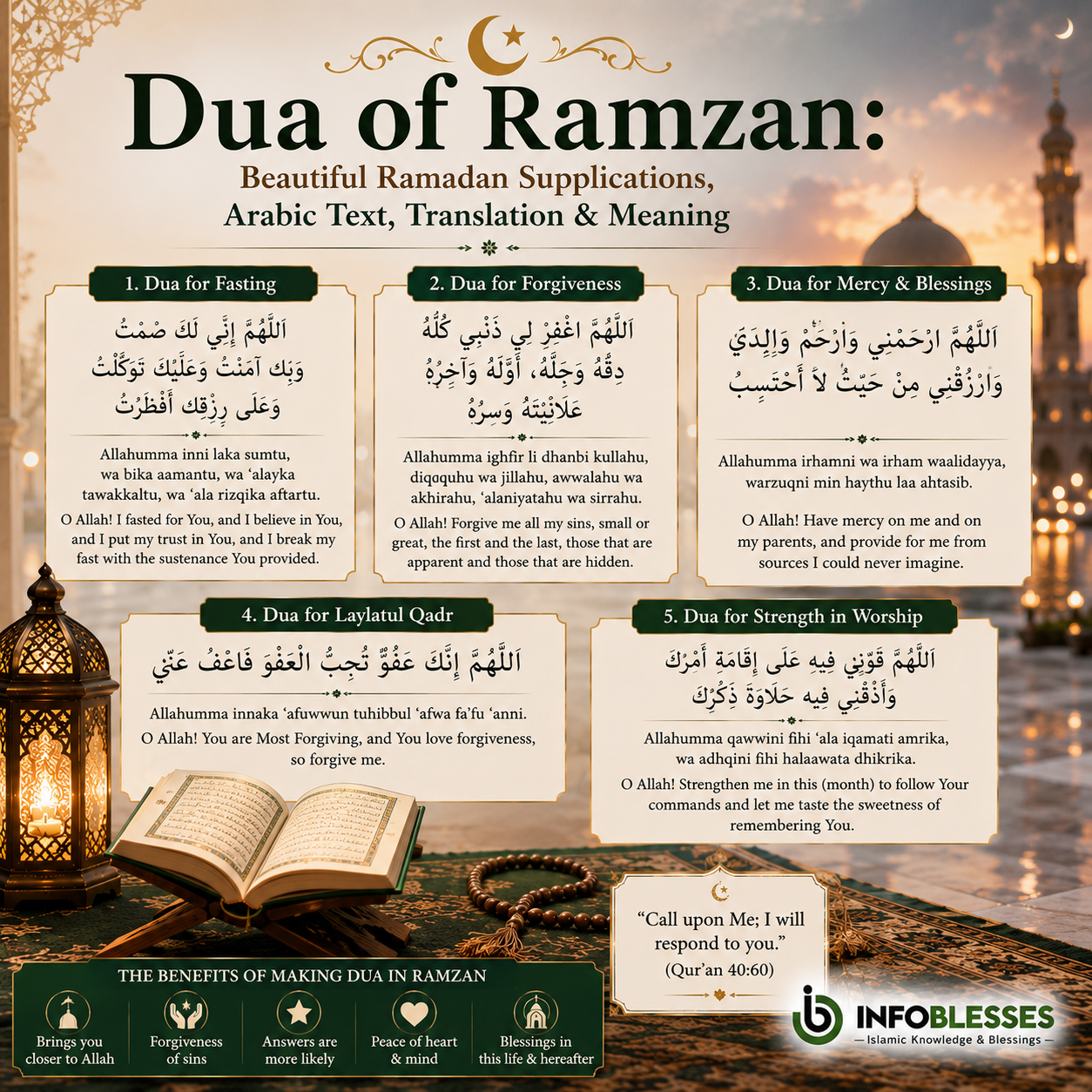
Dua of Ramzan is a beautiful way for Muslims to turn their hearts toward Allah during the blessed month of Ramadan. Ramadan is not only a month of fasting from food and drink; it is a season of worship, repentance, Qur’an, charity, patience, gratitude, and sincere supplication. Through dua, a believer asks Allah for forgiveness, mercy, guidance, protection, blessings, and goodness in this life and the Hereafter.
Allah reminds believers of His closeness and the importance of calling upon Him. In the Qur’an, Allah says that He is near and responds to the supplication of the one who calls upon Him.
There is no single dua that Muslims must recite throughout the entire month of Ramadan. Rather, the Qur’an and Sunnah contain many beautiful supplications that are especially meaningful during fasting, at iftar, during the last ten nights, and throughout acts of worship. This article presents authentic and well-established supplications, with Arabic text, transliteration, English translation, and simple explanations of their meanings.

What Is the Meaning of Dua in Ramadan?
Dua means calling upon Allah, asking Him for help, guidance, forgiveness, mercy, and whatever is good. It is an act of worship that reflects a believer’s dependence upon the Creator.
Ramadan gives dua a special place in a Muslim’s daily routine because fasting naturally encourages humility. During the day, a fasting person experiences hunger and thirst and becomes more aware of their dependence upon Allah. At night, Salah, Taraweeh, Qur’an recitation, Dhikr, and reflection provide additional opportunities to turn toward Allah.
The Qur’an places verses about fasting immediately before the famous verse concerning dua. In Surah Al-Baqarah 2:186, Allah tells believers that He is near and responds to those who call upon Him. This connection between Ramadan and dua is deeply meaningful: while discussing fasting, the Qur’an reminds believers that Allah is close to them.
Dua should therefore not be treated as a collection of words that are recited mechanically.
It should be a sincere conversation of worship in which the believer recognizes:
- Allah is the Creator.
- Allah knows our needs.
- Allah hears our supplications.
- Allah has complete power.
- Allah knows what is best for us.
- Allah deserves our gratitude.
- Allah alone should be worshipped.
A person can make dua in Arabic using supplications from the Qur’an and Sunnah, and outside formal prayer can also ask Allah in their own language and express their personal needs sincerely.

Powerful Dua of Ramzan for Forgiveness
One of the greatest themes of Ramadan is forgiveness. Muslims fast, pray, repent, give charity, read the Qur’an, and seek Allah’s mercy.
A beautiful Qur’anic supplication is:
رَبَّنَا ظَلَمْنَا أَنْفُسَنَا وَإِنْ لَمْ تَغْفِرْ لَنَا وَتَرْحَمْنَا لَنَكُونَنَّ مِنَ الْخَاسِرِينَ
Transliteration:
Rabbana zalamna anfusana wa illam taghfir lana wa tarhamna lanakunanna minal-khasireen.
Translation:
“Our Lord, we have wronged ourselves. If You do not forgive us and have mercy upon us, we will surely be among the losers.”
This dua appears in Surah Al-A‘raf 7:23.
Its message is powerful because it begins with personal accountability. Instead of blaming others, the believer admits their own shortcomings.
Ramadan is an ideal time to make this attitude part of daily life.
A Muslim can reflect:
What mistakes do I need to leave?
Whom have I hurt?
Which sins do I need to sincerely repent from?
What habits are taking me away from Allah?
True repentance is more than saying words. It involves recognizing wrongdoing, feeling sincere regret, seeking Allah’s forgiveness, and making a genuine effort to avoid returning to the sin.
Ramadan can therefore become a spiritual reset.

Dua for Laylatul Qadr
Among the most important supplications associated with Ramadan is the dua taught for Laylatul Qadr.
The Prophet Muhammad ﷺ taught Aishah (رضي الله عنها) what to say if she knew which night was Laylatul Qadr.
Arabic
اللَّهُمَّ إِنَّكَ عَفُوٌّ تُحِبُّ الْعَفْوَ فَاعْفُ عَنِّي
Transliteration
Allahumma innaka ‘afuwwun tuhibbul-‘afwa fa‘fu ‘anni.
Translation
“O Allah, You are Most Pardoning, You love to pardon, so pardon me.”
This supplication is recorded in Jami‘ at-Tirmidhi 3513, where the narration reports that the Prophet ﷺ taught this dua to Aishah (رضي الله عنها) in connection with Laylatul Qadr.
Notice how short this dua is.
Yet its meaning is enormous.
The believer is asking Allah not merely to reduce a difficulty or provide a worldly benefit but to pardon their sins.
This is particularly appropriate for Ramadan because the month encourages believers to return to Allah.
During the last ten nights, Muslims often increase their worship, prayer, Qur’an recitation, charity, remembrance, and supplication.
Rather than making dua only for material things, this prophetic supplication teaches us to prioritize forgiveness.
A person may ask Allah:
“Ya Allah, pardon what I have done knowingly and unknowingly. Correct my heart, strengthen my faith, and help me become better.”

Dua at the Time of Breaking the Fast
The moment of iftar is deeply meaningful.
After many hours without food or drink, the fasting person breaks the fast while remembering Allah and appreciating the blessings that are often taken for granted.
A supplication reported in Sunan Abi Dawud is:
Arabic
ذَهَبَ الظَّمَأُ وَابْتَلَّتِ الْعُرُوقُ وَثَبَتَ الْأَجْرُ إِنْ شَاءَ اللَّهُ
Transliteration
Dhahabaz-zama’u wabtallatil-‘urooqu wa thabatal-ajru in sha Allah.
Translation
“The thirst has gone, the veins are moistened, and the reward is assured, if Allah wills.”
This narration is recorded in Sunan Abi Dawud 2357 and is graded Hasan by Al-Albani on the referenced page.
The words remind the fasting person that fasting is not merely physical deprivation.
Thirst has passed.
The body receives nourishment.
But the believer also hopes for something greater: reward from Allah.
This dua encourages gratitude.
A simple glass of water can become a reminder of Allah’s mercy.
A few dates can become a reason to say Alhamdulillah.
A family gathered around an iftar table can become an opportunity to appreciate the blessing of companionship.
Ramadan teaches Muslims to notice blessings that ordinary routines can hide.

Quranic Dua for Goodness in This Life and the Hereafter
One of the most comprehensive duas in the Qur’an is:
Arabic
رَبَّنَا آتِنَا فِي الدُّنْيَا حَسَنَةً وَفِي الْآخِرَةِ حَسَنَةً وَقِنَا عَذَابَ النَّارِ
Transliteration
Rabbana atina fid-dunya hasanatan wa fil-akhirati hasanatan wa qina ‘adhaban-nar.
Translation
“Our Lord, give us good in this world and good in the Hereafter, and protect us from the punishment of the Fire.”
This dua appears in Surah Al-Baqarah 2:201.
It is especially beautiful because it balances worldly and eternal concerns.
Islam does not teach believers to completely ignore the world.
A Muslim can ask Allah for:
- Halal income
- Good health
- A peaceful home
- Righteous family
- Beneficial knowledge
- Meaningful work
- Protection from hardship
But the believer should also ask for the Hereafter.
This dua prevents a person from becoming obsessed with temporary success.
Worldly achievements eventually end.
The Hereafter is everlasting.
Therefore, Ramadan is an excellent time to make this comprehensive dua regularly.
Ask Allah for goodness in your present circumstances while asking Him to make your final destination successful.

Dua for Guidance During Ramadan
Guidance is one of the greatest blessings a believer can ask Allah for.
The Qur’an contains the beautiful supplication:
Arabic
اهْدِنَا الصِّرَاطَ الْمُسْتَقِيمَ
Transliteration
Ihdinas-siratal-mustaqeem.
Translation
“Guide us to the Straight Path.”
This is from Surah Al-Fatihah, which Muslims recite repeatedly during their daily prayers.
Why is guidance so important?
Because a person can have intelligence but still make destructive decisions.
A person can have wealth but misuse it.
A person can have knowledge but fail to act upon it.
A person can have opportunities but choose an unhealthy direction.
Therefore, Muslims repeatedly ask Allah for guidance.
During Ramadan, this request can become even more meaningful.
Ask Allah to guide your heart toward sincerity.
Ask Him to guide your speech.
Ask Him to guide your relationships.
Ask Him to guide your finances.
Ask Him to guide your choices.
Ask Him to guide you toward beneficial knowledge and righteous deeds.
Ramadan should not only change a person’s daily schedule.
It should help change the direction of their life.

Dua for Mercy and Compassion
Allah’s mercy is one of the central themes of Islamic worship.
A beautiful Qur’anic dua is:
Arabic
رَبِّ اغْفِرْ لِي وَارْحَمْنِي وَأَنْتَ خَيْرُ الرَّاحِمِينَ
Transliteration
Rabbighfir lee warhamnee wa anta khayrur-raahimeen.
Translation
“My Lord, forgive me and have mercy upon me, and You are the best of the merciful.”
This dua reminds the believer that forgiveness and mercy belong together.
A person may know they have made mistakes and still feel hopeful because Allah’s mercy is greater than human limitations.
Ramadan is a month in which Muslims should cultivate mercy not only by asking Allah for mercy but by showing mercy to others.
Be gentle with family.
Help someone who is struggling.
Feed someone who is fasting.
Forgive when forgiveness is appropriate.
Avoid unnecessary arguments.
Give charity.
Speak kindly.
The spiritual value of Ramadan becomes deeper when worship influences how we treat other people.

Dua for Parents During Ramadan
Ramadan is also an excellent time to remember parents in dua.
The Qur’an teaches:
Arabic
رَبِّ ارْحَمْهُمَا كَمَا رَبَّيَانِي صَغِيرًا
Transliteration
Rabbir-hamhuma kama rabbayanee sagheera.
Translation
“My Lord, have mercy upon them as they raised me when I was small.”
This beautiful supplication appears in Surah Al-Isra 17:24.
Parents make tremendous sacrifices for their children.
They provide care, guidance, food, shelter, education, and emotional support.
Ramadan gives families an opportunity to reconnect and remember these blessings.
If your parents are alive, make dua for their health, guidance, forgiveness, and well-being.
If they have passed away, continue remembering them in sincere supplication and righteous acts.
A Ramadan dua for parents can be simple and heartfelt:
“O Allah, forgive my parents, have mercy upon them, reward them for every sacrifice they made, protect them from hardship, and grant them goodness in this life and the Hereafter.”

Dua for Guidance, Faith and a Steadfast Heart
A believer should not assume that faith will automatically remain strong without effort.
The Qur’an teaches believers to ask:
Arabic
رَبَّنَا لَا تُزِغْ قُلُوبَنَا بَعْدَ إِذْ هَدَيْتَنَا وَهَبْ لَنَا مِنْ لَدُنْكَ رَحْمَةً إِنَّكَ أَنْتَ الْوَهَّابُ
Transliteration
Rabbana la tuzigh qulubana ba‘da idh hadaytana wa hab lana mil-ladunka rahmatan innaka antal-Wahhab.
Translation
“Our Lord, do not let our hearts deviate after You have guided us, and grant us mercy from You. Surely You are the Bestower.”
This is from Surah Aal ‘Imran 3:8.
It is a powerful Ramadan supplication because Ramadan is about transformation.
A person may begin the month with strong motivation but struggle later.
This dua teaches us to ask Allah to keep our hearts firm.
It reminds us that spiritual consistency is a blessing.
A believer can make this dua while asking Allah:
- Keep me sincere.
- Keep my heart attached to prayer.
- Keep me connected to the Qur’an.
- Protect me from arrogance.
- Protect me from hypocrisy.
- Keep me away from harmful habits.
- Help me continue righteous actions after Ramadan.
The goal of Ramadan should not be to become temporarily religious for one month and then return completely to old habits.
The deeper goal is to develop habits of obedience that continue beyond Eid.

Dua for Provision and Barakah in Ramadan
Provision is another important subject for dua.
A Muslim may ask Allah for halal rizq, financial stability, beneficial work, and barakah in whatever Allah provides.
One beautiful Qur’anic supplication is:
Arabic
رَبِّ إِنِّي لِمَا أَنْزَلْتَ إِلَيَّ مِنْ خَيْرٍ فَقِيرٌ
Transliteration
Rabbi innee lima anzalta ilayya min khayrin faqeer.
Translation
“My Lord, indeed I am, for whatever good You would send down to me, in need.”
This is from Surah Al-Qasas 28:24.
The wording teaches humility.
A believer recognizes:
This does not mean a Muslim should abandon work or practical effort.
Islam encourages lawful effort.
A person should seek employment, conduct business honestly, learn useful skills, and pursue permissible opportunities.
But alongside these efforts, the believer asks Allah for barakah.
There is a major difference between simply having more and having more goodness.
A large income without peace may not bring happiness.
A busy schedule without meaningful achievement may waste time.
A large house without family harmony may feel empty.
Barakah means asking Allah to put goodness and benefit into what He provides.

Dua for Patience and Strength During Ramadan
Fasting develops patience.
A fasting person controls hunger, thirst, desires, anger, and habits.
This makes Ramadan a practical training ground for self-control.
The Qur’an teaches believers to seek help through patience and prayer.
During Ramadan, a Muslim can make personal dua:
“O Allah, give me patience in fasting, patience in worship, patience in difficult situations, and patience when people test me. Help me control my anger and speak with kindness.”
This is an important area of Ramadan spirituality.
Fasting should influence character.
If someone avoids food and drink but continues insulting people, spreading gossip, cheating, lying, or deliberately harming others, the deeper purpose of fasting is being missed.
Ramadan teaches restraint.
A person should learn to say:
I can remain silent.
I can forgive.
I can walk away from an argument.
I can control my anger.
I can choose kindness.
This is one of the most valuable forms of spiritual growth.

How to Make Meaningful Dua During Ramzan
Making dua is not simply about repeating many words.
Sincerity matters.
Before making dua, a Muslim can reflect upon Allah’s greatness and recognize their own dependence.
Here are practical ways to make Ramadan dua more meaningful:
1. Begin With Praise of Allah
Remember Allah’s mercy, power, wisdom, and blessings.
2. Send Blessings Upon the Prophet ﷺ
Include salawat upon the Prophet Muhammad ﷺ in your supplication.
3. Ask for Forgiveness
Do not be afraid to admit your mistakes.
4. Ask for the Hereafter
Do not limit your Ramadan duas to money, employment, possessions, or worldly success.
Ask Allah for Jannah and protection from the Fire.
5. Ask for Your Family
Remember parents, spouse, children, siblings, relatives, and the wider Muslim community.
6. Be Specific
If you have a particular difficulty, explain it to Allah sincerely.
7. Ask With Hope
Do not assume your dua is worthless.
The Qur’an commands believers to call upon Allah and promises a response.
8. Be Patient
A believer should continue making dua without demanding an immediate outcome.
Sometimes the answer may come differently from what we expected.
9. Combine Dua With Action
Ask Allah for success while also taking responsible steps toward your goal.
10. Continue After Ramadan
Do not make dua only during Ramadan.
Build a lifelong relationship with Allah through supplication.

Best Times to Make Dua During Ramadan
Ramadan provides many opportunities for supplication.
During the Night
The quiet hours of the night can create an atmosphere of reflection and worship.
During Suhoor
While preparing for another day of fasting, take a moment to ask Allah for strength and acceptance.
During the Fast
A fasting Muslim can make personal supplications throughout the day.
Around Iftar
The end of the fast is an important moment for gratitude and dua. The Prophet ﷺ is reported to have made the iftar supplication recorded in Abu Dawud 2357.
During Taraweeh and Qiyam
The nights of Ramadan provide opportunities to remember Allah and make heartfelt supplications.
During the Last Ten Nights
The last ten nights deserve special attention, particularly because of Laylatul Qadr.
The prophetic dua for Laylatul Qadr is:
Allahumma innaka ‘afuwwun tuhibbul-‘afwa fa‘fu ‘anni.
The most important point is consistency.
You do not need to wait for one special moment before asking Allah.
Turn to Him throughout the day.

Short Personal Duas You Can Make in Ramadan
Along with Qur’anic and prophetic supplications, a Muslim can make sincere personal duas.
For example:
“O Allah, forgive my sins and accept my repentance.”
“O Allah, guide my heart toward what pleases You.”
“O Allah, put barakah in my family and home.”
“O Allah, protect my parents and grant them goodness.”
“O Allah, make my children righteous and protect them from harm.”
“O Allah, grant me halal and blessed provision.”
“O Allah, help me become a better Muslim.”
“O Allah, strengthen my relationship with the Qur’an.”
“O Allah, help me leave the sins and habits that distance me from You.”
“O Allah, grant peace to those who are suffering.”
“O Allah, forgive the believing men and women.”
These personal duas do not need complicated language.
Allah knows what is hidden in the heart.
The purpose is sincerity.
A simple sentence said with genuine humility may be more meaningful to a person than a long supplication they do not understand.

The Spiritual Benefits of Dua in Ramadan
Dua can transform how a person experiences Ramadan.
It Builds a Relationship With Allah
The more sincerely a person turns to Allah, the more they become conscious of their dependence upon Him.
It Encourages Humility
Dua reminds us that human ability has limits.
It Creates Hope
When life becomes difficult, dua reminds the believer that they are not alone.
It Encourages Repentance
Ramadan provides a powerful opportunity to ask forgiveness and change direction.
It Strengthens Gratitude
When people ask Allah for blessings, they often become more aware of blessings they already possess.
It Encourages Patience
Dua teaches believers to trust Allah even when answers do not appear immediately.
It Connects Worship With Everyday Life
Dua allows a person to bring concerns about family, work, education, finances, health, relationships, and the future before Allah.
The Qur’an makes the invitation beautifully clear: “Call upon Me; I will respond to you.”
This does not mean that every request will necessarily happen exactly as a person imagines. Rather, Muslims trust Allah’s wisdom and continue to turn toward Him.

Common Questions About Dua of Ramzan
What is the most important Dua of Ramzan?
There is no single dua that must be called the one “most important” dua for the entire month. Muslims should make supplications from the Qur’an and authentic Sunnah, along with sincere personal duas. For Laylatul Qadr, the Prophet ﷺ specifically taught the dua asking Allah for pardon.
What dua should I read at iftar?
A supplication reported in Sunan Abi Dawud 2357 is:
Dhahabaz-zama’u wabtallatil-‘urooqu wa thabatal-ajru in sha Allah.
It means that thirst has gone, the veins are moistened, and the reward is assured, if Allah wills.
What should I ask Allah for in Ramadan?
Ask Allah for forgiveness, guidance, mercy, Jannah, protection from the Fire, righteous family, halal provision, beneficial knowledge, good health, strength in worship, and goodness in this life and the Hereafter.
Can I make dua in my own language?
Outside formal Salah, a Muslim can ask Allah in whatever language they understand. Understanding what you are asking for can help make personal supplication more sincere and meaningful.
Is there one dua for every day of Ramadan?
There is no need to believe that each day has a separate mandatory dua. Muslims can make many authentic Qur’anic and prophetic supplications throughout Ramadan.
What is the dua for Laylatul Qadr?
The Prophet ﷺ taught:
Allahumma innaka ‘afuwwun tuhibbul-‘afwa fa‘fu ‘anni.
Meaning:
“O Allah, You are Most Pardoning, You love to pardon, so pardon me.”
Why is forgiveness so important in Ramadan?
Ramadan is a month of worship and spiritual renewal. Seeking forgiveness helps a believer recognize mistakes, repent sincerely, and work toward a better relationship with Allah.
Should I make dua only when I need something?
No. Dua should include requests, but it should also involve praise, gratitude, repentance, and recognition of Allah’s greatness.

How to Make This Ramadan Spiritually Different
A meaningful Ramadan is not necessarily the Ramadan in which you collect the longest list of duas.
It can be the Ramadan in which your relationship with Allah becomes more sincere.
Instead of trying to say hundreds of words without understanding them, choose several authentic supplications and learn their meanings.
For example, memorize the Laylatul Qadr dua.
Learn the dua for iftar.
Recite the comprehensive Qur’anic dua:
Rabbana atina fid-dunya hasanatan wa fil-akhirati hasanatan wa qina ‘adhaban-nar.
Then create your own personal dua list.
Divide it into categories:
Faith:
“O Allah, strengthen my iman.”
Family:
“O Allah, bless and protect my family.”
Forgiveness:
“O Allah, forgive my sins and accept my repentance.”
Provision:
“O Allah, grant me halal and blessed rizq.”
Future:
“O Allah, guide me toward what is best.”
Hereafter:
“O Allah, grant me Jannah and protect me from the Fire.”
Ummah:
“O Allah, have mercy upon Muslims facing hardship throughout the world.”
This approach can make Ramadan more personal.
It can also help you continue making dua after Ramadan ends.

Final Reflection on Dua of Ramzan
The Dua of Ramzan is not simply about memorizing Arabic phrases.
It is about turning the heart toward Allah.
Ramadan gives Muslims an opportunity to pause from the distractions of everyday life and remember what truly matters. Hunger teaches patience. Iftar teaches gratitude. Taraweeh encourages worship. The Qur’an brings guidance. Charity develops generosity. And dua teaches dependence upon Allah.
The most beautiful Ramadan supplications cover both worlds.
Ask Allah for forgiveness.
Ask Him for mercy.
Ask Him for guidance.
Ask Him for halal provision.
Ask Him to bless your family.
Ask Him to strengthen your faith.
Ask Him to protect your heart.
Ask Him to accept your fasting and prayers.
Ask Him to pardon you during Laylatul Qadr.
Ask Him for goodness in this world and the Hereafter.
And remember that dua is not limited to a particular language, location, or moment outside the specific requirements of formal worship. Whenever you sincerely turn toward Allah, you are acknowledging that you need your Creator.
The Qur’an gives believers a powerful reminder:
“Call upon Me; I will respond to you.”
May every Ramadan bring us closer to Allah.
May our fasting purify our hearts.
May our prayers become more sincere.
May our Qur’an recitation increase our guidance.
May our duas be accepted in the way that is best for us.
May Allah forgive our sins, have mercy upon our parents and families, grant us halal and blessed provision, protect us from harm, strengthen our faith, and grant us Jannatul-Firdaws.
May Allah allow us to reach Ramadan, worship Him sincerely throughout it, experience the blessings of Laylatul Qadr, and continue our good deeds long after Ramadan has ended.
Ameen Ya Rabbal ‘Alameen.