
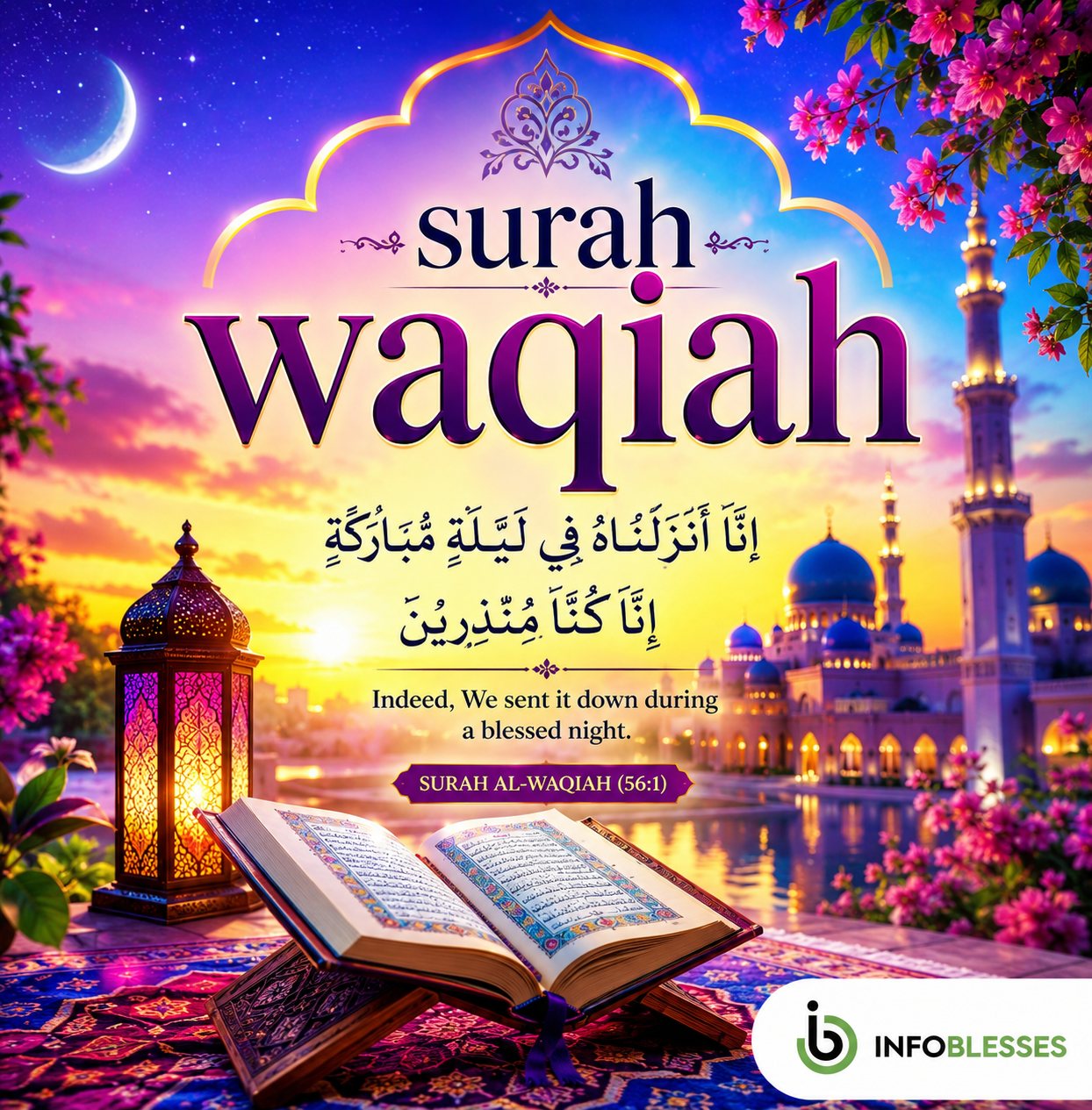
Surah Waqiah, also called Surah Al-Waqi’ah, is the 56th chapter of the Holy Quran and contains 96 verses in the commonly used verse numbering. The word Waqiah refers to the Inevitable Event, meaning the Day of Judgment.
The surah presents a powerful description of what will happen when this world comes to an end. It reminds Muslims that worldly life is temporary and that every person will ultimately return to Allah.
One of the central messages of Surah Waqiah is the division of people into three groups: the foremost, the people of the right, and the people of the left. Their different destinies encourage believers to think seriously about faith, worship, character, and righteous deeds.
The surah also asks people to reflect upon Allah’s creation. Human beings, crops, water, fire, and countless other blessings are signs of Allah’s power and mercy.
What Does Surah Waqiah Teach?
Surah Waqiah teaches Muslims to:
- Believe firmly in the Hereafter.
- Remember the Day of Judgment.
- Appreciate Allah’s blessings.
- Strengthen their faith.
- Perform righteous deeds.
- Avoid arrogance.
- Trust Allah.
- Remain grateful.
- Keep the Quran close to their hearts.
Rather than reading the surah only for a worldly purpose, Muslims should approach it as a source of guidance, reflection, and spiritual growth.
7 Powerful Lessons From Surah Waqiah

Surah Waqiah contains several lessons that can influence a Muslim’s daily life. These lessons encourage a believer to look beyond temporary worldly success and focus on pleasing Allah.
1. Remember the Day of Judgment
The surah begins with a powerful reminder of the inevitable event. Judgment Day isn’t something Muslims should treat as a distant idea.
Remembering the Hereafter can improve our daily decisions. Before speaking harshly, earning money unlawfully, or hurting someone, we can remember that Allah knows our actions.
This awareness encourages accountability and humility.
2. Understand the Three Groups
Surah Waqiah describes three groups of people and their ultimate destinations.
The foremost are those who are closest to Allah. The people of the right are promised tremendous blessings, while the people of the left face a very different outcome.
This teaches us that worldly status isn’t the true measure of success. Wealth, popularity, appearance, and social position don’t determine a person’s ultimate value before Allah.
Faith and righteous deeds matter.
3. Appreciate Allah’s Blessings
The surah encourages reflection upon blessings that people often overlook.
Consider water. We depend on it every day, yet we didn’t create it. Likewise, food, crops, fire, and human life are all dependent upon Allah’s will.
This should inspire shukr, or gratitude.
Instead of focusing constantly on what we don’t have, we should recognize what Allah has already provided.
4. Trust Allah’s Power
Surah Waqiah points toward Allah’s ability to create, sustain, give life, and bring about resurrection.
This strengthens tawakkul, or reliance upon Allah.
Tawakkul doesn’t mean sitting back and refusing to make an effort. A Muslim should work hard, seek halal opportunities, make dua, and then place trust in Allah.
5. Build a Relationship With the Quran
Regular Quran reading can become one of the strongest habits in a Muslim’s life.
Try reading Surah Waqiah slowly rather than rushing through it. Read its translation and consider what Allah is teaching you.
Even a short period of sincere Quran reflection can become meaningful when practiced consistently.
6. Prepare for the Hereafter
Surah Waqiah directs attention toward the eternal life to come.
Preparing for the Hereafter includes:
- Salah
- Dua
- Tawbah
- Charity
- Good character
- Honoring parents
- Helping others
- Halal earnings
- Avoiding injustice
- Remembering Allah
Nobody is free from mistakes. What matters is returning sincerely to Allah and continuing to improve.
7. Glorify Allah
The surah ultimately reminds believers of Allah’s greatness.
When we understand how dependent we are upon Allah for life, food, water, and everything around us, arrogance becomes difficult to justify.
A believer should respond with humility, gratitude, worship, and praise.
Benefits and Spiritual Guidance of Surah Waqiah

Reading Surah Waqiah can be a meaningful part of a Muslim’s Quran routine. Its verses repeatedly remind the reader about Allah, the Hereafter, creation, death, resurrection, and accountability.
These reminders can help strengthen a person’s awareness of Allah.
Surah Waqiah and Rizq
Many Muslims have heard that Surah Waqiah guarantees protection from poverty or automatically increases wealth.
This claim should be treated carefully. A narration commonly circulated for this purpose has been considered weak by hadith scholars, so it should not be presented as an established authentic promise.
A Muslim can absolutely recite Surah Waqiah and make dua for halal rizq. However, seeking provision should also involve lawful work, honesty, charity, gratitude, dua, and reliance upon Allah.
Allah is the true Provider.
Therefore, don’t treat Quran recitation like a formula for getting money. Read the Quran because it is the Word of Allah and a source of guidance.
Spiritual Benefits
Reflecting upon Surah Waqiah can help a Muslim:
- Remember death.
- Think about the Hereafter.
- Develop gratitude.
- Strengthen tawakkul.
- Increase awareness of Allah.
- Appreciate His blessings.
- Become more conscious of righteous deeds.
These benefits come through sincere recitation, understanding, and reflection.
How to Make Surah Waqiah Part of Your Daily Routine
Creating a Quran routine doesn’t have to be complicated.
Choose a time when you’re less likely to be distracted. You might read after Maghrib, after Fajr, or during a quiet part of the evening.
A simple routine could look like this:
- Make a sincere intention.
- Find a peaceful place.
- Read Surah Waqiah.
- Read the translation.
- Think about its main message.
- Make dua.
- Choose one lesson to apply.
The goal isn’t simply to finish the surah as quickly as possible.
Understanding is important.
If a verse raises a question, look for a reliable tafsir or ask a knowledgeable scholar. Over time, this can deepen your relationship with the Quran.
You can read the Arabic text, translation, and available study resources on Quran.com — Surah Al-Waqiah.
Frequently Asked Questions

Is Surah Waqiah good for rizq?
Surah Waqiah reminds us of Allah’s power and provision. However, the popular claim that reading it guarantees protection from poverty isn’t established through a reliably authentic hadith. Muslims should make dua for halal rizq while also working honestly and trusting Allah.
Can I read Surah Waqiah every day?
Yes. You may make Surah Waqiah part of your regular Quran-reading routine. Consistent Quran recitation is a beneficial practice, especially when accompanied by understanding and reflection.
What is the best time to read Surah Waqiah?
There is no need to restrict its recitation to one particular time unless reliable evidence establishes a specific virtue. Choose a time that allows you to read consistently and with concentration.
How many verses are in Surah Waqiah?
Surah Waqiah has 96 verses according to the commonly used Kufan verse numbering.
Is Surah Waqiah Makki or Madani?
Surah Waqiah is generally classified as a Makki surah.
What is the main message of Surah Waqiah?
Its major themes include the certainty of Judgment Day, the different groups of humanity, Allah’s power, His blessings, resurrection, and the importance of faith and righteous deeds.
Should I read Surah Waqiah with translation?
Yes. Reading the Arabic recitation along with a reliable translation can help you understand the message and apply its lessons to your life.
Can I make dua after reading Surah Waqiah?
Yes. Muslims may make dua to Allah at any time. You can ask Allah for forgiveness, guidance, beneficial knowledge, halal provision, protection, and success in the Hereafter.
Conclusion:
Surah Waqiah is a powerful chapter of the Quran that reminds Muslims about the Inevitable Event, resurrection, accountability, Allah’s blessings, and the eternal Hereafter.
Its message is much deeper than commonly repeated claims about worldly wealth. The surah calls us to strengthen our faith, recognize Allah’s power, appreciate His blessings, perform righteous deeds, and prepare for the day when we return to Him.
Make Quran reading a consistent part of your life. Read Surah Waqiah with sincerity, study its meaning, reflect on its lessons, and try to put those lessons into practice.
May Allah make the Quran the light of our hearts, increase our faith, grant us halal and blessed rizq, forgive our sins, and make us among the people of the right and the foremost in faith. Ameen.