
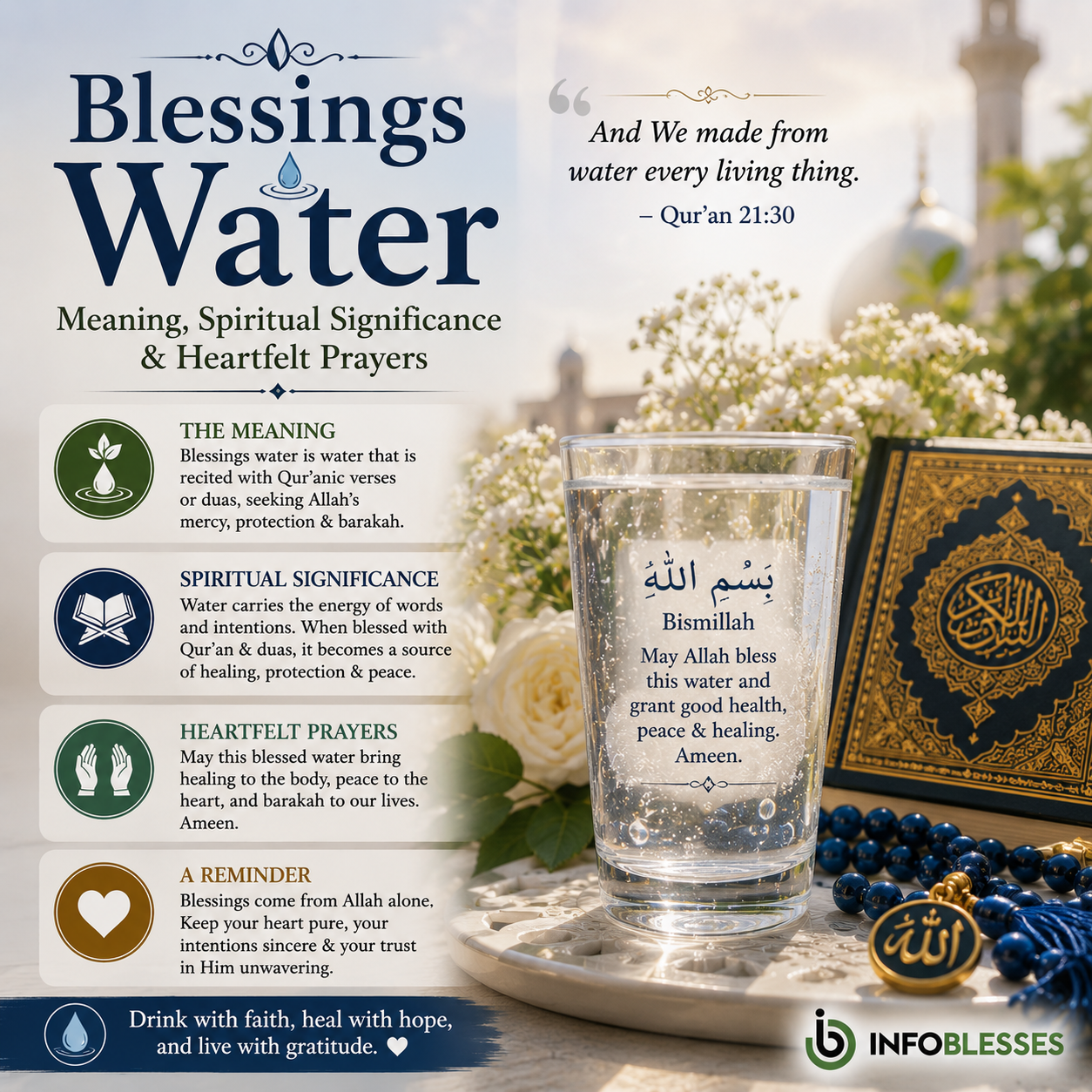
In Islam, water is far more than something we drink to satisfy thirst. It is a remarkable blessing from Allah, a source of life, purification, mercy, and reflection. The Qur’an repeatedly reminds believers of the importance of water and directs their hearts toward the One who provides it. For Muslims, water can become part of worship through wudu, ghusl, drinking Zamzam, and supplication.
The phrase “Blessings Water” can be used to describe water associated with sincere Islamic remembrance, Qur’anic recitation, or heartfelt dua while seeking Allah’s mercy and blessings. However, it is important to remember that blessing and healing come from Allah alone. Water itself does not possess independent supernatural power.
The Qur’an says:
“And We made from water every living thing.” — Qur’an 21:30
This beautiful verse invites Muslims to recognize water as one of Allah’s great signs. Qur’an 21:30 — Quran.com

This article explores the Islamic meaning of blessed water, its spiritual significance, the special status of Zamzam, appropriate duas, and ways Muslims can approach water with gratitude and faith.
What Does “Blessings Water” Mean in Islam?
The expression “blessings water” does not represent a single formal Islamic ritual with one universally prescribed method. Rather, people may use the phrase to refer to water connected with dua, Qur’an recitation, remembrance of Allah, or seeking healing and barakah.
In Islam, the fundamental principle is that Allah is the source of every blessing. A believer should never believe that an ordinary object independently controls health, success, protection, or destiny.
Allah says:
“And whatever blessing you have is from Allah.” — Qur’an 16:53
This principle is extremely important. If a Muslim recites Qur’an or makes dua over water, the believer’s heart should remain attached to Allah rather than to the water itself.
Some Muslims use water in connection with ruqyah, which involves Qur’anic recitation and supplication for protection or healing. Practices surrounding recited water can differ among scholars and communities, so it is wise to distinguish established Islamic teachings from cultural customs.
The safest spiritual attitude is simple: recite authentic Qur’anic verses and duas, ask Allah for benefit, and believe that Allah alone grants the result.

The Spiritual Significance of Water in the Qur’an
Water has an extraordinary place in the Qur’an. It is repeatedly presented as a sign of Allah’s mercy and creative power.
The Qur’an teaches that Allah sends rain, brings dead land back to life, provides drinking water, and creates living beings through water. These references encourage believers to look beyond the physical usefulness of water and recognize the Creator behind the blessing.
Allah says:
“And We sent down from the sky rain charged with blessing.” — Qur’an 50:9
Rain transforms dry land, supports plants, fills rivers, and sustains countless forms of life. Every drop can therefore become an opportunity for shukr, or gratitude.
Water also teaches Muslims about dependence. Human beings can survive only a limited time without it. Yet people often take clean water for granted. Islamic teachings encourage believers to appreciate Allah’s blessings rather than becoming careless about them.
When drinking water, a Muslim can pause and remember:
“Alhamdulillah” — All praise belongs to Allah.
That simple expression can transform an ordinary moment into an act of gratitude.
Water also symbolizes purification in Islamic worship. Muslims perform wudu before many acts of worship, and ritual bathing is required in certain circumstances. Thus, water is connected not only with physical cleanliness but also with preparation for spiritual devotion.

Zamzam Water: A Special and Blessed Water
Among all forms of water known in Islamic tradition, Zamzam water holds a unique position.
Zamzam is associated with the sacred sanctuary in Makkah and with the story of Prophet Ibrahim (Abraham), Hajar, and their son Ismail (Ishmael), peace be upon them. Islamic tradition connects the emergence of Zamzam with Allah’s mercy toward Hajar and her child.
For Muslims, Zamzam represents hope, reliance upon Allah, and divine provision.
The Prophet Muhammad ﷺ spoke about Zamzam, and authentic hadith literature records its special status. Muslims traditionally drink it while making sincere dua and asking Allah for beneficial things.
It is important, however, not to turn Zamzam into superstition. A Muslim does not believe that water independently controls destiny. Rather, its blessed status is understood within faith in Allah.
When drinking Zamzam, a believer can make a sincere prayer such as:
“O Allah, grant me beneficial knowledge, lawful provision, good health, forgiveness, and a heart that remains close to You.”
The value of Zamzam therefore lies not simply in drinking water but in the faith, gratitude, dua, and remembrance of Allah associated with it.

Blessings Water and the Practice of Dua
Dua is one of the most beautiful ways a believer communicates with Allah. A person does not need complicated words to ask Allah for blessings.
The Qur’an teaches believers to call upon Allah:
“Call upon Me; I will respond to you.” — Qur’an 40:60
A person may make dua before drinking water, after drinking water, or at any other appropriate moment. The essential element is sincerity.
A heartfelt prayer might be:
“O Allah, bless this provision You have given me. Make it a means of strength, health, gratitude, and obedience to You. Protect me from harm and increase me in faith. Ameen.”
Another beautiful Qur’anic supplication is:
“Our Lord, give us good in this world and good in the Hereafter and protect us from the punishment of the Fire.”
This is from Qur’an 2:201.
A believer can also pray for parents, children, friends, teachers, students, people experiencing hardship, and the entire Muslim Ummah.
The power of dua is not dependent on beautiful language. Allah knows what is inside every heart.

Qur’anic Healing and Water
The Qur’an describes itself as guidance and also speaks of healing and mercy for believers.
Allah says:
“And We send down of the Qur’an that which is healing and mercy for the believers.” — Qur’an 17:82
This verse is often connected with the spiritual benefit of Qur’anic recitation. Muslims have traditionally used Qur’anic recitation as part of ruqyah, provided that the practice remains within Islamic boundaries.
Some Muslims recite Qur’anic verses and supplications and then gently blow, or they use water in connection with recitation. There are differences among scholars regarding specific details of such practices, so one should avoid presenting every cultural method as an established Sunnah.
Among the Qur’anic passages commonly used in Islamic ruqyah are:
- Surah Al-Fatihah
- Ayat al-Kursi from Surah Al-Baqarah
- The final two verses of Surah Al-Baqarah
- Surah Al-Ikhlas
- Surah Al-Falaq
- Surah An-Nas
The believer should understand that the Qur’an is not a magical formula. Healing ultimately comes from Allah.
A person who is sick should also seek appropriate medical care. Spiritual practice and responsible healthcare do not need to be treated as opposites.

Heartfelt Prayers for Blessings, Protection, and Peace
Water can provide a beautiful reminder to pause and make dua. Here are several original Islamic-inspired prayers that focus on Allah’s mercy and blessings.
Dua for General Blessings
“O Allah, Lord of the heavens and the earth, bless my life with iman, sincerity, health, lawful provision, beneficial knowledge, and righteous companionship. Put barakah in everything You have given me and make me grateful for every blessing. Ameen.”
Dua for Protection
“O Allah, protect me and my family from visible and hidden harm. Strengthen our faith, guard our hearts from evil, and keep us firm upon what pleases You. Ameen.”
Dua for Healing
“O Allah, You are the One who gives healing. Remove hardship, grant strength to the body, calm the heart, forgive our shortcomings, and make every difficulty a means of drawing closer to You. Ameen.”
Dua for Parents
“O Allah, bless my parents with mercy, forgiveness, health, peace, and goodness. Reward them for every sacrifice they have made and surround them with Your mercy. Ameen.”
Dua for Children
“O Allah, protect our children, increase them in faith and wisdom, guide their hearts toward righteousness, and make them a source of goodness for their families and communities. Ameen.”
Dua for Peace of Heart
“O Allah, remove anxiety from my heart, strengthen my trust in You, and help me remember that Your wisdom is greater than my understanding. Give me patience during trials and gratitude during ease. Ameen.”
These prayers should be understood as personal supplications, not as fixed prophetic formulas unless specifically identified as such.

How to Approach Blessed Water With Islamic Etiquette
If someone chooses to drink water while making dua or remembering Allah, the experience can be approached with simple Islamic manners.
First, remember that the water is a creation and blessing from Allah. Do not attribute independent power to it.
Second, begin with Bismillah. Remember Allah before consuming His provision.
Third, drink with gratitude and moderation. The Prophet ﷺ taught Muslims beautiful manners concerning eating and drinking, including avoiding excess.
Fourth, say Alhamdulillah after drinking.
Fifth, make sincere dua. Ask Allah for what is good in this world and the Hereafter.
Sixth, avoid superstition. Do not believe that a particular ordinary glass of water automatically removes problems, guarantees wealth, or controls another person’s life.
Seventh, if using Qur’anic recitation in connection with healing, rely upon authentic Islamic teachings and avoid practices involving unknown words, charms, talismans, or beliefs contrary to tawhid.
The heart of the practice should always remain tawhid: Allah alone is worthy of worship, and Allah alone ultimately controls benefit and harm.

The Connection Between Water, Gratitude, and Barakah
One of the greatest lessons of water is the lesson of gratitude.
A person may have access to clean water every day and rarely think about it. Yet when water becomes unavailable, its value becomes immediately obvious.
Islam teaches Muslims to recognize blessings before they disappear.
Barakah, or blessing, is not necessarily measured by quantity. A small amount can be beneficial when Allah places blessing in it, while something abundant may bring little real benefit.
The same principle applies to time, money, knowledge, family relationships, and health.
When a Muslim drinks water and says Alhamdulillah, the moment becomes an opportunity for reflection:
- Who created this water?
- Who made it accessible?
- Who gives me the ability to drink it?
- How should I use the strength it provides?
- Am I grateful for Allah’s blessings?
- Am I helping people who lack access to clean water?
These questions turn an everyday action into spiritual reflection.
Islamic gratitude is not only words. It should influence behavior. If Allah gives someone abundant water, that person should avoid waste and appreciate the blessing.

Sharing Water as an Act of Charity
Islam places great emphasis on helping others, and providing water is a particularly meaningful form of charity.
A person can share drinking water with travelers, neighbors, workers, people experiencing hardship, or communities facing water shortages.
This gives “blessings water” another important dimension: the blessing is not only something we receive but something we share.
A glass of water offered sincerely can become an act of kindness.
A water project can become ongoing charity when people continue benefiting from it. Muslims around the world support wells, water systems, filtration projects, and other charitable initiatives as forms of sadaqah.
This reflects an important Islamic principle: when Allah gives us a blessing, we should use it responsibly and allow others to benefit whenever possible.
Instead of thinking only, “How can this water bless me?”, a believer can also ask:
“How can Allah make me a means of blessing someone else?”
That change in perspective can transform the way we understand generosity.

Important Islamic Reminder: Allah Is the Source of Every Blessing
When discussing blessed water, one principle should never be forgotten: Allah is the source of every blessing.
Water cannot independently cure disease.
Water cannot independently remove evil.
Water cannot independently guarantee success.
Water cannot independently change destiny.
Allah may make particular means beneficial, but the benefit ultimately occurs by His permission.
This distinction protects a believer from superstition and keeps the heart connected to tawhid.
The Qur’an repeatedly directs believers toward Allah. When seeking healing, protection, provision, guidance, or forgiveness, Muslims should turn to Him.
This is also why sincere dua matters more than complicated rituals.
A believer can hold a glass of ordinary water and sincerely say:
“O Allah, thank You for this blessing. Make it beneficial for me and help me use Your blessings in ways that please You.”
That attitude is deeply meaningful because it combines gratitude, humility, tawakkul, and remembrance.

Questions About Blessings Water in Islam
Is “blessings water” an official Islamic term?
Not as a single standardized Islamic ritual. The phrase can describe water associated with dua, Qur’anic recitation, Zamzam, or seeking Allah’s blessings. It is important to distinguish established Islamic teachings from cultural practices.
Can Muslims make dua while drinking water?
Yes. Muslims may make sincere dua to Allah at appropriate times, including while drinking or after drinking. The dua should be directed to Allah alone.
Is Zamzam water blessed?
Yes. Zamzam has a special and honored status in Islamic tradition, and authentic hadith literature discusses its virtues.
Can Qur’an be recited for healing?
Yes. Qur’anic recitation is part of Islamic ruqyah, and the Qur’an is described as healing and mercy for believers. However, Muslims should avoid superstition and practices that conflict with Islamic beliefs.
Does blessed water guarantee healing?
No. Muslims believe that Allah alone gives healing. Water or any other permissible means should never be regarded as an independent source of supernatural power.
Can I make my own dua over water?
You may make sincere personal dua to Allah. If you are following a specific ruqyah practice, it is best to learn its details from a knowledgeable and trustworthy Islamic scholar.
Should blessed water replace medical treatment?
No. Spiritual supplication and appropriate medical treatment can be pursued together. Serious illness should be addressed responsibly with qualified healthcare professionals.
What should I say before drinking water?
A Muslim can say Bismillah before drinking and Alhamdulillah afterward. One may also make personal dua to Allah.
Can giving water be charity?
Yes. Providing water to people is a meaningful act of charity and kindness. It can be especially valuable where people lack reliable access to clean drinking water.
What is the greatest lesson water teaches Muslims?
Water reminds Muslims of Allah’s mercy, power, provision, and generosity. It teaches gratitude and encourages believers to share blessings with others.

Conclusion: Let Every Drop Become a Reminder of Allah
Blessings Water: Meaning, Spiritual Significance & Heartfelt Prayers is ultimately a topic about much more than a glass of water. It is about recognizing Allah’s blessings, remembering His mercy, making sincere dua, and developing gratitude.
The Qur’an teaches that water is fundamental to life, while Islamic tradition gives special significance to Zamzam. Water is also connected to purification, worship, charity, and reflection.
When Muslims drink water, they can remember the One who created it. When they make dua, they can place their trust in Allah. When they share water, they can turn a simple blessing into an act of charity.
The most important principle is to keep the heart connected to Allah alone. Water is a creation. Allah is the Creator. Water can be a means of benefit, but every benefit ultimately comes by Allah’s permission.
May Allah bless us with pure hearts, beneficial knowledge, good health, halal provision, sincere faith, and gratitude for every blessing He gives us.
May Allah make every drop of water a reminder of His mercy, every dua a source of hope, and every blessing a reason for us to say Alhamdulillah. Ameen.