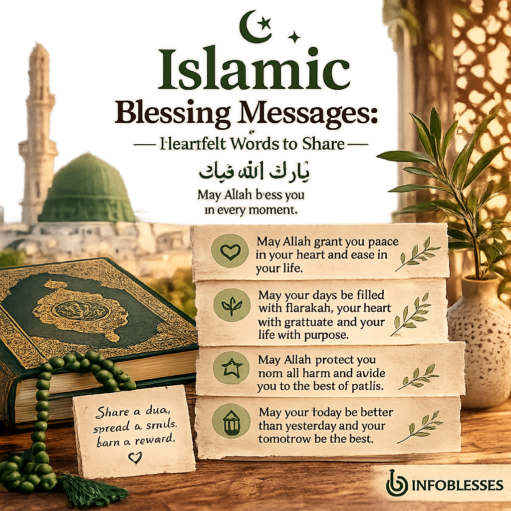
Islamic blessing messages are a beautiful way to share kindness, faith, hope, and sincere prayers with the people we care about. A thoughtful Islamic message can bring comfort during a difficult moment, add joy to a celebration, or simply remind someone that they are remembered in dua.
In Islam, words have great value. Muslims are encouraged to speak with kindness, avoid harmful speech, maintain family relationships, and encourage one another toward goodness. Because of this, an Islamic blessing isn’t merely a pleasant sentence. It can become a small expression of faith and compassion.
Whether you’re looking for a message for your parents, spouse, children, friends, colleagues, or someone facing a difficult time, the right words can make a meaningful difference.
The best Islamic blessings usually focus on Allah’s mercy, guidance, protection, forgiveness, patience, gratitude, halal provision, family, and success in both this life and the Hereafter.
What Are Islamic Blessing Messages?
Islamic blessing messages are heartfelt words that contain a good wish, prayer, or dua connected to Islamic beliefs and values. They can be short and simple or personal and detailed.
For example:
“May Allah bless your life with barakah, guide your heart toward goodness, protect you from harm, and grant you peace in both worlds.”
This type of message expresses more than ordinary goodwill. It recognizes that Allah is the ultimate source of blessing, guidance, mercy, and provision.
Islamic blessing messages can be shared on many occasions, including:
- Friday and Jumu’ah
- Ramadan
- Eid
- Weddings
- Births
- Graduations
- New jobs
- New homes
- Birthdays
- Difficult times
- Journeys
- Personal achievements
- Family gatherings
- Everyday conversations
A message doesn’t need to be complicated to be meaningful. Sometimes a simple “May Allah bless you and your family” can express genuine care.
The important thing is sincerity. Beautiful Islamic words should come from a genuine desire for another person’s well-being.
Why Dua and Kind Words Matter in Islam
Dua is one of the most meaningful ways a Muslim communicates with Allah. It allows believers to ask for guidance, forgiveness, protection, mercy, patience, and goodness.
The Qur’an contains many beautiful prayers. Surah Al-Fatihah, for example, includes the request for guidance to the straight path. This makes guidance one of the central themes of Islamic supplication.
Kind words also have an important place in Muslim character. A person doesn’t need wealth or a special position to encourage someone. A sincere sentence can be an easy act of kindness.
For instance:
“May Allah make your difficult days easier and reward you for your patience.”
This message doesn’t remove someone’s problem, but it can provide emotional and spiritual encouragement.
Qualities of a Meaningful Islamic Blessing
A good Islamic blessing should generally be:
- Sincere — Write it with genuine concern.
- Respectful — Use appropriate and thoughtful language.
- Faith-centered — Keep Allah naturally at the heart of the message.
- Positive — Encourage hope without making unrealistic promises.
- Relevant — Match the message to the person’s situation.
- Simple — Avoid unnecessary complexity.
The goal isn’t to impress someone with vocabulary. The goal is to remind them of goodness and strengthen the relationship between hearts.
Islamic Blessing Messages for Family
Family is one of life’s greatest blessings. Parents, children, siblings, spouses, and relatives all have important places in our lives.
Sending Islamic blessing messages to family members is a simple way to express love and gratitude. You don’t have to wait for a special occasion. An unexpected message can sometimes be even more meaningful.
Here are some heartfelt examples:
- May Allah protect our family, strengthen the love between us, and fill our home with peace and barakah.
- May Allah keep you close to Him, protect your heart, and guide every step you take.
- May Allah bless our family with righteous hearts, halal provision, good health, and lasting happiness.
- May Allah forgive our shortcomings and bring our family together in goodness and Jannah.
- May Allah place mercy and understanding between our hearts and make our home a place of peace.
- May Allah protect every member of our family from harm and surround us with His mercy.
A family blessing can also be personal. If someone is starting a new job, studying for an important exam, traveling, or facing a difficult decision, mention that situation in your dua.
For example:
“May Allah guide you in your new journey, make every step easy, and place barakah in your efforts.”
Personal messages often feel more sincere because they show that you understand what the person is experiencing.
Islamic Blessing Messages for Friends
Good friends can have a positive influence on our lives. A friend who encourages patience, honesty, worship, and good character is a valuable blessing.
Islamic blessing messages for friends can focus on guidance, success, protection, peace, and happiness.
Here are several messages you can share:
- May Allah bless your journey, protect your heart, and open doors of goodness for you.
- May Allah grant you success that brings you closer to Him and benefits those around you.
- May Allah replace every worry in your heart with peace and every difficulty with ease.
- May Allah increase you in iman, wisdom, patience, and gratitude.
- May Allah bless your friendships, protect your family, and grant you halal happiness.
- May Allah make your future brighter, your heart stronger, and your faith deeper.
A meaningful friend doesn’t only celebrate another person’s achievements. True friendship also means remembering someone when they’re struggling.
A short message saying, “You’re in my dua. May Allah make things easy for you,” can mean a great deal to someone going through a difficult season.
Islamic Blessings for Parents
Parents deserve special kindness and respect in Islam. Their sacrifices, care, guidance, and love often shape a person’s entire life.
The Qur’an teaches believers to treat their parents with kindness and includes a beautiful supplication asking Allah to have mercy upon them.
One well-known Qur’anic dua is:
“My Lord, have mercy upon them, as they raised me when I was young.”
This prayer appears in Surah Al-Isra, 17:24.
You can also share original heartfelt blessings such as:
- May Allah reward you for every sacrifice you have made for me and bless you with peace and happiness.
- May Allah protect you, forgive you, and surround you with His mercy.
- May Allah grant you strength, good health, peace, and abundant barakah.
- May Allah make me a source of happiness for you and help me fulfill my responsibilities toward you.
- May Allah bless our family and reunite us among the righteous in Jannah.
Sometimes the simplest message is the most powerful.
“May Allah always protect you, Mama and Papa, and reward you for everything you’ve done for me.”
A message like this can be especially touching because it combines gratitude with dua.
Islamic Blessings for Marriage
Marriage is a significant relationship in Islam, and an Islamic wedding blessing should go beyond wishes for temporary happiness.
A beautiful blessing can ask Allah to place love, mercy, patience, understanding, and faith between the couple.
For example:
“May Allah bless your marriage, place love and mercy between your hearts, and make your home a place of peace, iman, and happiness.”
Other messages include:
- May Allah bless your Nikah and fill your marriage with love, patience, mercy, and understanding.
- May Allah make you a source of comfort and strength for one another.
- May Allah protect your marriage from difficulties and guide you through every challenge together.
- May Allah bless your home with righteous children, halal provision, and lasting happiness.
- May Allah increase the love between you and bring you both closer to Him.
A strong marriage blessing recognizes that marriage isn’t always effortless. It asks Allah to give the couple the patience and wisdom needed to handle life’s challenges.
The most meaningful wedding messages therefore combine celebration with prayer.
Islamic Blessings for Birth and New Beginnings
The arrival of a child is a joyful new beginning. It also brings responsibility, love, and countless hopes for the future.
A blessing for a newborn can ask Allah to protect the child, guide them, and make them a source of goodness for their family.
Examples include:
- May Allah bless this precious child, protect them from harm, and grant them a life filled with iman and goodness.
- May Allah make your child righteous, kind, healthy, and a source of happiness for your family.
- May Allah guide this child throughout life and make them among those who love goodness.
- May Allah grant the parents wisdom, patience, and strength to raise their child upon righteousness.
New beginnings aren’t limited to childbirth. The same approach can be used for someone starting a new job, moving into a new home, beginning education, launching a halal business, or starting another important chapter.
For example:
“May Allah bless this new chapter of your life, guide your decisions, and place barakah in everything that is good for you.”

Islamic Blessings for Success
Success is something many people pray for, but Islamic understanding of success goes deeper than money, status, or recognition.
True success includes faith, good character, beneficial knowledge, halal earnings, righteous actions, and a successful Hereafter.
When blessing someone with success, it’s therefore better to ask Allah to give them what is beneficial.
Consider these messages:
- May Allah bless your efforts and grant you success in everything that is good for you.
- May Allah open doors of halal opportunity and give you wisdom to recognize what is best.
- May Allah make your knowledge beneficial and your work a source of goodness.
- May Allah bless your career while keeping your heart connected to Him.
- May Allah grant you success in this life and eternal success in the Hereafter.
- May Allah make your efforts fruitful and put barakah into everything you do.
An Islamic blessing for success should also recognize that our plans don’t always match Allah’s wisdom.
Sometimes we ask for one particular outcome, but another outcome may ultimately be better.
That’s why a thoughtful blessing can say:
“May Allah grant you what is best for you, even when it differs from what you expect.”
This reflects trust in Allah while still expressing hope.
Islamic Blessings for Difficult Times
Life includes moments of sadness, uncertainty, disappointment, grief, financial pressure, and personal struggle.
When someone is going through hardship, an Islamic blessing should be gentle. Avoid forcing positivity onto someone who is hurting.
Instead, offer compassion and dua.
You can say:
- May Allah give you sabr during this difficult time and bring you relief.
- May Allah strengthen your heart, ease your worries, and guide you toward what is best.
- May Allah reward you for your patience and replace your hardship with ease.
- May Allah protect you from despair and strengthen your trust in His wisdom.
- May Allah bring comfort to your heart and make your difficult path easier.
- May Allah turn this hardship into a source of reward, growth, and closeness to Him.
The Qur’an repeatedly gives believers reasons to maintain hope and patience.
When someone is struggling, you don’t always need a long speech. A short message accompanied by sincere support can be enough.
For example:
“I may not have the right words, but I pray Allah makes this easier for you. May He give you strength, sabr, and relief.”
That kind of message feels human because it doesn’t pretend to solve everything.
Islamic Blessings for Friday
Friday, known as Jumu’ah, has special importance in Islam. Muslims gather for the Friday prayer and use the day for worship, remembrance, reflection, and sending blessings upon the Prophet Muhammad ﷺ.
Friday messages can encourage people to remember Allah and make dua.
Here are some examples:
- Jumu’ah Mubarak. May Allah accept your prayers, forgive your shortcomings, and fill your heart with peace.
- May Allah make this blessed Friday a source of mercy, guidance, and barakah for you and your family.
- May Allah accept your duas and grant you what is best for your dunya and akhirah.
- May Allah strengthen your iman and bring peace to your heart on this blessed Friday.
- May Allah forgive us, guide us, and make us among those who receive His mercy. Jumu’ah Mubarak.
A Friday message becomes more meaningful when it encourages remembrance instead of being treated as a routine greeting.
Islamic Blessings for Ramadan and Eid
Ramadan and Eid provide beautiful opportunities to share Islamic blessing messages.
During Ramadan, messages can focus on forgiveness, mercy, worship, charity, patience, gratitude, and spiritual renewal.
Ramadan Blessings
- May Allah accept your fasting, prayers, charity, and every sincere act of worship.
- May Allah make Ramadan a means of forgiveness, guidance, and renewed faith.
- May Allah fill your home with the mercy and blessings of Ramadan.
- May Allah accept your duas and strengthen your heart throughout this blessed month.
- May Allah allow you to complete Ramadan with stronger iman and a heart full of gratitude.
Eid Blessings
- Eid Mubarak! May Allah accept your worship and fill your home with peace, love, and barakah.
- May Allah make this Eid a day of gratitude, forgiveness, family, and happiness.
- May Allah bless you and your loved ones with goodness in this life and the Hereafter.
- May Allah accept our good deeds, forgive our mistakes, and keep our hearts firm upon Islam.
These messages connect celebration with gratitude and worship, which gives them a deeper meaning.
Short Islamic Blessing Messages
Sometimes you don’t need a long paragraph. A short Islamic blessing can work perfectly for WhatsApp, SMS, social media, greeting cards, or a quick personal message.
Here are some short options:
- May Allah bless you with endless barakah.
- May Allah guide you and protect you always.
- May Allah fill your heart with peace and iman.
- May Allah accept your duas and good deeds.
- May Allah make every difficulty easy for you.
- May Allah grant you halal success and lasting happiness.
- May Allah protect your family and bless your home.
- May Allah increase you in faith, wisdom, and patience.
- May Allah forgive you and shower you with His mercy.
- May Allah bless your journey and guide every step.
- May Allah grant you goodness in this life and the next.
- May Allah keep your heart close to Him.
- May Allah replace your worries with peace.
- May Allah bless your day with mercy and barakah.
- May Allah make you a source of goodness wherever you go.
These short messages are easy to personalize. Adding the person’s name or mentioning their situation can make them feel much more genuine.
How to Write Meaningful Islamic Blessing Messages
Writing your own Islamic blessing messages isn’t difficult. In fact, personal words can often be more meaningful than copied quotes.
Start by considering the person’s situation.
Are they celebrating something? Starting something new? Facing hardship? Looking for guidance? Recovering from disappointment?
Once you know the situation, choose a relevant theme.
Start With Allah
Make Allah the center of the blessing.
For example:
“May Allah guide you…”
“May Allah bless your efforts…”
“May Allah protect you…”
Mention Something Specific
Instead of writing only:
“May Allah bless you.”
you can make the message more personal:
“May Allah bless your new business, provide you with halal success, and make your work beneficial to others.”
Keep It Sincere
Don’t try too hard to sound poetic. Simple language can be powerful.
A sincere sentence is better than an impressive sentence that doesn’t feel genuine.
Match the Occasion
A wedding message should focus on marriage, love, mercy, and companionship.
A hardship message should focus on sabr, relief, mercy, and hope.
A success message can focus on beneficial achievement, guidance, and halal provision.
Avoid Unverified Religious Claims
This is particularly important when creating Islamic content.
If you’re quoting the Qur’an or a hadith, verify the wording and source. Don’t present an original inspirational sentence as a Qur’anic verse or authentic prophetic saying.
This helps maintain accuracy and trust.
Islamic Themes to Include in Blessing Messages
Many Islamic values work naturally in blessing messages.
| Islamic Theme | Example Blessing |
|---|---|
| Mercy | May Allah surround you with His mercy. |
| Guidance | May Allah guide you toward the straight path. |
| Barakah | May Allah place barakah in your life. |
| Protection | May Allah protect you and your family. |
| Patience | May Allah grant you beautiful sabr. |
| Forgiveness | May Allah forgive your mistakes. |
| Knowledge | May Allah grant you beneficial knowledge. |
| Provision | May Allah provide for you through halal means. |
| Family | May Allah strengthen your family bonds. |
| Jannah | May Allah gather us among the righteous in Jannah. |
| Peace | May Allah grant tranquility to your heart. |
| Gratitude | May Allah make us among those who are grateful. |
These themes can be combined depending on the occasion.
For example:
“May Allah grant you patience during every difficulty, increase you in gratitude during every blessing, and guide you toward what is best.”
That’s a flexible message that can work in many circumstances.
Why Sharing Islamic Blessings Strengthens Relationships
A thoughtful message can strengthen a relationship because it shows that you care about someone’s spiritual and worldly well-being.
Imagine receiving this from a friend:
“I remembered you in my dua today. May Allah make your situation easy and grant you what is best.”
Those words communicate genuine care.
Islam encourages kindness, maintaining relationships, helping others, and remembering Allah. Sharing sincere blessings can therefore become a small but meaningful habit.
You can send an Islamic blessing to:
- Parents
- Children
- Siblings
- Spouses
- Friends
- Teachers
- Students
- Colleagues
- Neighbors
- Relatives
- Someone experiencing hardship
You don’t need a special reason.
Sometimes an ordinary day is the perfect time to remind someone that they’re valued.
A Reliable Islamic Resource for Further Reading
When writing or sharing Islamic content, it’s important to distinguish between personal inspirational wording and established religious sources.
For readers who want to explore Qur’anic guidance directly, Quran.com provides access to the Qur’an, translations, chapters, and study resources.
Explore the Qur’an on Quran.com
For example, Surah Al-Fatihah teaches believers to ask Allah for guidance to the straight path, while Surah Al-Isra 17:24 contains the beautiful prayer for mercy upon one’s parents.
Using reliable sources helps ensure that Islamic content remains respectful and accurate.
Frequently Asked Questions About Islamic Blessing Messages
1. What are Islamic blessing messages?
Islamic blessing messages are kind words that often contain a dua or good wish based on Islamic values. They may ask Allah for guidance, protection, mercy, forgiveness, peace, patience, success, or barakah.
2. What is a good Islamic blessing for a friend?
You can say: “May Allah bless your life, guide your decisions, protect your heart, and grant you goodness in this world and the Hereafter.”
3. What Islamic blessing can I send to my parents?
You can say: “May Allah have mercy upon my parents, reward them for their sacrifices, protect them, forgive them, and bless them with goodness in this life and the Hereafter.”
You can also use the Qur’anic supplication from Surah Al-Isra 17:24.
4. What should I write in an Islamic wedding message?
Focus on love, mercy, faith, patience, and companionship. For example:
“May Allah bless your marriage, place love and mercy between your hearts, and make your home a place of peace and iman.”
5. What is a good Islamic blessing for someone facing hardship?
Try:
“May Allah strengthen your heart, grant you sabr, ease your difficulties, and bring you relief at the right time.”
6. Can Islamic blessing messages be short?
Yes. Short messages can be very meaningful. For example:
“May Allah guide you, protect you, and fill your life with barakah.”
7. Should Islamic blessing messages contain Arabic?
They don’t have to. English can express a sincere Islamic dua clearly. Arabic expressions such as Alhamdulillah, Ameen, and JazakAllahu Khayran can also be used appropriately.
8. How can I make an Islamic blessing more personal?
Mention the person’s situation. Instead of simply saying, “May Allah bless you,” you could say:
“May Allah bless your new journey, give you wisdom in every decision, and place barakah in your work.”
9. Can I use these messages on social media?
Yes. Islamic blessing messages can be shared through social media, WhatsApp, greeting cards, or private conversations. However, verify any Qur’an verse or hadith before attributing it to a religious source.
10. What makes an Islamic blessing meaningful?
Sincerity is the most important quality. A meaningful blessing should be respectful, relevant, hopeful, and connected naturally to Islamic values.
Conclusion:
Islamic blessing messages provide a simple and beautiful way to combine kindness, faith, hope, and dua. Whether you’re congratulating someone, comforting a friend, honoring your parents, celebrating Eid, sending a Friday greeting, or simply checking on someone you love, heartfelt words can make a difference.
The strongest messages don’t need to be complicated. They simply need to be sincere.
May Allah bless our families, strengthen our iman, forgive our shortcomings, accept our good deeds, protect us from harm, grant us beneficial knowledge, provide halal sustenance, bring peace to our hearts, and guide us all toward the straight path.
Ameen.